Floatation Separation (Leaving Cert Engineering): Revision Notes
📚Revision Notes
Flotation Separation
Introduction to ore concentration
After mining operations extract ores from the ground, these materials are not pure metals. They contain significant amounts of waste materials such as clay and rock that must be removed. Ore concentration is the process of separating valuable metals from these unwanted materials. Various methods including magnetism, water, and heat are used to achieve this separation.
Note
Ore concentration is a crucial step in metallurgy - without it, we would be unable to obtain the pure metals needed for manufacturing everything from electronics to construction materials.
What is flotation separation?
Flotation separation is a water-based ore concentration method classified as hydrometallurgy. This process uses the different surface properties of materials to separate valuable metal particles from waste rock. The technique relies on making certain particles either attract to or repel from water surfaces.
Important
The key principle behind flotation separation is controlling whether particles are hydrophobic (water-repelling) or hydrophilic (water-attracting). This fundamental difference in surface properties is what makes the separation possible.
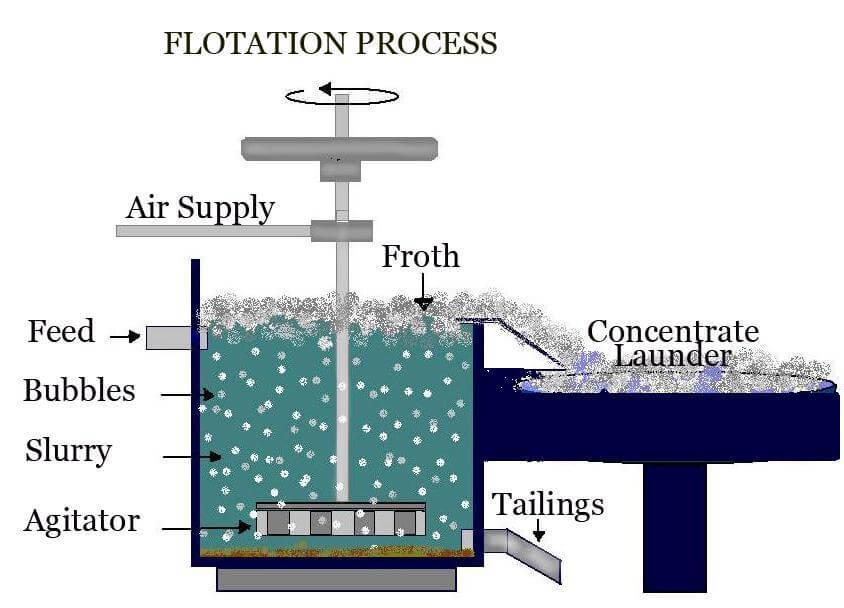
The flotation separation process
The flotation process follows a systematic approach to separate metals from their ores. This complex procedure involves several carefully coordinated stages that work together to achieve effective separation.
Example
Step-by-Step Flotation Process:
Step 1: Equipment setup The process takes place in a large container filled with water. The crushed ore is added to this water along with specific chemical additives that help the separation process.
Step 2: Mixing stage An agitator continuously breaks up and mixes the ore particles throughout the water. This ensures all particles come into contact with the chemical additives.
Step 3: Air injection Compressed air is pumped into the water mixture, creating numerous small bubbles that rise towards the surface.
Step 4: Particle attachment Due to the chemical additives, valuable metal particles become hydrophobic and attach to rising air bubbles. Waste materials remain hydrophilic and stay in the water.
Step 5: Froth formation The bubble-particle combinations reach the surface and form a metal-rich froth.
Step 6: Collection The valuable metal-rich froth is skimmed off from the surface, leaving waste materials behind.
The success of this process depends on the precise control of chemical conditions and the mechanical action of the agitator. The chemical additives are specifically chosen to modify the surface properties of the target metals, making them selectively attach to air bubbles while leaving waste materials behind.
Applications and suitable metals
Flotation separation proves particularly effective for recovering copper and lead from their respective ores. The process works well with metals that can be made hydrophobic through chemical treatment, allowing them to attach to air bubbles and float to the surface.
Note
While copper and lead are the most common applications, flotation separation can be adapted for other metals by adjusting the chemical additives used in the process.
Key advantages
This separation method offers several benefits for metallurgical operations. It effectively concentrates valuable metals while removing large quantities of waste material. The process can handle complex ore mixtures and allows for selective separation of different metals by adjusting chemical conditions. Additionally, it operates at relatively low temperatures compared to other metallurgical processes.
Note
The ability to operate at low temperatures makes flotation separation more energy-efficient than many alternative concentration methods, reducing both costs and environmental impact.
Remember!
Summary
Key Points to Remember:
- Flotation separation is a form of hydrometallurgy that uses water, chemicals, and air bubbles to separate metals from waste rock
- The process makes valuable metal particles hydrophobic so they attach to air bubbles and float to the surface as froth
- An agitator mixes the ore while compressed air creates the bubbles needed for separation
- This method works particularly well for recovering copper and lead from their ores
- The metal-rich froth that forms at the surface can be easily collected by skimming