Open Cast Mining (Leaving Cert Engineering): Revision Notes
📚Revision Notes
Open Cast Mining
Open cast mining represents the most straightforward approach to extracting metal ores that lie near the Earth's surface. This method has become essential in modern metallurgy due to its efficiency and cost-effectiveness, though it comes with significant environmental considerations.
What is open cast mining?
Open cast mining is a surface mining technique used when metal ores are located close to or at ground level. The process involves using heavy industrial equipment to systematically remove layers of soil and rock that cover the valuable ore deposits.
Note
The term overburden refers to all the unwanted material (topsoil, rock, and debris) that sits above the ore and must be removed before extraction can begin. This material is carefully stripped away in layers to expose the ore beneath.
The extraction process
The open cast mining process follows a systematic approach that maximises efficiency whilst minimising costs. Initially, exploration teams identify suitable ore deposits near the surface. Once a viable site is confirmed, heavy machinery moves in to begin the extraction process.
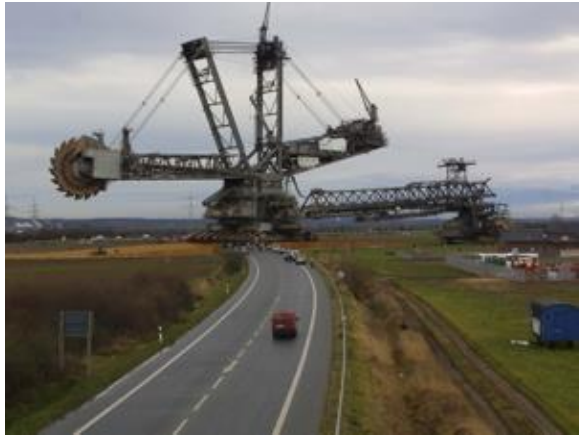
Heavy plant equipment forms the backbone of open cast operations. Massive bucket-wheel excavators, some of the largest land vehicles ever built, can remove enormous quantities of overburden and ore. These machines work alongside bulldozers, excavators, and haul trucks to create an integrated extraction system.
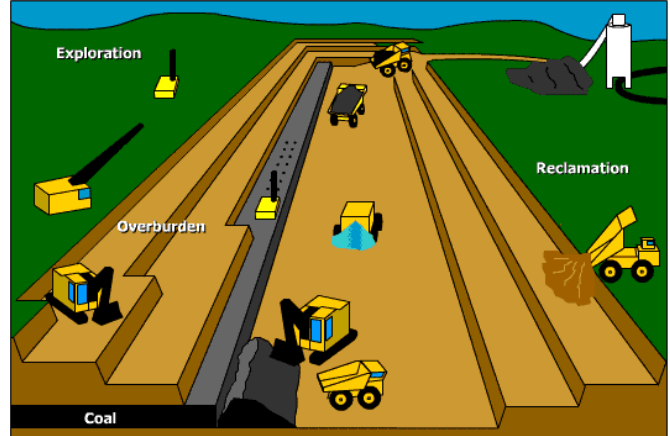
The process begins with the removal of topsoil and vegetation, which is often stored separately for later land reclamation efforts. Next, the overburden is systematically stripped away in layers, creating stepped levels or terraced benches that allow equipment to access different depths safely.
Note
The creation of terraced benches is not just for accessibility - these stepped levels also provide crucial safety measures by preventing landslides and allowing controlled extraction at multiple depths simultaneously.
Large-scale operations
Modern open cast mines operate on an industrial scale that can dramatically reshape entire landscapes. The mines feature characteristic terraced walls that spiral downward, creating access routes for heavy machinery to transport materials from various levels.
Haul roads wind through these terraced levels, allowing massive mining trucks to transport extracted ore and waste rock. These vehicles, often painted in bright colours for safety, appear surprisingly small when viewed against the vast scale of the mining operation.
The proximity of mining operations to residential areas highlights both the economic importance of these sites and the environmental challenges they present.
Advantages and disadvantages
Open cast mining offers several significant advantages over other extraction methods. The technique proves highly cost-effective because ores located near the surface are relatively easy to locate and extract. The process requires less complex infrastructure than underground mining and can handle large volumes of material efficiently.
Important
However, these economic benefits come with serious environmental costs. Open cast mining can permanently destroy entire landscapes, removing vegetation, disrupting local ecosystems, and altering drainage patterns.
The visual impact on surrounding communities can be substantial, as seen in aerial photographs where massive excavations dominate the landscape.
Environmental considerations
The environmental impact of open cast mining extends beyond the immediate excavation site. Land reclamation efforts attempt to restore mined areas after extraction is complete, but the original landscape can never be fully recreated.
Important
Modern mining operations must balance economic efficiency with environmental responsibility. This includes proper management of waste rock, protection of groundwater, and planning for post-mining land use.
Summary
Key Points to Remember:
- Open cast mining is used for ores located close to the Earth's surface
- Overburden (unwanted material) must be removed before ore extraction begins
- Heavy plant equipment including bucket-wheel excavators and haul trucks enable large-scale operations
- The process is cost-effective but can cause permanent landscape destruction
- Modern operations must include environmental planning and land reclamation efforts