Thermoplastic Polymers (Thermoplastics) (Leaving Cert Engineering): Revision Notes
📚Revision Notes
Thermoplastic Polymers (Thermoplastics)
What are thermoplastic polymers?
Thermoplastic polymers (or thermoplastics) are modern synthetic polymers that have been developed over the past century. They include popular materials such as acrylic (Perspex), polythene (used for plastic bags), and polypropylene (used for plastic chairs).
The key characteristic of thermoplastics is their ability to become flexible when heated and rigid when cooled. This property makes them extremely useful for manufacturing and recycling processes.
Note
This unique thermal property is what distinguishes thermoplastics from other types of polymers and makes them particularly valuable in industrial applications where reshaping and recycling are important.
How are thermoplastics made?
Thermoplastics are produced through a process called addition polymerisation. This process works as follows:
- It begins with a single mer (molecule) of ethylene
- A double bond exists within the molecule between the two carbon atoms
- A free radical (catalyst) is introduced as a chemical additive
- This catalyst breaks the double bond between the carbon atoms
- The mer then bonds to another mer, and the breaking of double bonds continues
- The process rapidly repeats, creating long chains of molecules
- These chains start and finish at random locations within the material
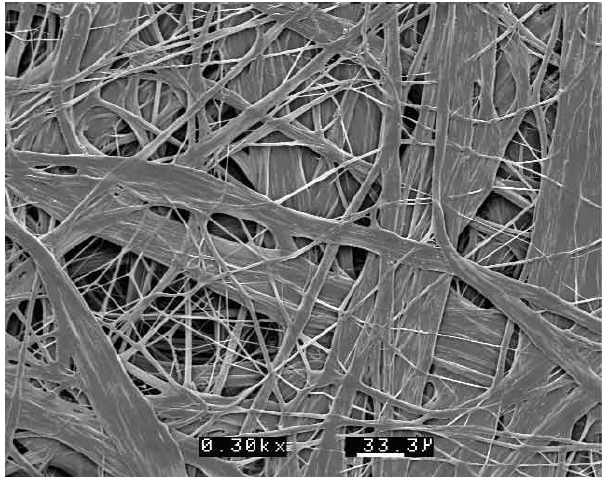
The result is an amorphous structure - a random, scattered and disorganised arrangement of polymer chains.
Important
The random nature of chain formation is crucial - it means the final structure lacks any organised pattern, which directly affects the material's properties.
Molecular structure and bonding
Within thermoplastic polymers, there are two types of bonding:
Primary bonding: The mers along the chains are bonded covalently. This form of primary bonding is very strong and extremely difficult to break down.
Secondary bonding: Between different chains or across overlapping chains, a weaker type of bonding exists called Van Der Wall's Forces. These forces are named after the Dutch scientist who discovered them.
Unlike primary bonds, Van Der Wall's Forces can easily be broken down by heat and reform upon cooling. This principle explains why thermoplastic polymers become flexible when heated and rigid when cooled.
Note
Understanding the Bonding Difference
The contrast between strong primary bonds (within chains) and weak secondary bonds (between chains) is what gives thermoplastics their unique properties. The primary bonds keep the polymer chains intact, while the secondary bonds allow the chains to move relative to each other when heated.
Improving thermoplastic properties
Thermoplastics can be engineered to improve their properties through several processes:
Co-polymers
Co-polymers involve mixing and combining different types of molecular chains. This can improve the material by making it harder, softer, more rigid or flexible depending on what is required. This process is similar to making alloys (mixing metals). The newly engineered materials will possess new and unique properties as determined by the required material use.
Note
The analogy to metal alloys is particularly useful - just as mixing different metals creates materials with enhanced properties, combining different polymer chains allows engineers to tailor materials for specific applications.
Branching
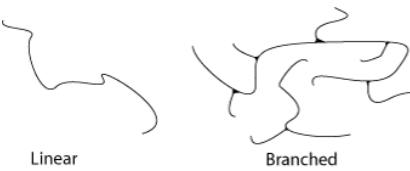
A linear molecular chain in an amorphous structure will produce a reasonably flexible material. Where a more rigid or firm material is required, a catalyst or chemical may be added during polymerisation. This causes branches to form from each molecular chain, creating a much firmer material as the different branches mesh together.
Crystalline regions
Thermoplastics naturally have an amorphous structure. However, these polymers may be modified to include crystalline regions. Crystalline means organised or patterned, which contrasts with amorphous (random or scattered). Crystalline regions within the structure will give the material more tensile strength in the direction of the aligned chains.
Important
Crystalline vs Amorphous Structure
Remember that crystalline regions provide directional strength - the material becomes stronger along the direction of the aligned polymer chains, but this also means the material may have different properties in different directions.
Comparison with thermosetting polymers
While thermoplastics use addition polymerisation, thermosetting polymers (thermosets) are produced by condensation polymerisation. Unlike thermoplastics, thermosets cannot be reheated or remoulded once they have been formed. They tend to be more rigid and brittle compared to the more flexible thermoplastics.
Summary
Key Points to Remember:
- Thermoplastics become flexible when heated and rigid when cooled due to Van Der Wall's Forces
- They are made through addition polymerisation starting with single mers that form long chains
- The structure is amorphous (random and disorganised arrangement)
- Properties can be improved through co-polymers, branching, and crystalline regions
- Van Der Wall's Forces are weak secondary bonds that break with heat, explaining thermoplastic behaviour