Electrolytes, Ionisation, and Conductivity (Grade 10 NSC Matric Physical Sciences): Revision Notes
📚Revision Notes
Electrolytes, Ionisation, and Conductivity
What are electrolytes?
When ionic substances dissolve in water, they break apart into individual ions. These ions are free to move around in the solution, which allows the solution to conduct electricity. This is a crucial concept for understanding chemical reactions in water.
Important
Definition: Electrolyte
An electrolyte is a substance that contains free ions and behaves as an electrically conductive medium.
Water itself is a polar molecule, which means it can dissolve ionic substances effectively. When ions are present in water, the solution becomes able to conduct electricity. We call this solution an electrolyte.
Types of electrolytes
Not all electrolytes conduct electricity equally well. We can classify them into three main types based on how well they conduct electricity:
Strong electrolytes
These are substances where many ions are present in the solution. Strong electrolytes are excellent conductors of electricity. Most ionic compounds like sodium chloride (NaCl) and potassium bromide (KBr) are strong electrolytes.
Weak electrolytes
These are substances where few ions are present in the solution. Weak electrolytes are poor conductors of electricity. Some acids and bases fall into this category.
Non-electrolytes
These substances do not conduct electricity at all because they don't form ions when dissolved in water. Most molecular compounds like sugar, alcohol, and oil are non-electrolytes.
Factors affecting conductivity
Conductivity in aqueous solutions measures water's ability to conduct an electric current. The conductivity of an electrolyte depends on several important factors:
Concentration of ions
The higher the concentration of ions in solution, the higher its conductivity will be. More ions means more charge carriers available to conduct electricity.
Note
Think of it this way: more ions = more conductivity. It's like having more workers to carry electrical charge through the solution.
Type of substance
Whether a material is a strong electrolyte (like potassium nitrate, KNO₃), a weak electrolyte (like acetic acid, CH₃COOH), or a non-electrolyte (like sugar, alcohol, oil) significantly affects the conductivity. Strong electrolytes form ions easily, weak electrolytes do not form ions easily, and non-electrolytes do not form ions in solution at all.
Temperature
The warmer the solution, the higher the solubility of the material being dissolved and therefore the higher the conductivity as well.
Investigating electrical conductivity
Understanding conductivity is best achieved through practical investigation. Here's how we can test different substances:
Aim
To investigate the electrical conductivities of different substances and solutions.
Apparatus
- Solid salt (NaCl) crystals
- Different liquids such as distilled water, tap water, seawater, sugar, oil and alcohol
- Solutions of salts (e.g. NaCl, KBr, CaCl₂, NH₄Cl)
- A solution of an acid (e.g. HCl) and a solution of a base (e.g. NaOH)
- Torch cells
- Ammeter
- Conducting wire, crocodile clips and 2 carbon rods
Method
Note
Setting up the Conductivity Test
Follow these steps carefully to ensure accurate results:
-
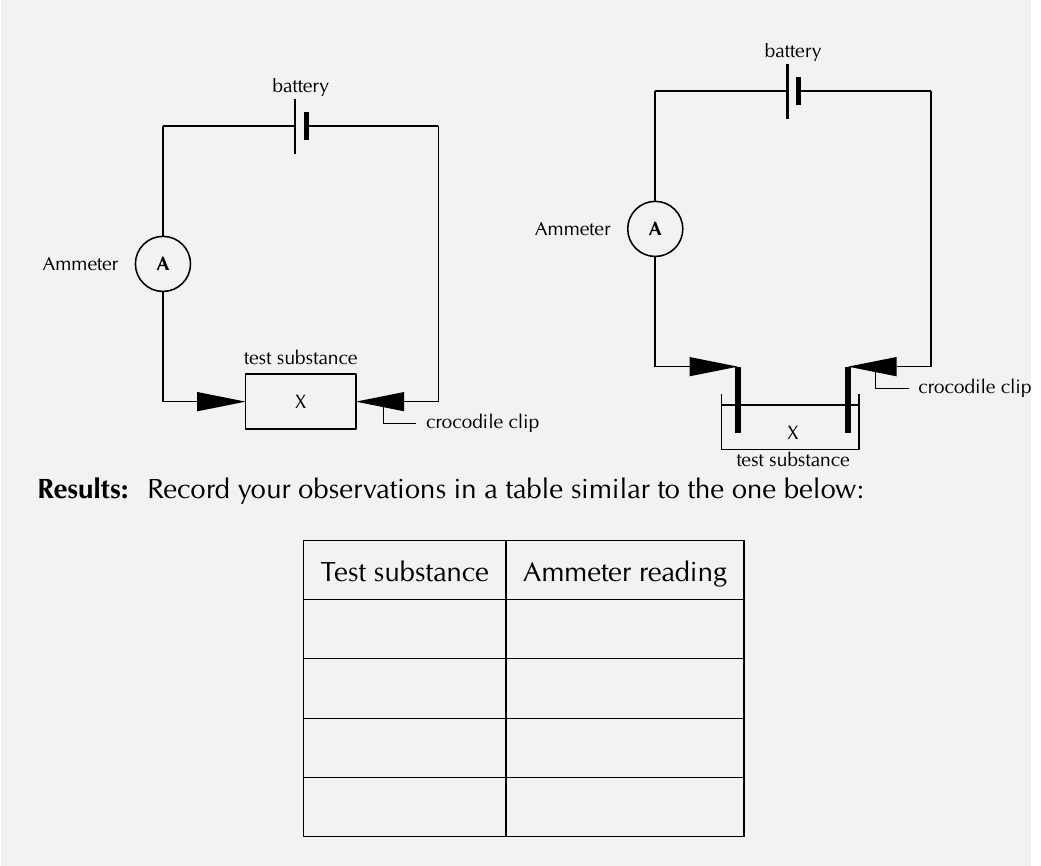
Set up the experiment by connecting the circuit as shown in the diagram below. In the diagram, X represents the substance or solution that you will be testing.
-
When you are using the solid crystals, the crocodile clips can be attached directly to each end of the crystal. When you are using solutions, two carbon rods are placed into the liquid and the clips are attached to each of the rods.
-
In each case, complete the circuit and allow the current to flow for about 30 seconds.
-
Observe whether the ammeter shows a reading.
Important
Safety Reminder
Always ensure proper connections and handle electrical equipment carefully. Allow current to flow for exactly 30 seconds to get consistent readings.
Understanding the results
When you complete this experiment, you'll notice some important patterns. Solutions that contain free-moving ions are able to conduct electricity because of the movement of charged particles. Solutions that do not contain free-moving ions do not conduct electricity.
For electricity to flow, there needs to be a movement of charged particles (ions). With solid NaCl crystals, there was no flow of electricity recorded on the ammeter. Although the solid is made up of ions, they are held together very tightly within the crystal lattice and therefore no current will flow.
Note
Why Don't Some Substances Conduct?
Distilled water, oil and alcohol also don't conduct a current because they are covalent compounds and therefore do not contain ions.
The ammeter should have recorded a current when the salt solutions and the acid and base solutions were connected in the circuit. In solution, salts dissociate into their ions, so that these are free to move in the solution.
Key dissociation equations
Here are important examples of how different substances break apart in water:
Example
Worked Example: Dissociation Equations
Dissociation of potassium bromide:
Dissociation of table salt:
Ionisation of hydrochloric acid:
Dissociation of sodium hydroxide:
Note that some molecular substances will form ions when they dissolve. Hydrogen chloride, for example, can ionise to form hydrogen and chloride ions when dissolved in water.
Summary
Key Points to Remember:
- Electrolytes contain free ions and can conduct electricity when dissolved in water
- Strong electrolytes have many ions and are good conductors; weak electrolytes have few ions and are poor conductors
- Non-electrolytes don't form ions and cannot conduct electricity at all
- Higher ion concentration leads to higher conductivity
- Ionic compounds dissociate into separate ions when dissolved, while covalent compounds generally don't form ions
- The conductivity experiment uses an ammeter to detect current flow, which only occurs when free ions are present