Atomic Mass and Diameter (Grade 10 NSC Matric Physical Sciences): Revision Notes
📚Revision Notes
Atomic Mass and Diameter
What is atomic mass?
When scientists want to measure how heavy an atom is, they face a problem. Atoms are incredibly tiny! A carbon atom has a mass of about kg, and a hydrogen atom weighs about kg. These numbers are so small that they become very difficult to work with and compare.
To solve this problem, scientists created a special unit called the atomic mass unit (abbreviated as amu or simply u). This makes it much easier to compare the masses of different atoms.
The carbon standard
Scientists use carbon as their reference point, called the carbon standard. They decided that carbon should have an atomic mass of exactly 12.0 u. Using this standard, hydrogen has an atomic mass of 1.0 u, making it easy to see that carbon is 12 times heavier than hydrogen.
Important
Atomic mass units don't give us the actual mass of an atom. Instead, they show us the mass of one atom compared to another atom. It's like saying "this apple is twice as heavy as that apple" without knowing the exact weight of either apple.
Atomic masses of common elements
Here are the atomic masses of some elements you'll encounter frequently:
| Element | Atomic mass (u) |
|---|---|
| Carbon (C) | 12.0 |
| Nitrogen (N) | 14.0 |
| Bromine (Br) | 79.9 |
| Magnesium (Mg) | 24.3 |
| Potassium (K) | 39.1 |
| Calcium (Ca) | 40.1 |
| Oxygen (O) | 16.0 |
Converting atomic mass units to actual mass
If you need the actual mass, 1 atomic mass unit equals:
- g
- kg
Note
Written out in full, this is 0.000 000 000 000 000 000 000 000 167 kg - showing just how incredibly small atoms really are!
Rutherford's discovery of the nucleus
In the early 1900s, scientists weren't sure what atoms looked like inside. Ernest Rutherford designed a brilliant experiment to find out.
The experiment setup
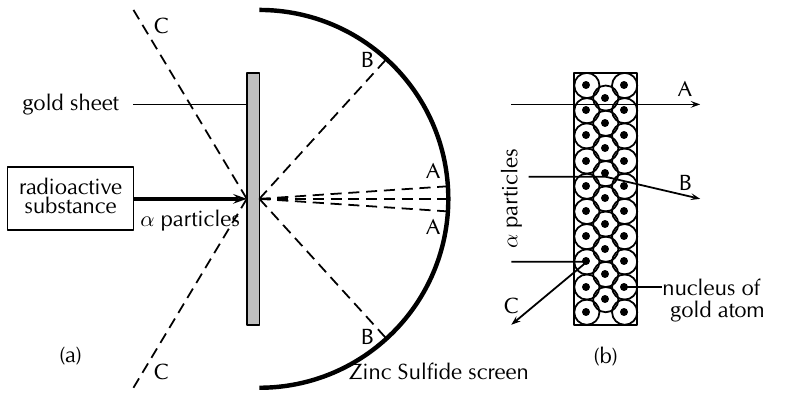
Rutherford knew that radioactive elements give off positively charged particles called alpha particles. He decided to fire these alpha particles at thin sheets of gold foil to see what would happen.
Behind the gold sheets, Rutherford placed a screen made of zinc sulphide. This special screen would flash whenever an alpha particle hit it, allowing him to track where the particles went.
Example
Rutherford's Gold Foil Experiment - What Happened
Expected Result: If atoms were just "blobs" of positive charge, alpha particles should be deflected only slightly.
Actual Observations:
- Path A: Most alpha particles passed straight through the gold foil without being deflected at all
- Path B: Some particles were deflected at small angles
- Path C: A few particles bounced back at large angles, or even straight back towards the source!
This unexpected result completely changed our understanding of atomic structure.
Rutherford's conclusions
These surprising results led Rutherford to conclude that:
- The nucleus is positively charged - only something with a concentrated positive charge could deflect or bounce back the positively charged alpha particles
- The nucleus is very small - most particles passed straight through, showing that most of the atom is empty space
- The nucleus contains most of the atom's mass - it had to be dense enough to bounce back the fast-moving alpha particles
How small is the atomic nucleus?
The nucleus is incredibly tiny compared to the whole atom. To help you visualise this, imagine the entire atom was the size of a large football stadium. In this comparison, the nucleus would be only the size of a pea sitting in the centre of the stadium!
Note
Amazing Fact: This means atoms are mostly empty space. If you could remove all the empty space from the atoms in your body, you would shrink down to the size of a grain of salt!
Relative atomic mass
Important
Definition: The relative atomic mass of an element is the average mass of all the naturally occurring isotopes of that element, measured in atomic mass units.
This is the number you'll find for each element on the periodic table. It's called "relative" because it compares the mass to the carbon-12 standard.
The relative atomic mass takes into account that most elements exist as mixtures of different isotopes (atoms with the same number of protons but different numbers of neutrons). The periodic table value represents the weighted average of all these isotopes.
Summary
Key Points to Remember:
- Atomic mass unit (amu) is a special unit that makes it easier to compare atomic masses
- Carbon-12 is the standard - it's defined as exactly 12.0 u
- Rutherford's experiment proved atoms have small, dense, positively charged nuclei
- Atoms are mostly empty space - the nucleus is tiny compared to the whole atom
- Relative atomic mass is the average mass of an element's isotopes and appears on the periodic table