Atoms and Compounds (Grade 10 NSC Matric Physical Sciences): Revision Notes
📚Revision Notes
Atoms and Compounds
Atoms as building blocks of matter
Understanding matter starts with recognising that everything around us is made up of tiny particles called atoms. Think of atoms like building blocks - just as different building materials create structures with different properties, the type of atoms and how they are arranged determines the properties of different substances.
Important
Atom: The smallest unit of matter that retains the properties of an element. Atoms are the fundamental building blocks from which all substances are constructed.
Most substances we encounter are not made of individual atoms floating around by themselves. Instead, atoms typically join together through chemical bonds to form larger structures. This is similar to how individual building materials are rarely used alone - they are combined to create more complex and useful structures.
What are compounds?
When atoms of different elements combine, they form compounds. Understanding compounds is essential for chemistry because most of the substances we interact with daily are compounds rather than pure elements.
Important
Compound: A substance formed when two or more different atoms are attracted to each other by relatively strong chemical bonds. The atoms in a compound are always combined in definite, fixed proportions.
Note
For example, water is always made of hydrogen and oxygen atoms in a 2:1 ratio, regardless of whether you're looking at a drop of water or an entire ocean.
Classification of compounds
Compounds can be organised into different categories based on the type of bonding that holds their atoms together. This classification system helps us understand and predict the properties of different substances.
The main classification divides compounds into two broad categories:
Covalent molecular structures
These compounds consist of small, discrete molecules where atoms share electrons through covalent bonds. The molecules exist as separate units and interact with each other through weaker forces.
Examples include:
- Water ()
- Oxygen gas ()
- Sulphur ()
- Buckyballs ()
Note
These substances typically have relatively low melting and boiling points because the forces between separate molecules are weak.
Network structures
Unlike molecular compounds, network structures form continuous networks of bonded atoms extending in all directions. These can be further subdivided into three types:
Covalent network structures
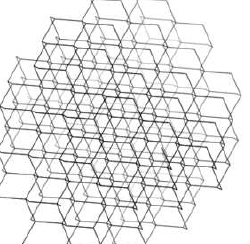
Atoms are connected throughout the entire structure by covalent bonds, creating very strong, three-dimensional networks.
- Examples: Diamond, graphite, silica ()
Ionic network structures
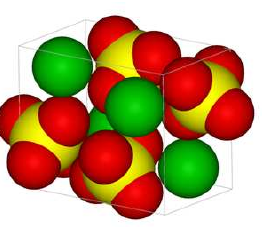
Metal and non-metal atoms form a regular, repeating pattern where electrons are transferred from metals to non-metals, creating charged ions held together by electrostatic forces.
- Examples: Sodium chloride (), barium sulphate (), silver iodide ()
Metallic network structures
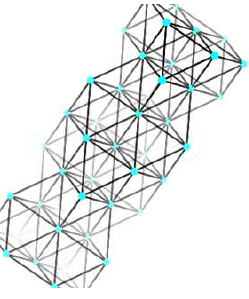
Metal atoms are arranged in regular patterns where electrons are delocalised, forming a "sea" of electrons that can move freely throughout the structure.
- Examples: Copper (), iron (), gold ()
Representing molecules and compounds
Scientists use several different methods to represent compounds, each showing different aspects of their structure and composition.
Chemical formulae
Chemical formulae provide a shorthand way to show what elements are present in a compound and in what proportions.
Important
Molecular formula: A formula that shows the exact number of each type of atom in one molecule of a covalent compound.
For example, the molecular formula tells us that one molecule of butane contains exactly 4 carbon atoms and 10 hydrogen atoms.
Important
Empirical formula: A formula that shows the simplest whole number ratio of atoms in a compound, but not necessarily the actual number of atoms in one molecule.
Using the same example, if a compound has the molecular formula , its empirical formula would be because this shows the simplest ratio (2:5) of carbon to hydrogen atoms.
Note
The empirical formula is particularly useful for network structures because these contain millions of atoms, making it impossible to specify exact numbers.
Types of molecular models
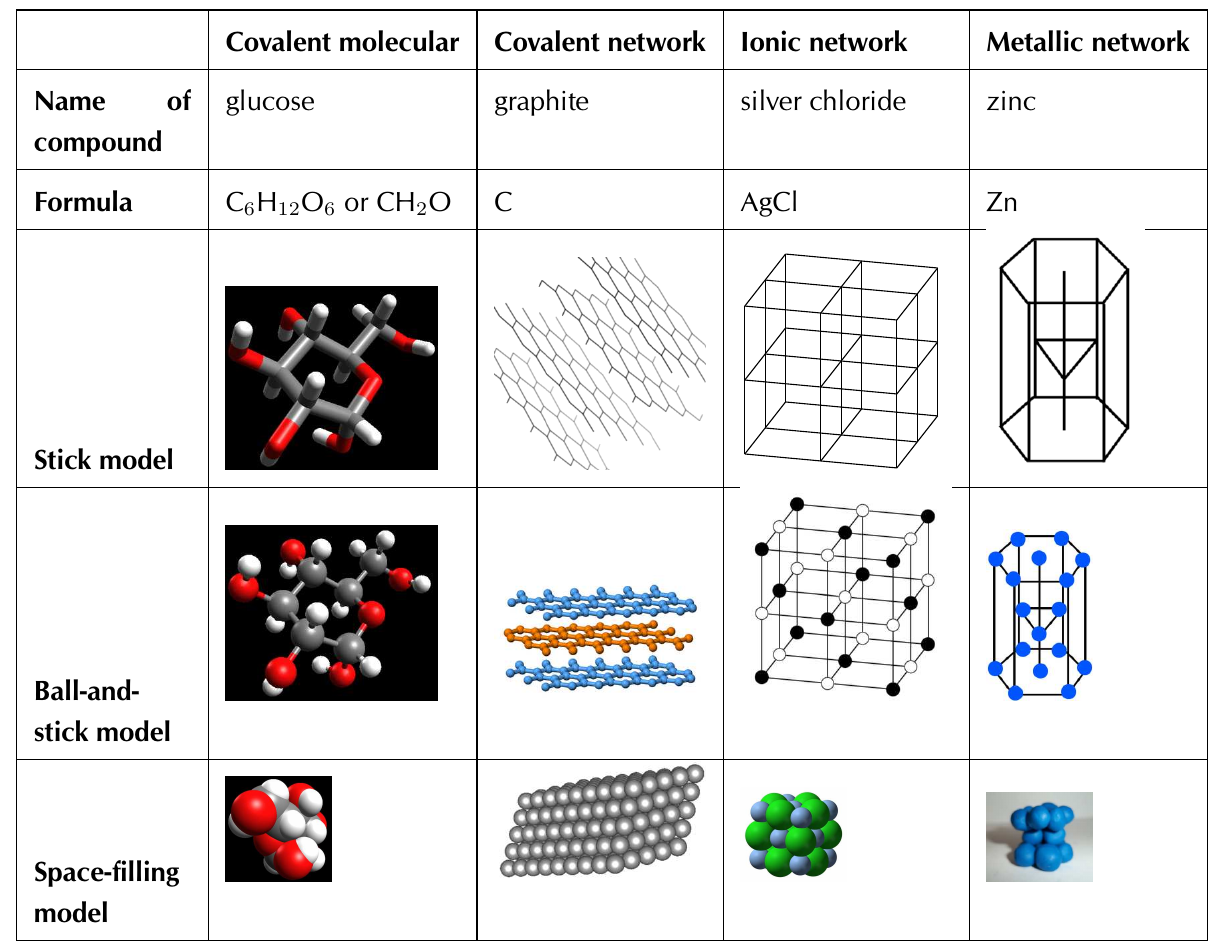
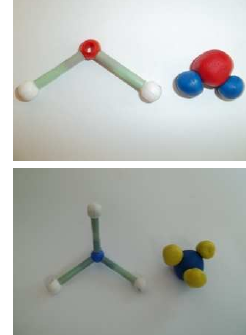
Visual models help us understand the three-dimensional structure of compounds. There are three main types:
Wireframe or stick models: Show the bonds between atoms as coloured "sticks" or lines. These clearly display how atoms connect but don't show atomic size.
Ball-and-stick models: Represent atoms as coloured spheres connected by rods representing bonds. This type shows both connectivity and gives some indication of atomic size.
Space-filling models: Show atoms as spheres sized according to their actual relative sizes. These models give the best representation of molecular shape and size but make it harder to see individual bonds.
Practical investigations
Investigating elements and compounds experiment
Example
Practical Investigation: Elements and Compounds
This experiment demonstrates the difference between elements and compounds through three simple reactions:
Aim: To investigate three reactions and learn about the nature of elements and compounds.
Key observations:
- Reaction 1: When calcium carbonate (Cal-C-Vita tablet) reacts, it produces carbon dioxide gas, which can be detected because it turns lime water milky and extinguishes a flame.
- Reaction 2: Zinc metal reacts with hydrochloric acid to produce hydrogen gas, which burns with a distinctive "pop" sound.
- Reaction 3: Heating copper sulphate crystals removes their water of crystallisation, causing them to change colour from blue to white.
Note
These reactions show that compounds can be broken down into simpler substances (elements or other compounds), while elements cannot be broken down further by chemical means.
The electrolysis of water
Example
Practical Investigation: Electrolysis of Water
This experiment demonstrates that compounds can be broken down into their constituent elements using electrical energy.
Aim: To investigate the elements that make up water.
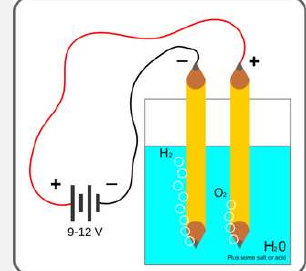
Method: An electric current is passed through water using pencil electrodes connected to a battery. Salt is added to make the water conduct electricity better.
Results:
- Bubbles form at both electrodes
- Oxygen gas is produced at the positive electrode
- Hydrogen gas is produced at the negative electrode
Key equation:
Note
This experiment proves that water is a compound made of hydrogen and oxygen elements, and that electrical energy can break the chemical bonds holding the compound together.
This equation shows that two molecules of water break down to produce two molecules of hydrogen gas and one molecule of oxygen gas.
Summary
Key Points to Remember:
- Atoms are the building blocks of all matter, and their arrangement determines the properties of substances
- Compounds form when different atoms bond together in fixed proportions, creating substances with properties different from their constituent elements
- Compounds are classified by bonding type: molecular compounds (covalent bonding), ionic compounds (ionic bonding), and metallic compounds (metallic bonding)
- Different formulae serve different purposes: molecular formulae show exact atom numbers, while empirical formulae show the simplest ratios
- Visual models help us understand structure: wireframe models show connectivity, ball-and-stick models show size and connectivity, and space-filling models show realistic molecular shapes