The Periodic Table (Grade 10 NSC Matric Physical Sciences): Revision Notes
📚Revision Notes
The Arrangement of the Elements
Introduction to the periodic table
The periodic table of the elements is a systematic way of organising all chemical elements according to their atomic number. This arrangement reveals important patterns in the properties of elements that help us understand and predict their behaviour.
The modern periodic table is based on the work of Russian chemist Dmitri Mendeleev, who created his version in 1869. Mendeleev was brilliant because he arranged elements by increasing atomic mass and noticed repeating patterns in their properties. He even left gaps for elements he predicted were "missing" and described what properties these unknown elements should have. When these elements were later discovered, Mendeleev's predictions proved to be remarkably accurate.
Note
Mendeleev's ability to predict the properties of undiscovered elements demonstrated the power of recognizing patterns in the periodic table. This showed that the arrangement was based on fundamental principles of atomic structure, not just coincidence.
Basic structure and organisation
Groups and periods
The periodic table is organised into rows and columns that have specific names and meanings:
Groups are the vertical columns in the periodic table. These are numbered from 1 to 18 (left to right) and represent the most important way of classifying elements. Elements in the same group have similar chemical properties because they have the same number of electrons in their outer shell.
Periods are the horizontal rows in the periodic table. These are numbered from 1 to 7 (top to bottom). Elements in the same period have the same number of electron shells.
Important
The group number is crucial for understanding chemical behaviour - elements in the same group have similar chemical properties because they have the same number of electrons in their outer shell. This is one of the most fundamental principles of the periodic table.
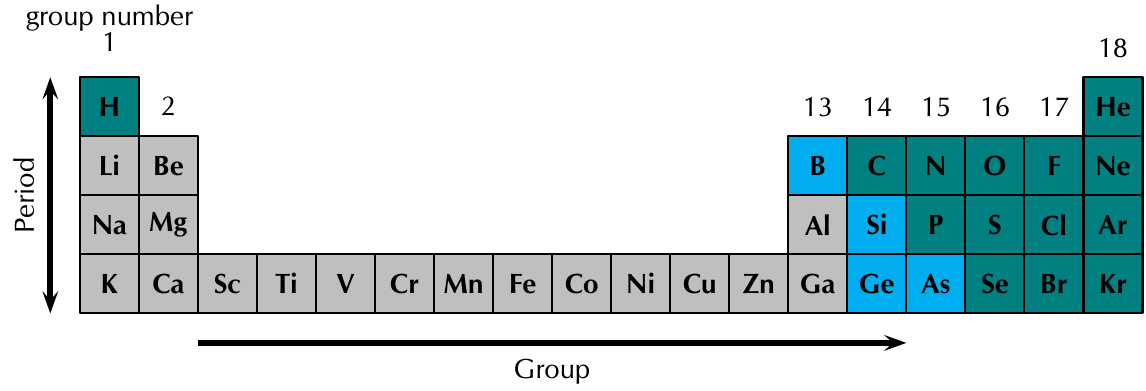
The diagram above shows how the periodic table is organised, with metals shown in grey, metalloids in light blue, and non-metals highlighted in turquoise.
Block structure
The periodic table can be divided into different blocks based on which type of orbital is being filled with electrons:
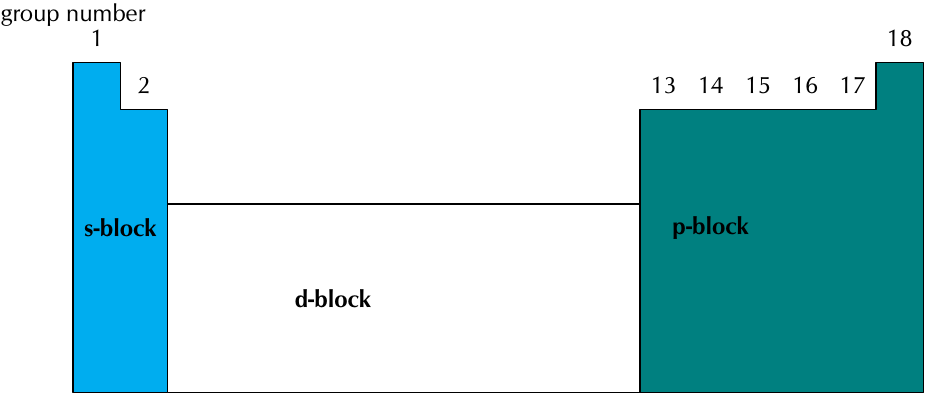
- s-block: Groups 1 and 2 (left side of table)
- p-block: Groups 13 to 18 (right side of table)
- d-block: The middle section containing transition elements
This block structure helps us understand electron configurations and predict properties of elements.
Note
Each block corresponds to the type of atomic orbital that is being filled as we move across the periodic table. Understanding blocks helps predict electron configurations and chemical behaviour.
Key definitions and concepts
Before examining periodic trends, you need to understand these important terms:
Atomic radius is a measure of the size of an atom. It tells us how large an atom is from its centre to its outermost electrons.
Ionisation energy is the energy needed to remove one electron from an atom in the gas phase. We can measure first, second, third ionisation energies depending on how many electrons we remove.
Electron affinity describes how much an element "wants" to gain electrons. It measures the energy change when an electron is added to a neutral atom.
Electronegativity is the tendency of atoms to attract electrons when they form chemical bonds. The electronegativity scale runs from about 0.7 (Francium) to 4.0 (Fluorine), with fluorine being the most electronegative element.
Important
These four properties - atomic radius, ionisation energy, electron affinity, and electronegativity - are fundamental to understanding how elements behave and interact with each other in chemical reactions.
Using the periodic table to find electron configurations
The position of an element in the periodic table tells us about its electron configuration. The period number shows which energy level is being filled, and the group number helps determine how many electrons are in the outer shell.
Example
Worked Example: Finding Electron Configuration for Phosphorus
For phosphorus (P) in period 3 and group 15:
Step 1: Identify the energy levels
- Period 3 means it has electrons in energy levels 1, 2, and 3
Step 2: Determine the orbital being filled
- Group 15 is in the p-block, so the 3p orbital is being filled
Step 3: Write the electron configuration
- Its electron configuration is [Ne]3s²3p³
Periodic trends across periods
As we move across a period from left to right, several important trends occur:
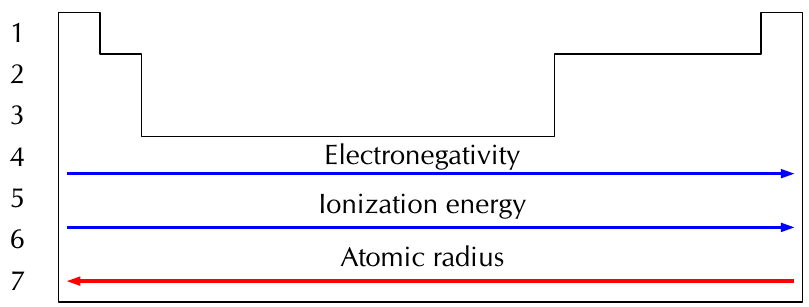
The diagram above shows how three key properties change across periods:
- Atomic radius decreases (atoms get smaller)
- Ionisation energy increases (harder to remove electrons)
- Electronegativity increases (atoms attract electrons more strongly)
These trends happen because as we move across a period, the number of protons increases while electrons are added to the same energy level. More protons create a stronger positive charge that pulls electrons closer, making atoms smaller and holding electrons more tightly.
Note
Understanding these trends is essential for predicting how elements will behave in chemical reactions. The increasing nuclear charge across a period is the driving force behind all these property changes.
Period 3 trends - a worked example
Let's examine how properties change across period 3, from sodium to chlorine:
| Element | Na | Mg | Al | Si | P | S | Cl |
|---|---|---|---|---|---|---|---|
| Chlorides | NaCl | MgCl₂ | AlCl₃ | SiCl₄ | PCl₅ or PCl₃ | S₂Cl₂ | no chlorides |
| Oxides | Na₂O | MgO | Al₂O₃ | SiO₂ | P₄O₆ or P₄O₁₀ | SO₂ or SO₃ | Cl₂O₇ or Cl₂O |
| Valence electrons | 3s¹ | 3s² | 3s²3p¹ | 3s²3p² | 3s²3p³ | 3s²3p⁴ | 3s²3p⁵ |
| Atomic radius | Decreases across the period | ||||||
| First ionisation energy | Generally increases across the period | ||||||
| Electronegativity | Increases across the period | ||||||
| Melting/boiling point | Increases to silicon, then decreases to argon | ||||||
| Electrical conductivity | Increases from sodium to aluminium. Silicon is a semiconductor. The rest are insulators |
Key observations from period 3:
- Atomic radius decreases from sodium (largest) to chlorine (smallest) because increasing nuclear charge pulls electrons closer
- Ionisation energy generally increases because electrons are held more tightly by the increasing positive charge
- Electronegativity increases as atoms become more effective at attracting electrons
- Electrical conductivity changes from metals (good conductors) to silicon (semiconductor) to non-metals (insulators)
- Melting points increase up to silicon (which has a giant covalent structure) then decrease for the molecular substances
Note that argon is not included in most comparisons because it's a noble gas with a complete electron configuration [Ne]3s²3p⁶ and doesn't readily form compounds.
Important
Period 3 provides the clearest demonstration of periodic trends because it contains representative examples of metals, metalloids, and non-metals, making it ideal for studying how properties change systematically across the periodic table.
Summary
Key Points to Remember:
- Groups are vertical columns with similar properties; periods are horizontal rows
- Mendeleev created the first successful periodic table by arranging elements by mass and predicting missing elements
- Atomic radius decreases across a period as nuclear charge increases
- Ionisation energy and electronegativity increase across a period due to stronger nuclear attraction
- The periodic table's structure (s, p, d blocks) reflects electron configuration patterns
- Period 3 trends demonstrate all major periodic patterns clearly with measurable property changes