Plant Defence Mechanisms (Grade 12 NSC Matric Life Sciences): Revision Notes
📚Revision Notes
Plant Defence Mechanisms
Plants have evolved remarkable strategies to protect themselves from threats in their environment. Since plants cannot move away from danger like animals can, they have developed sophisticated defence systems to survive and thrive. These protective mechanisms help plants defend against herbivores (plant-eating animals), harmful insects, and disease-causing pathogens.
Important
Unlike animals that can flee from danger, plants are rooted in place and must defend themselves where they grow. This fundamental limitation has driven the evolution of sophisticated chemical and physical defence mechanisms that allow plants to survive in hostile environments.
Chemical defences
Chemical defence represents one of nature's most effective plant protection strategies. Plants act like natural chemists, manufacturing toxic compounds that serve as powerful deterrents against potential threats.
The main mechanism involves plants producing specialised chemical compounds that can poison herbivores and insects whilst simultaneously providing protection against harmful pathogens. These defensive chemicals work by affecting the feeding behaviour, growth patterns, and overall survival of organisms that might harm the plant.
Note
Chemical defences are particularly energy-efficient because they provide continuous protection without requiring the plant to grow large physical structures. The chemicals can be targeted to specific plant parts that need the most protection.
A prime example of chemical defence is the production of tannins. These compounds create an unpleasant taste and can be toxic to many herbivores, effectively discouraging them from eating the plant. When herbivores consume plants containing these chemicals, they may experience digestive problems or other harmful effects, teaching them to avoid such plants in the future.
Example
Practical Example: Tannin Defence Mechanism
Step 1: Plant produces tannins in leaves and stems
Step 2: Herbivore attempts to eat the plant tissue
Step 3: Tannins create bitter taste and cause digestive discomfort
Step 4: Herbivore learns to avoid this plant species in future
Result: Successful plant defence through chemical deterrent
This chemical warfare strategy proves highly effective because it provides continuous protection without requiring the plant to expend energy on growing large physical barriers. The chemicals can be concentrated in leaves, stems, roots, or fruits, depending on which parts of the plant need the most protection.
Mechanical defences
Mechanical defences involve the development of physical structures that create barriers against herbivores. These external defensive structures make it physically difficult, painful, or dangerous for animals to consume the plant.
The primary purpose of mechanical defences is to deter herbivores through physical obstacles that can injure or discourage feeding. These structures have evolved into various forms, each adapted to provide maximum protection against different types of threats.
Types of mechanical defence structures
Plants have developed three main types of sharp defensive structures: thorns, prickles, and spines. Whilst these might appear similar at first glance, they differ significantly in their origin and structure.
Important
Understanding the differences between thorns, prickles, and spines is crucial for plant identification and understanding how different defence strategies have evolved. Each type originates from different plant tissues and serves slightly different protective functions.
Thorns are modified branches or stems that develop into hard, pointed structures with sharp edges. These formidable defences can pierce the skin or injure the mouth of herbivores attempting to eat the plant. The strategic positioning of thorns makes it challenging for larger herbivores to reach their mouths to the leaves without risking injury. However, the spaces between thorns still allow smaller animals to access leaves if they can navigate carefully.
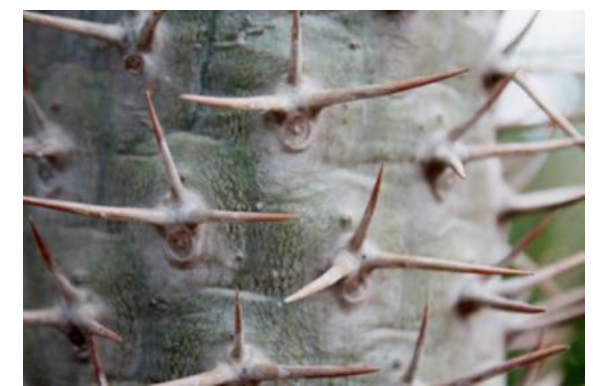
Prickles represent modified extensions of the plant's cortex and epidermis that transform into sharp, needle-like structures. These defensive features commonly appear on rose bushes, where they provide effective protection against herbivores. Prickles differ from thorns because they develop from the outer layers of the plant rather than from modified stems or branches.
Note
Prickles are often easier to remove than thorns or spines because they only extend from the surface layers of the plant. This is why rose thorns (which are actually prickles) can be broken off relatively easily compared to cactus spines.

Spines are actually modified leaves that have evolved into cylindrically shaped, hard, and sharp-pointed structures. These are frequently found on aloes and cacti, where they provide excellent protection in harsh environments. Spines tend to be thinner than thorns and can be particularly difficult to remove once they penetrate skin or mouth tissue. Their leaf origin means they often appear in regular patterns across the plant surface.

Effectiveness of mechanical defences
These physical barriers prove highly effective because they provide immediate consequences for herbivores that attempt to feed on protected plants. The pain and potential injury associated with encountering these structures create strong negative associations, encouraging herbivores to seek alternative food sources.
Note
The success of mechanical defences also lies in their permanent nature - once developed, these structures provide continuous protection without requiring ongoing energy investment from the plant. This makes them particularly valuable for plants growing in environments where herbivore pressure is consistently high.
Summary
Key Points to Remember:
- Chemical defences work by producing toxic compounds like tannins that poison herbivores and protect against pathogens
- Mechanical defences use physical structures to create barriers that make feeding difficult or painful for herbivores
- Thorns are modified stems/branches, prickles are modified outer tissue extensions, and spines are modified leaves
- Both defence types provide evolutionary advantages by reducing herbivory and increasing plant survival rates
- These defence mechanisms demonstrate how plants have adapted sophisticated strategies to thrive despite being unable to move away from threats