Negative Feedback: CO2 Concentrations (Grade 12 NSC Matric Life Sciences): Revision Notes
📚Revision Notes
Negative Feedback: CO2 Concentrations
Introduction to CO2 regulation
Carbon dioxide levels in your blood play a crucial role in maintaining your body's internal balance. When CO2 concentrations change, it directly affects the pH (acidity) of your blood, which can disrupt normal metabolic processes. Your body has developed an elegant system to keep CO2 levels stable through a process called negative feedback.
Note
pH balance is so critical that even small changes can affect enzyme function throughout your entire body. This is why CO2 regulation is considered one of the most important homeostatic mechanisms.
Why CO2 regulation matters
Carbon dioxide is a waste product created during cellular respiration - the process where your cells produce energy. When CO2 dissolves in water (like your blood plasma), it forms carbonic acid. The more CO2 present in your blood, the more acidic your blood becomes (lower pH). Since enzymes in your body are very sensitive to pH changes, maintaining proper CO2 levels is essential for normal body function.
Important
Critical Connection: CO2 + H₂O → H₂CO₃ (carbonic acid)
This chemical reaction is why CO2 regulation is really about maintaining blood pH, not just removing waste products.
The negative feedback mechanism
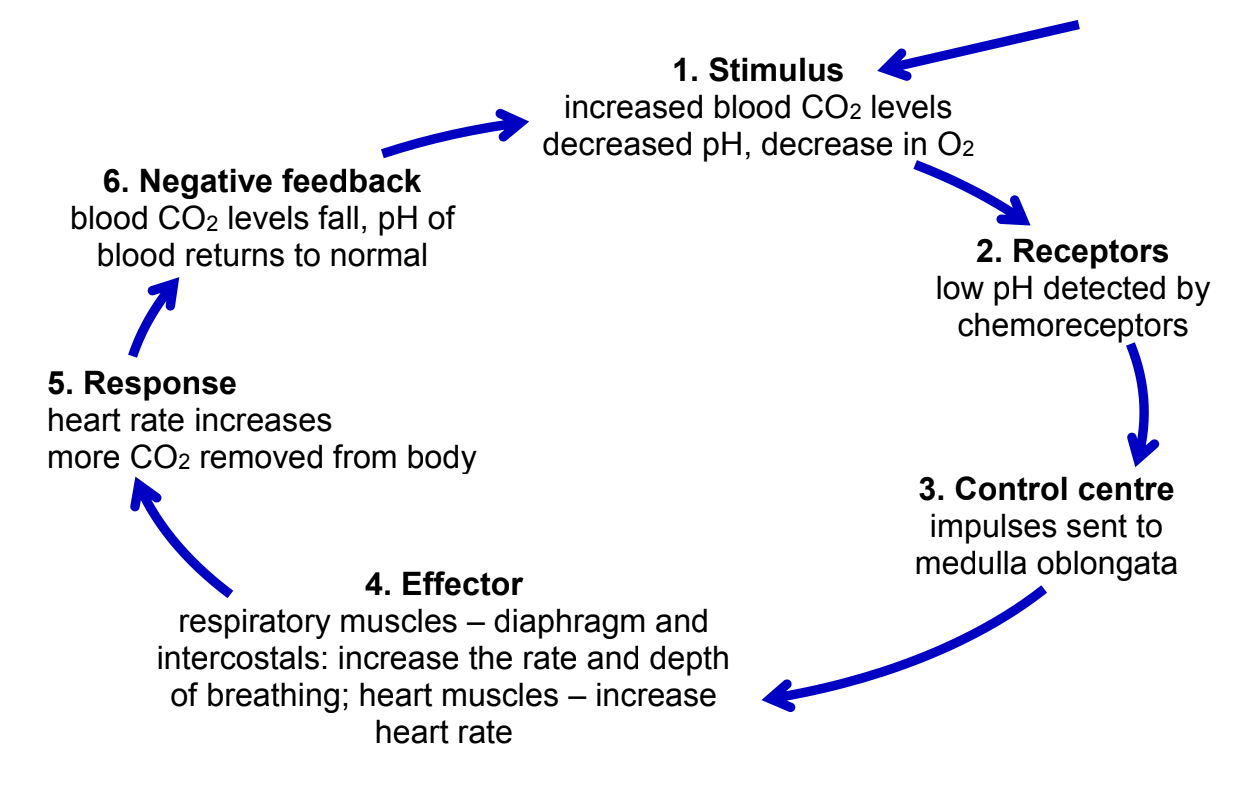
Your body uses a sophisticated negative feedback system to monitor and control CO2 concentrations. This system works like a thermostat - when CO2 levels rise too high, your body automatically takes action to bring them back to normal.
Note
In negative feedback systems, the response always opposes the original stimulus. This creates stability by preventing dangerous extremes in either direction.
Step-by-step process of CO2 regulation
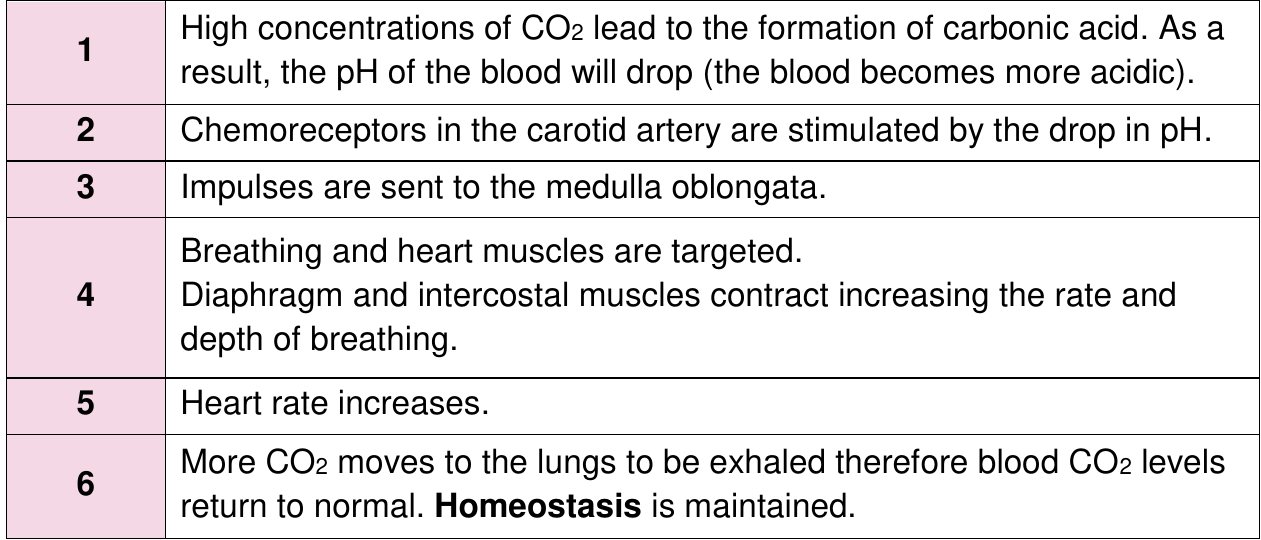
The regulation of CO2 follows a precise six-step process that demonstrates how negative feedback maintains homeostasis:
Example
Worked Example: Complete CO2 Regulation Cycle
Scenario: You've just finished a sprint and your muscles are producing excess CO2.
Step 1 - Stimulus: Blood CO2 ↑, pH ↓ (more acidic)
Step 2 - Detection: Chemoreceptors in carotid arteries detect pH drop
Step 3 - Control: Medulla oblongata processes signal
Step 4 - Effectors: Breathing muscles + heart receive activation signals
Step 5 - Response: Faster/deeper breathing + increased heart rate
Step 6 - Feedback: CO2 levels return to normal, response decreases
Result: Homeostasis restored within minutes!
Step 1: The stimulus
When CO2 levels increase in your blood, several changes occur simultaneously:
- Blood CO2 concentrations rise above normal
- Blood pH decreases (becomes more acidic) due to carbonic acid formation
- Oxygen levels may also decrease
Step 2: Detection by receptors
Special sensors called chemoreceptors are located in your carotid arteries (major blood vessels in your neck). These receptors are specifically designed to detect changes in blood chemistry, particularly drops in pH caused by increased CO2 levels.
Step 3: Control centre response
Once the chemoreceptors detect the problem, they send nerve impulses to your medulla oblongata - a vital control centre located in your brainstem. This region processes the information and coordinates the body's response.
Step 4: Effector activation
The medulla oblongata sends signals to two main groups of effector organs:
- Respiratory muscles: The diaphragm and intercostal muscles (between your ribs) receive signals to increase both the rate and depth of breathing
- Heart muscles: The heart receives signals to increase heart rate, pumping blood faster through your lungs
Step 5: Physiological response
The effector organs respond by working harder:
- Faster, deeper breathing moves more air in and out of your lungs
- Increased heart rate pumps blood through your lungs more quickly
- These changes allow more CO2 to be removed from your body through exhalation
Step 6: Negative feedback
As more CO2 is eliminated from your body:
- Blood CO2 levels decrease back to normal
- Blood pH returns to its optimal range
- The stimulus is removed, so the response gradually decreases
- Homeostasis is restored
Key components of the system
Chemoreceptors
These specialised nerve cells act as your body's "chemical smoke detectors." They're strategically positioned in the carotid arteries where they can constantly monitor blood chemistry as it flows to your brain.
Note
Chemoreceptors are incredibly sensitive - they can detect pH changes as small as 0.01 units, allowing for precise regulation of blood chemistry.
Medulla oblongata
This control centre in your brainstem is like the "command headquarters" for breathing and heart rate regulation. It receives information, processes it, and sends out appropriate response signals.
Respiratory muscles
- Diaphragm: The main breathing muscle that moves up and down to change chest volume
- Intercostal muscles: Muscles between your ribs that help expand and contract your chest during breathing
Note
The coordinated action of these respiratory muscles can increase breathing rate from a resting 12-15 breaths per minute to over 40 breaths per minute during intense exercise.
Real-world applications
This CO2 regulation system explains several everyday experiences:
- Why you breathe faster during exercise (increased CO2 production)
- Why holding your breath eventually becomes uncomfortable (CO2 buildup)
- Why hyperventilation can make you feel dizzy (too much CO2 removed)
Common misconceptions
Important
Misconception: "We breathe faster because we need more oxygen."
Reality: While oxygen is important, the primary trigger for increased breathing is usually rising CO2 levels, not falling oxygen levels.
Important
Misconception: "All feedback in the body is positive feedback."
Reality: Most regulatory systems in your body use negative feedback because it promotes stability and prevents dangerous extremes.
Exam tips
Summary
Key Exam Success Points:
- Remember that this is a negative feedback system - the response opposes the original stimulus
- Be able to identify all six steps in the correct sequence
- Understand that CO2 regulation is primarily about maintaining blood pH, not just removing waste
- Know the specific locations: chemoreceptors in carotid arteries, control centre in medulla oblongata
- Be able to explain why both breathing and heart rate increase together
Remember!
Summary
Essential Takeaways:
-
CO2 regulation maintains blood pH balance - high CO2 makes blood acidic, triggering the regulatory response
-
Chemoreceptors in carotid arteries detect pH changes and send signals to the medulla oblongata control centre
-
The response involves both respiratory and cardiovascular systems working together to remove excess CO2
-
This is a negative feedback system - the response opposes the original stimulus to maintain homeostasis
-
The process is automatic and continuous - your body constantly monitors and adjusts CO2 levels without conscious control