Negative Feedback: Water Balance – Osmoregulation (Grade 12 NSC Matric Life Sciences): Revision Notes
📚Revision Notes
Negative Feedback: Water Balance – Osmoregulation
What is osmoregulation?
Osmoregulation is the body's way of keeping water and salt levels balanced in your blood and tissue fluids. This process is essential for maintaining proper body function and is controlled through a negative feedback system. Think of it like a thermostat that automatically adjusts to keep your house at the right temperature – your body does something similar with water levels.
When we talk about water balance, we need to understand that your body constantly loses water through breathing, sweating, and urine production. At the same time, you gain water from drinking fluids and eating food. Your body needs to carefully balance these inputs and outputs to keep everything working properly.
Note
Water balance is crucial for cellular function because cells need the right concentration of water and dissolved substances to maintain their shape, transport nutrients, and carry out metabolic processes efficiently.
The role of ADH in water regulation
The key player in water balance is a hormone called ADH (antidiuretic hormone), also known as vasopressin. This hormone is produced by your pituitary gland and acts like a messenger that tells your kidneys how much water to keep or release.
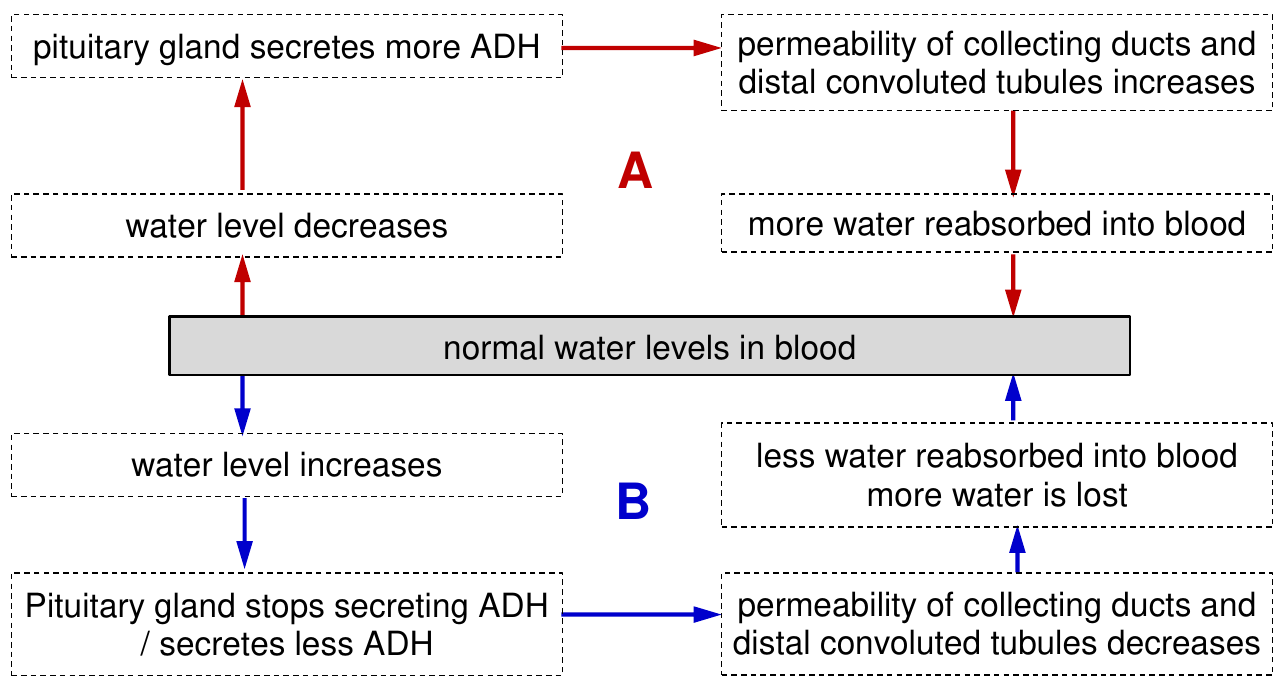
The diagram above shows how ADH works in a negative feedback loop. When your body detects changes in water levels, it responds by either increasing or decreasing ADH production, which then affects how much water your kidneys reabsorb.
Note
The term "antidiuretic" literally means "against increased urination" – so ADH reduces the amount of urine produced by helping your body retain more water.
How your body detects water level changes
Your hypothalamus contains special receptor cells called osmoreceptors. These cells act like tiny water detectors – they can sense when the concentration of water in your blood changes. When these receptors detect that water levels are too high or too low, they send signals to your pituitary gland to either release more ADH or reduce ADH production.
Note
Osmoreceptors are incredibly sensitive and can detect changes in blood concentration as small as 1-2%. This precision allows your body to maintain very tight control over water balance.
Understanding dehydration and overhydration responses
Your body responds differently depending on whether you have too little water (dehydration) or too much water (overhydration). Let's look at both situations.
When you're dehydrated (water levels below normal)
Dehydration can happen when you exercise heavily, experience hot temperatures, sweat excessively, or don't drink enough water. Here's what your body does:
Example
Worked Example: Body's Response to Dehydration
Step 1: Detection - Osmoreceptors in your hypothalamus notice that water levels in your blood are low
Step 2: Signal transmission - Your hypothalamus sends impulses to your pituitary gland
Step 3: Hormone release - Your pituitary gland releases more ADH into your bloodstream
Step 4: Kidney response - ADH travels to your kidneys and increases the permeability of the collecting ducts and distal convoluted tubules
Step 5: Water conservation - More water is reabsorbed back into your blood instead of being lost in urine
Step 6: Result - Your blood becomes more dilute, and you produce concentrated (darker) urine
When you're overhydrated (water levels above normal)
Overhydration can occur in cooler temperatures, when you exercise very little, don't sweat much, or drink excessive amounts of water. Here's the body's response:
Example
Worked Example: Body's Response to Overhydration
Step 1: Detection - Osmoreceptors detect high water levels in your blood
Step 2: Reduced signalling - Your hypothalamus reduces the signals sent to your pituitary gland
Step 3: Less hormone - Your pituitary gland secretes less ADH (or stops secreting it)
Step 4: Kidney adjustment - With less ADH, the collecting ducts and distal convoluted tubules become less permeable
Step 5: Water elimination - Less water is reabsorbed, so more water is lost through urine
Step 6: Result - You produce more dilute (lighter coloured) urine, and water levels return to normal
The negative feedback mechanism explained
This system is called "negative feedback" because the response always opposes the original change. If water levels go down, the body responds by conserving water. If water levels go up, the body responds by eliminating excess water. This creates a stable balance around the normal water level.
Important
The beauty of this system is that it's automatic – you don't have to think about it. Your body constantly monitors and adjusts water levels throughout the day to keep you healthy.
Salt concentration regulation
Water balance isn't just about water – it's also about maintaining the right concentration of salts in your body fluids. The osmotic pressure in your blood and tissue fluids depends on dissolved substances, particularly salts.
Two important salts that your body regulates are:
- Sodium ions (Na⁺): These are crucial for nerve function and muscle contraction
- Potassium ions (K⁺): These are essential for heart function and cellular processes
Your kidneys also regulate these salts through negative feedback mechanisms, working alongside the water regulation system to maintain proper osmotic balance.
Note
Salt and water regulation work together because changing the concentration of salts affects the osmotic pressure, which in turn affects how water moves in and out of cells.
Common misconceptions and exam tips
Important
Common misconception: Students often think that drinking more water is always good. However, drinking excessive amounts can lead to overhydration, which dilutes essential salts in your body and can be dangerous.
Note
Exam tip: Remember that ADH stands for "anti-diuretic hormone." The word "diuretic" means something that increases urine production, so "anti-diuretic" means it reduces urine production by helping your body retain water.
Note
Exam tip: When describing the process, always mention the specific parts involved: osmoreceptors (detection), hypothalamus (control centre), pituitary gland (hormone production), and kidney tubules (effector organs).
Note
South African context: In South Africa's hot climate, especially during summer sports activities, understanding proper hydration is crucial. Athletes need to balance water intake to avoid both dehydration (heat stroke risk) and overhydration (electrolyte imbalance).
Remember!
Summary
Key Points to Remember:
- Osmoregulation maintains water and salt balance through negative feedback mechanisms
- ADH is the key hormone that controls water reabsorption in the kidneys
- Osmoreceptors in the hypothalamus detect changes in water levels and trigger appropriate responses
- Dehydration leads to increased ADH production and water conservation
- Overhydration leads to decreased ADH production and increased water elimination
- The system automatically maintains homeostasis by always opposing the initial change in water levels