The Doppler Effect with Light (Grade 12 NSC Matric Physical Sciences): Revision Notes
📚Revision Notes
The Doppler Effect with Light
Introduction to light and the Doppler effect
Light is an electromagnetic wave that travels at a constant speed of approximately in a vacuum. Just like sound waves, light exhibits the Doppler effect when there is relative motion between the source and the observer.
The key principle is that when a light source moves relative to an observer, the frequency and wavelength of the observed light will be different from the emitted values. This occurs because light behaves as a wave, and the same physics that applies to sound waves also applies to electromagnetic radiation.
Note
Understanding the Doppler effect with light is crucial for modern astronomy, as it allows us to determine the motion of distant celestial objects and has led to discoveries about the expanding universe.
Frequency shifts and colour changes
When dealing with light, we need to remember the fundamental relationship:
Where:
- = speed of light ()
- = frequency (Hz)
- = wavelength (m)
Since the speed of light is constant, if the wavelength changes, the frequency must change proportionally in the opposite direction.

The visible light spectrum ranges from violet light (around 400 nm) to red light (around 700 nm). This means that changes in wavelength can result in observable colour changes that we can detect with the naked eye.
Redshift and blueshift
There are two main types of Doppler shifts for light:
Redshift
- Definition: A shift towards longer wavelengths (lower frequencies) in the electromagnetic spectrum
- Cause: Occurs when the light source is moving away from the observer
- Effect: Light appears more red than it actually is
- Symbol: The light is "redshifted"
Blueshift
- Definition: A shift towards shorter wavelengths (higher frequencies) in the electromagnetic spectrum
- Cause: Occurs when the light source is moving towards the observer
- Effect: Light appears more blue than it actually is
- Symbol: The light is "blueshifted"
Important
Memory Aid: Remember that longer wavelengths correspond to lower frequencies, and shorter wavelengths correspond to higher frequencies. Think "Red Away, Blue Closer" — redshift when moving away, blueshift when approaching.
Applications to astronomy
Spectral lines
Astronomers use powerful telescopes to analyse light from distant stars and galaxies. Each chemical element produces characteristic spectral lines — specific wavelengths of light that the element either emits or absorbs.
When these spectral lines are observed to be shifted from their normal wavelengths:
- Shift to shorter wavelengths → the galaxy is moving towards us (blueshifted)
- Shift to longer wavelengths → the galaxy is moving away from us (redshifted)
This technique allows astronomers to determine whether celestial objects are approaching or receding from Earth, making it one of the most powerful tools in modern astrophysics.
Note
The precision of modern spectrometers allows astronomers to detect incredibly small wavelength shifts, enabling the study of objects millions of light-years away and their precise velocities.
The expanding universe
Hubble's observations
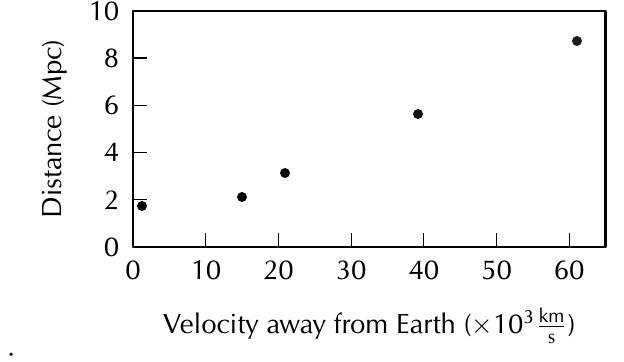
Edwin Hubble (1889–1953) made a groundbreaking discovery when he studied the light from distant galaxies. He found that:
- Nearly all distant galaxies show redshift in their spectral lines
- More distant galaxies show greater redshift than nearby ones
- This suggests that distant galaxies are moving away from us at high speeds
Hubble's law
From his observations, Hubble established a proportional relationship between a galaxy's distance and its recession velocity:
Where:
- = recession velocity of the galaxy
- = Hubble constant ()
- = distance to the galaxy
This relationship is known as Hubble's law.
Understanding universal expansion
The key insight
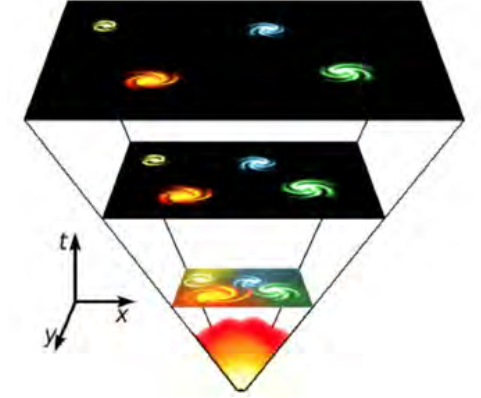
The reason almost all galaxies appear redshifted is that the universe itself is expanding. This is not because galaxies are moving through space away from us, but because space itself is stretching.
As space expands, the light waves travelling through it get stretched, increasing their wavelength and causing the observed redshift.
Important
Common Misconception Alert: Many students think that Earth must be at the centre of the universe because everything appears to be moving away from us. This is incorrect. The expansion of space means that every point in the universe observes the same phenomenon — all distant galaxies appearing to recede.
Analogies for universal expansion
Two helpful ways to visualise this:
- Balloon analogy: Draw dots on a balloon surface. As you inflate the balloon, all dots move away from each other, and each dot sees all others receding.
- Raisin bread analogy: As bread dough rises, raisins embedded in it move apart. Each raisin observes all others moving away.
Example
Worked Example: Calculating Recession Velocity
Question: A galaxy is located 5.0 Mpc from Earth. What is its recession velocity according to Hubble's law?
Solution:
Using Hubble's law:
The galaxy is receding at approximately .
Example
Worked Example: Determining Redshift Type
Question: An astronomer observes that hydrogen spectral lines from a distant galaxy appear at 520 nm instead of their normal 500 nm. Is this galaxy approaching or receding?
Solution:
- Normal wavelength: 500 nm
- Observed wavelength: 520 nm
- The observed wavelength is longer than normal
- Longer wavelength = redshift
- Redshift means the galaxy is moving away from us
Example
Worked Example: Distance Calculation
Question: A galaxy shows a recession velocity of . How far away is it?
Solution:
Using Hubble's law:
Rearranging:
The galaxy is approximately 22.3 megaparsecs away.
Summary
Key Points to Remember:
- Light exhibits the Doppler effect just like sound waves — frequency and wavelength change when there's relative motion between source and observer
- Redshift (longer wavelengths) occurs when the source moves away; blueshift (shorter wavelengths) occurs when approaching
- Almost all distant galaxies show redshift, indicating they are moving away from us due to universal expansion
- Hubble's law () describes the linear relationship between a galaxy's distance and recession velocity
- The universe is expanding — space itself stretches, causing light waves to be stretched and appear redshifted