Batteries and Internal Resistance (Grade 12 NSC Matric Physical Sciences): Revision Notes
📚Revision Notes
Batteries and Internal Resistance
What makes real batteries different from ideal batteries?
Until now, we've worked with ideal batteries that provide a constant voltage regardless of the circuit conditions. However, real batteries are different because they have internal resistance. This means that when current flows through a real battery, the voltage available to the external circuit decreases.
Note
Think of a real battery as containing two components: an ideal voltage source (the EMF) connected in series with a small resistor (the internal resistance). This model helps us understand why real batteries behave differently from theoretical ones.
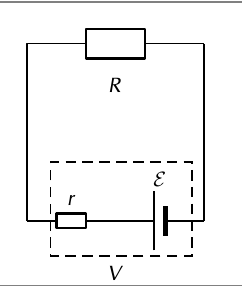
Key definitions you need to know
EMF (Electromotive Force) - ε: The total potential difference that the battery can provide when no current is flowing. This represents the chemical energy converted to electrical energy per unit charge.
Internal Resistance (r): The resistance within the battery itself, caused by the materials from which the battery is made.
Terminal Voltage (V): The actual potential difference measured across the battery terminals when current is flowing in a circuit.
Load: The external resistance in the circuit - this is everything connected outside the battery.
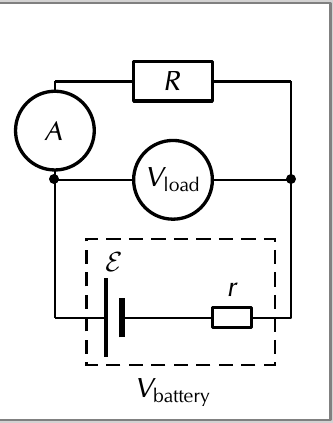
Understanding the relationship between EMF and terminal voltage
When a battery supplies current to a circuit, some voltage is "lost" across the internal resistance. This creates the fundamental relationship:
Important
The Key Equation:
Where:
- = EMF of the battery
- = terminal voltage (voltage across the load)
- = current flowing through the circuit
- = internal resistance
This can also be written as:
This equation tells us that the terminal voltage is always less than the EMF when current flows, because some energy is used to push current through the internal resistance.
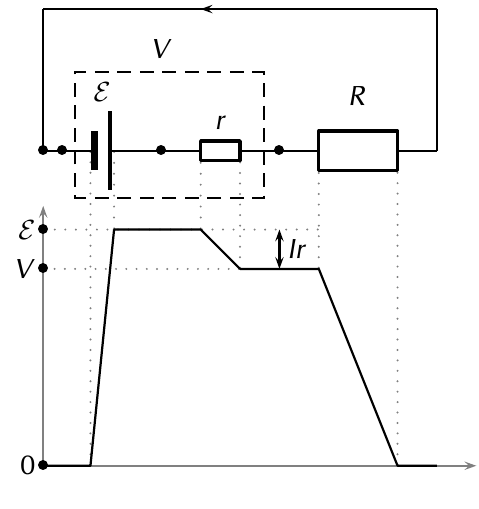
The higher the current drawn from the battery, the greater the voltage drop across the internal resistance, and therefore the lower the terminal voltage available to the external circuit.
Maximum current from a battery
There's a limit to how much current a battery can supply. The maximum current occurs when the external resistance approaches zero (short circuit conditions).
Note
When the external resistance is zero, all the EMF appears across the internal resistance. This gives us the maximum current formula:
Where is the maximum current the battery can deliver.
This maximum current is always less than in practical situations because there's always some external resistance in the circuit.
Worked example: calculating internal resistance
Example
Worked Example: Finding Internal Resistance
Question: A battery has an EMF of 12.00 V and shows a terminal voltage of 10.00 V when supplying a current of 4.00 A. Calculate the internal resistance.
Solution:
Step 1: Identify the known values
- EMF () = 12.00 V
- Terminal voltage () = 10.00 V
- Current () = 4.00 A
- Internal resistance () = ?
Step 2: Apply the formula
Step 3: Solve for
Therefore, the internal resistance is 0.50 Ω.
How to determine internal resistance experimentally
To find the internal resistance of a battery experimentally, we use the relationship between terminal voltage and current.
Method: Set up a circuit with the battery connected to different external resistances. Measure the terminal voltage and current for each setup.
Note
Key insight: As we change the external resistance, the current changes, which affects the voltage drop across the internal resistance.
Using the equation:
If we rearrange this:
This is in the form , where:
- (terminal voltage)
- (current)
- (slope = negative internal resistance)
- (y-intercept = EMF)
By plotting terminal voltage against current, we get a straight line where:
- The y-intercept gives us the EMF ()
- The slope gives us the negative internal resistance ()
Common exam tips and traps
Important
Exam Success Tips
Always check: Whether the question asks for EMF, terminal voltage, or internal resistance - these are different quantities.
Common mistake to avoid: Forgetting that terminal voltage decreases as current increases when internal resistance is present.
Problem-solving approach:
- Identify what type of battery problem you have
- List known and unknown variables
- Choose the correct form of the equation: or
- Substitute values and solve
- Check that your answer makes physical sense
Summary
Key Points to Remember:
-
Real batteries have internal resistance that causes the terminal voltage to be less than the EMF when current flows
-
The key equation is , where is EMF, is terminal voltage, is current, and is internal resistance
-
Terminal voltage decreases as more current is drawn from the battery due to the voltage drop across internal resistance
-
Maximum current from a battery is limited by internal resistance and equals when external resistance is zero
-
Experimentally, internal resistance can be found by plotting terminal voltage against current - the slope gives the negative internal resistance