Alternating Current (Grade 12 NSC Matric Physical Sciences): Revision Notes
📚Revision Notes
Alternating Current
What is alternating current?
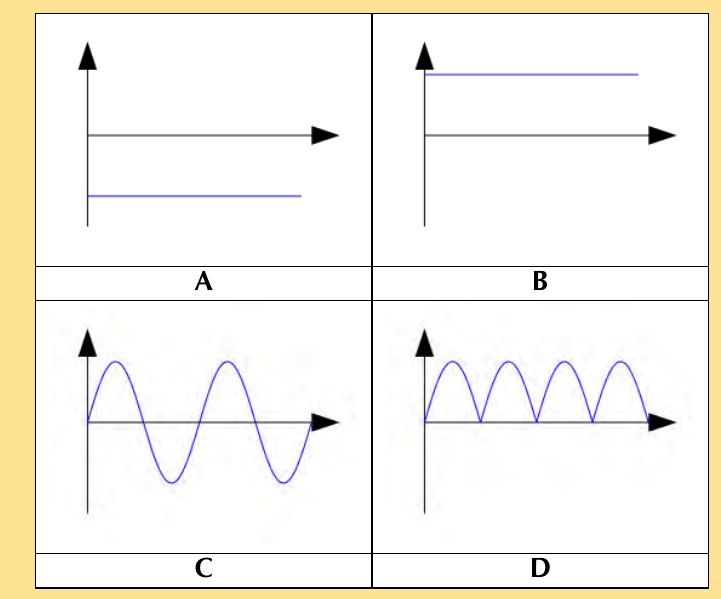
When you first learn about electricity, you typically start with direct current (DC), which flows in only one direction. This is the type of electricity produced by batteries, where there are clear positive and negative terminals.
However, the electricity generated by power stations works differently. This electricity constantly alternates or switches direction, which is why it's called alternating current (AC). In South Africa, this alternating happens at a frequency of 50 Hz, meaning the current changes direction 50 times every second.
Note
The circuit symbol for alternating current consists of a circle with a wavy line inside it, representing the alternating nature of the current.
Advantages of AC over DC
AC has several important advantages over DC that make it the preferred choice for electrical power distribution:
- Easy transformation - AC voltage can be easily stepped up or stepped down using transformers
- Efficient transmission - AC can be transmitted at high voltage and low current over long distances with minimal energy loss due to heating
- Simple voltage conversion - It's easier to convert from AC to DC than from DC to AC
- Easy generation - AC is easier to generate than DC using rotating generators
- Motor applications - High frequency AC is particularly suitable for electric motors
Note
These advantages make AC the universal choice for power grid systems worldwide. The ability to easily transform voltage levels allows power companies to transmit electricity efficiently over long distances and then step it down to safe levels for household use.
Current and voltage in AC circuits
In a DC circuit, current and voltage remain constant over time. However, in an AC circuit, both current and voltage vary continuously with time. The value of current or voltage at any specific moment is called the instantaneous current or instantaneous voltage.
These values follow sinusoidal patterns and can be calculated using these equations:
Where:
- = instantaneous current
- = maximum current
- = instantaneous voltage
- = maximum voltage
- = frequency of the AC
- = time at which the calculation is made
Note
The sinusoidal nature of AC means that both current and voltage smoothly vary between positive and negative peak values, creating the characteristic wave pattern that defines alternating current.
RMS (root mean square) values
Since AC current and voltage are constantly changing, we need a way to express their effective values. The root mean square (RMS) value represents the equivalent DC value that would produce the same power output.
RMS values are calculated using these formulas:
Important
The RMS value is crucial because AC varies sinusoidally - it's equally positive and negative. If we calculated a simple average, we'd get zero. The RMS value solves this problem by giving us a meaningful measure of AC's effective strength.
Power in AC circuits
In circuits containing only resistive components, the average power can be calculated using RMS values:
This can also be expressed as:
Note
An important point about AC power: since both current and voltage have the same sign at any given moment (both positive or both negative), the power is always positive. This means the average power won't be zero, unlike the case with current or voltage alone in AC circuits.
Worked example 1: Laptop transformer calculations
Example
Worked Example: Laptop Transformer Calculations
Question: A laptop transformer has the following specifications:
- INPUT: 100-240 V; 1,5 A; 50/60 Hz
- OUTPUT: 20 V; 3,25 A
Calculate the RMS current and voltage values for a 240 V input.
Solution:
Step 1: Identify what changes from input to output The input includes frequency because it's designed for AC household use. The output has no frequency listed, meaning it produces DC output.
Step 2: Calculate RMS values for the input Since the transformer takes AC input, we only need RMS values for the input:
Worked example 2: Camera battery charger
Example
Worked Example: Camera Battery Charger
Question: A camera charger shows:
- INPUT: 100-240 V; 0,085 A (100 V) - 0,05 A (240 V); 50/60 Hz
- OUTPUT: 4,2 V; 0,7 A
Calculate RMS values for both input voltages.
Solution:
For 100 V input:
For 240 V input:
Worked example 3: Power calculation
Example
Worked Example: Power Calculation
Question: Using the laptop transformer from Example 1 (240 V input), calculate the average power dissipated.
Solution:
Step 1: Use previously calculated RMS values
V
A
Step 2: Calculate average power
Summary
Key Points to Remember:
- AC constantly changes direction while DC flows in one direction only
- South Africa uses 50 Hz frequency for AC power generation
- RMS values equal maximum values divided by √2 - this gives the effective AC value
- AC can be easily transformed using transformers, making it ideal for power transmission
- Power in AC circuits is always positive because current and voltage have the same sign at any moment