Momentum and Impulse (Grade 12 NSC Matric Physical Sciences): Revision Notes
📚Revision Notes
Collisions
When objects interact and exchange momentum, we observe collisions. Understanding how momentum behaves during collisions is fundamental to solving physics problems and explaining real-world phenomena.
What happens during collisions
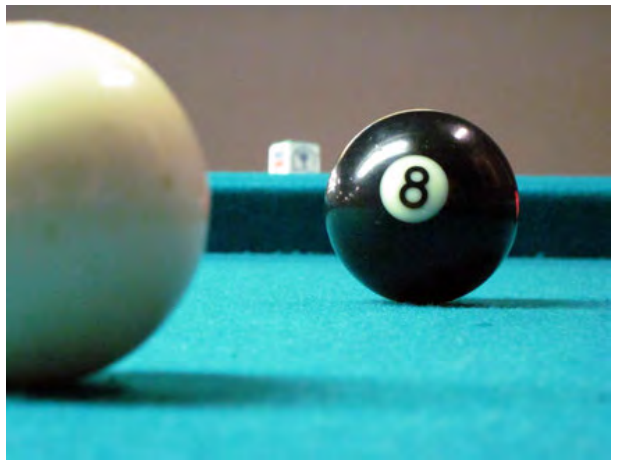
In any collision between objects, the total momentum of the system remains constant. This principle applies whether we're looking at billiard balls on a table, cars in an accident, or particles in space.
Important
The key principle governing all collisions is conservation of momentum. This means that in an isolated system (where no external forces act), the total momentum before a collision equals the total momentum after the collision.
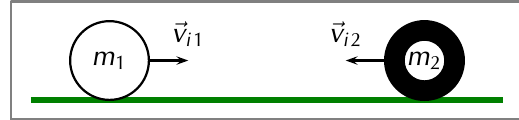
Consider two objects approaching each other before collision. Object 1 has mass and initial velocity , while object 2 has mass and initial velocity .
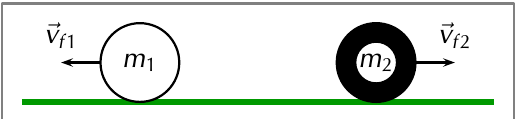
After the collision, both objects have different velocities. Object 1 now has final velocity and object 2 has final velocity . Despite these changes, the total momentum remains the same.
Conservation of momentum equation
The mathematical expression for conservation of momentum in collisions is:
Expanded for two objects, this becomes:
Where:
- , are the masses of objects 1 and 2 (in kg)
- , are initial velocities (in m·s with direction)
- , are final velocities (in m·s with direction)
Note
This equation applies to all collisions regardless of the type of collision or the objects involved.
Types of collisions
There are two main types of collisions that you need to understand:
Elastic collisions
Note
Definition: An elastic collision is a collision where both total momentum and total kinetic energy are conserved.
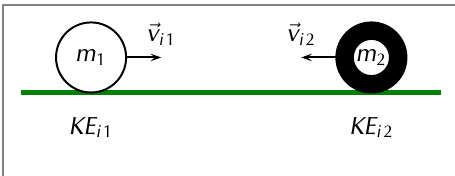
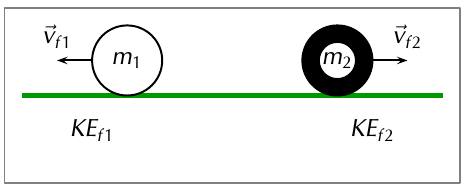
In elastic collisions, the objects typically separate cleanly after impact. The kinetic energy is temporarily stored as elastic potential energy during compression, then released as the objects push apart. Think of perfectly bouncy balls or billiard balls.
For elastic collisions, two conservation laws apply:
- Momentum conservation:
- Kinetic energy conservation:
This means:
Inelastic collisions
Note
Definition: An inelastic collision is a collision where total momentum is conserved but total kinetic energy is not conserved.
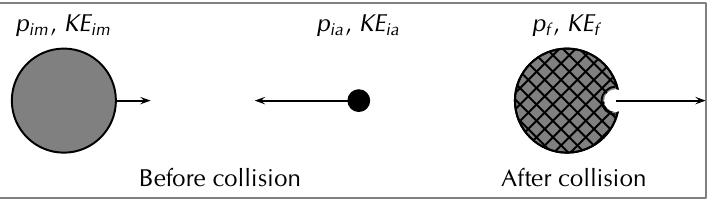
In inelastic collisions, some kinetic energy is transformed into other forms of energy such as:
- Heat energy
- Sound energy
- Energy used to deform the objects
Important
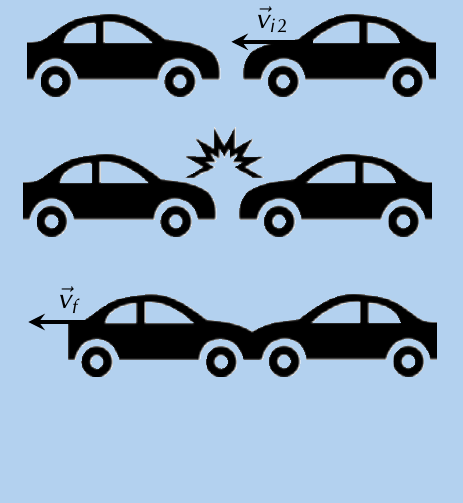
The most extreme case is a perfectly inelastic collision where the objects stick together after collision and move with the same final velocity.
For inelastic collisions:
- Momentum is conserved:
- Kinetic energy is NOT conserved:
Solving collision problems
Follow this systematic approach when solving collision problems:
Note
Problem-Solving Steps:
Step 1: Analyse what you are given
- Identify masses of all objects
- Identify initial velocities
- Determine what you need to find
- Establish whether the collision is elastic or inelastic
Step 2: Choose a frame of reference
- Pick a positive direction (usually left or right)
- Assign positive and negative signs to velocities accordingly
Step 3: Apply conservation of momentum
Step 4: For elastic collisions, also apply conservation of energy
Worked examples
Example
Worked Example 1: Head-on collision (conservation of momentum)
A toy car of mass 1 kg moves westwards at 2 m·s. It collides head-on with a toy train of mass 1.5 kg moving eastwards at 1.5 m·s. After collision, the car rebounds at 2.05 m·s eastwards. Calculate the final velocity of the train.
Solution:
Step 1: Choose east as positive direction
- kg (train), m·s
- kg (car), m·s
- m·s
- Find:
Step 2: Apply conservation of momentum
The train moves at 1.2 m·s westwards after collision.
Example
Worked Example 2: Bullet through block
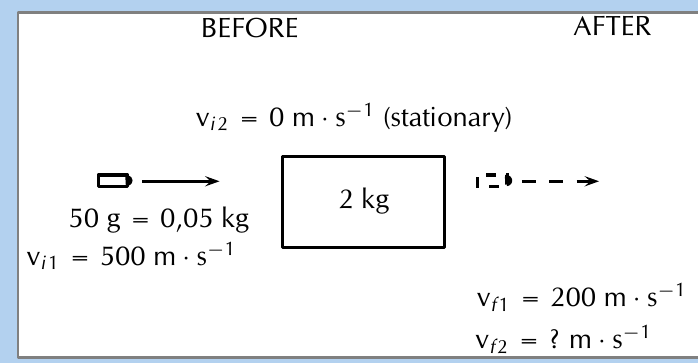
A bullet of mass 50 g travels at 500 m·s and strikes a stationary wooden block of mass 2 kg. The bullet passes through and exits at 200 m·s. Calculate the final velocity of the block.
Solution:
Step 1: Choose rightward as positive
- kg (bullet), m·s
- kg (block), m·s
- m·s
- Find:
Step 2: Apply conservation of momentum
The block moves at 7.5 m·s in the same direction as the bullet.
Example
Worked Example 3: Elastic collision between pool balls
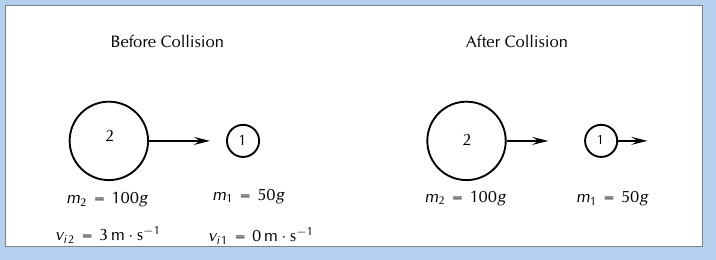
Two pool balls collide elastically. Ball 1 (mass 0.3 kg) is initially at rest. Ball 2 (mass 0.3 kg) approaches at 2 m·s. After collision, ball 2 comes to rest. Find the final velocity of ball 1.
Solution:
Since the collision is elastic and the masses are equal, when one ball stops completely, the other takes on its initial velocity.
Using conservation of momentum:
Ball 1 moves at 2 m·s in the original direction of ball 2.
Example
Worked Example 4: Perfectly inelastic collision
Two cars collide and stick together. Car 1 (500 kg) is stationary, car 2 (500 kg) approaches at 2 m·s. Find their common velocity after collision.
Solution:
In a perfectly inelastic collision, both objects move together with the same final velocity.
Both cars move together at 1 m·s after collision.
Exam tips
Note
Essential Exam Strategies:
- Always define your positive direction clearly
- Check units and convert to SI if necessary
- Remember that momentum is a vector quantity - direction matters
- For elastic collisions, you have two equations to work with
- For inelastic collisions, use only momentum conservation
- Draw diagrams showing before and after collision scenarios
Summary
Key Points to Remember:
-
Conservation of momentum applies to ALL collisions: or
-
Elastic collisions conserve both momentum and kinetic energy - objects typically bounce apart cleanly
-
Inelastic collisions conserve only momentum - some kinetic energy transforms to other energy forms like heat and sound
-
Always choose and state your positive direction before starting calculations to avoid sign errors
-
In perfectly inelastic collisions, objects stick together and move with the same final velocity