Impulse (Grade 12 NSC Matric Physical Sciences): Revision Notes
📚Revision Notes
Impulse
What is impulse?
When a net force acts on a body, it causes acceleration and changes the object's motion. The effect depends on both the size of the force and how long it acts. A large net force creates bigger acceleration than a small net force. However, the total change in motion can be the same whether you apply a large force briefly or a smaller force for longer. This combination of force and time gives us the concept of impulse.
Note
Impulse is the product of the net force acting on an object and the time interval during which the force acts.
The formula for impulse is:
Where:
- = net force (in Newtons, N)
- = time interval (in seconds, s)
- Impulse is measured in Newton-seconds (N·s) or kilogramme metres per second (kg·m·s)
Connection to Newton's second law
From Newton's Second Law, we know that:
Rearranging this equation:
This tells us something important: Impulse equals the change in momentum of an object.
The impulse-momentum theorem
This relationship gives us the impulse-momentum theorem:
Important
This theorem shows that impulse and change in momentum are equivalent. For a given change in momentum, if the net force is large, the time interval must be small. Conversely, if the net force is small, the time interval must be large to achieve the same change in momentum.
This principle explains why:
- Car airbags inflate to increase collision time and reduce force
- Cricket players "give" with the ball when catching to extend contact time
- Trampolines have springs to increase the time taken to stop a jumper
Force-time graphs and impulse
Force-time graphs show how force varies with time. The area under a force-time curve represents the impulse delivered to the object.
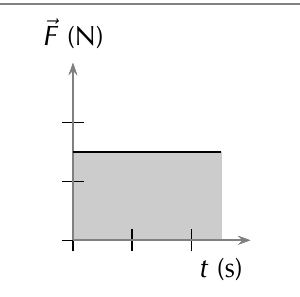
For a rectangular force profile (constant force), the impulse equals the area of the rectangle: Force × time.
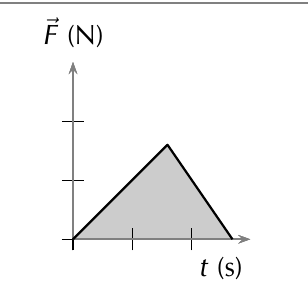
For a triangular force profile (linearly varying force), the impulse equals the area of the triangle:
Calculating impulse from complex graphs
Note
For more complex force-time graphs, you can calculate impulse by:
- Dividing the graph into simple geometric shapes (rectangles, triangles)
- Calculating the area of each shape
- Adding areas above the time axis (positive impulse)
- Subtracting areas below the time axis (negative impulse)
Worked example 1: Impulse and momentum change
Example
Worked Example: Impulse and Momentum Change
Question: A 150 N resultant force acts on a 300 kg trailer. Calculate how long it takes this force to change the trailer's velocity from 2 m·s to 6 m·s in the same direction.
Solution:
Step 1: Identify given information
- Mass: kg
- Initial velocity:
- Final velocity:
- Net force: N
Step 2: Choose positive direction
Let rightward be positive.
Step 3: Apply impulse-momentum theorem
Step 4: Calculate
Answer: It takes 8 seconds for the force to change the trailer's velocity.
Worked example 2: Cricket ball impulse
Example
Worked Example: Cricket Ball Impulse
Question: A cricket ball weighing 156 g moves at 54 km·h towards a batsman. The batsman hits it back towards the bowler at 36 km·h. Calculate:
- The ball's impulse
- The average force if contact time is 0.13 s
Solution:
Step 1: Convert units
- Mass: 156 g = 0.156 kg
- Initial velocity: 54 km·h = 15 m·s
- Final velocity: 36 km·h = 10 m·s
Step 2: Choose positive direction
From batsman to bowler as positive.
- Initial velocity:
- Final velocity:
Step 3: Calculate change in momentum
Step 4: Find impulse
Impulse = in the direction from batsman to bowler
Step 5: Calculate average force
Answer: The impulse is 3.9 N·s towards the bowler, and the average force is 30 N.
Worked example 3: Force-time graph analysis
Example
Worked Example: Force-time Graph Analysis
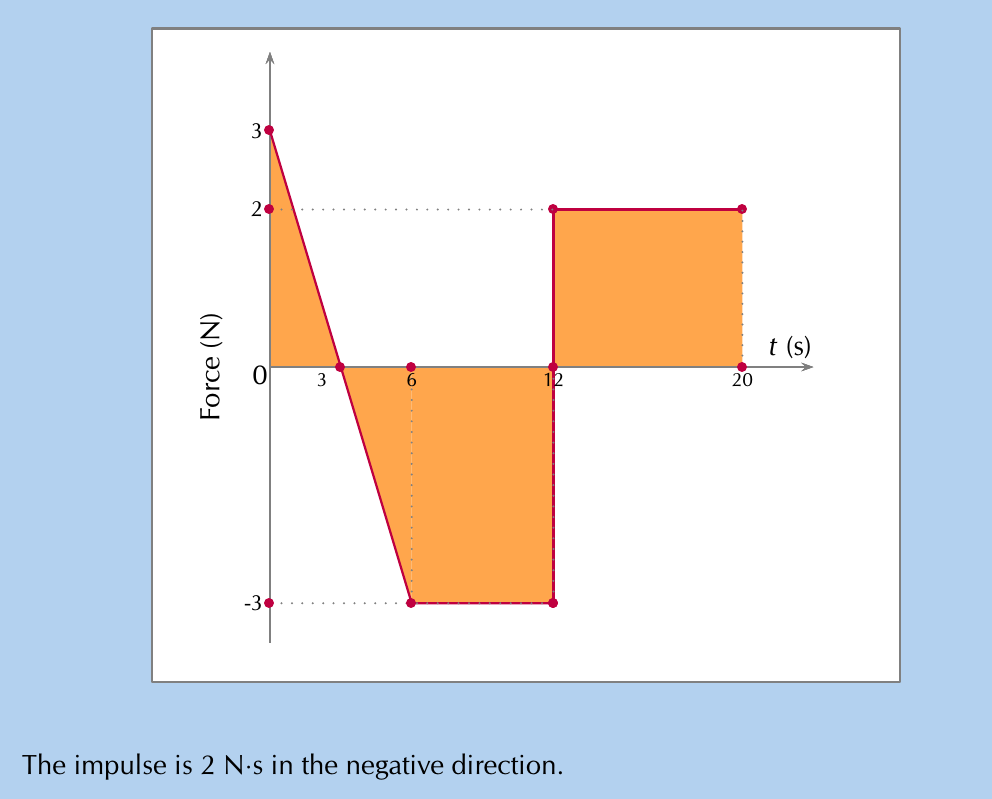
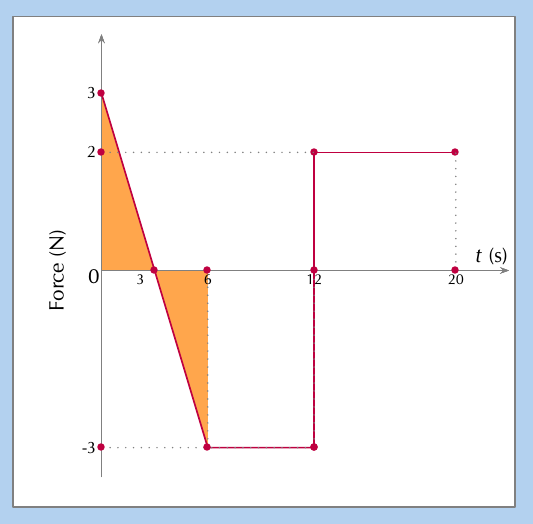
Question: Analyse the force-time graph and calculate the impulse for different time intervals.
Solution:
For interval 0 to 3 s (triangular area):
For interval 3 to 6 s (triangular area below axis):
For interval 6 to 12 s (rectangular area below axis):
For interval 12 to 20 s (rectangular area above axis):
Total impulse =
Exam tips and common mistakes
Important
Key exam strategies:
- Always state your chosen positive direction clearly
- Convert units consistently (especially mass from grammes to kilogrammes)
- When analysing graphs, identify areas carefully — positive above axis, negative below
- Remember that impulse and change in momentum are equivalent
- Show all working steps, especially unit conversions
Common mistakes to avoid:
- Forgetting to convert units (particularly mass and velocity)
- Not choosing a clear positive direction
- Confusing impulse with momentum (impulse is the change in momentum)
- Incorrectly calculating areas under force-time curves
- Missing negative signs when forces or velocities are in opposite directions
Summary
Summary
Key Points to Remember:
- Impulse equals force multiplied by time:
- Impulse equals change in momentum:
- Area under force-time graph gives impulse — positive areas above axis, negative below
- Large force acting briefly can equal small force acting for longer — same impulse, same momentum change
- Units of impulse are N·s or kg·m·s — both are equivalent