Momentum (Grade 12 NSC Matric Physical Sciences): Revision Notes
📚Revision Notes
Momentum
What is momentum?
Momentum is a fundamental concept in physics that describes the motion of objects. It is closely related to forces and represents a property that applies to all moving objects - essentially, it is mass in motion. When something has mass and is moving, it possesses momentum.
Note
Momentum helps us understand what happens when objects collide or interact with each other. The concept becomes particularly important when analysing crashes, sports impacts, and any situation where moving objects change their motion.
Definition and formula
Momentum is defined as a vector quantity that depends on both the mass and velocity of an object.
Important
Definition: The linear momentum of a particle or object is a vector quantity equal to the product of the mass of the object and its velocity.
The mathematical relationship is expressed as:
Where:
- = momentum (measured in )
- = mass (measured in )
- = velocity (measured in )
From this formula, we can see that momentum is directly proportional to both mass and velocity. This means:
- A small car travelling at the same velocity as a big truck will have smaller momentum than the truck
- If mass stays constant, the greater the velocity, the greater the momentum
- If velocity stays constant, the greater the mass, the greater the momentum
Vector nature of momentum
Since momentum equals mass multiplied by velocity, and mass is a scalar while velocity is a vector, momentum is always a vector quantity. This means momentum has both magnitude and direction.
Note
Key points about momentum as a vector:
- Momentum always points in the same direction as the velocity
- When calculating momentum, you must include the direction
- Different objects can have the same magnitude of momentum but in different directions
For example, a car travelling at will have larger momentum than the same car travelling at . Similarly, a heavy motorcycle travelling slowly can have the same momentum as a light car travelling relatively fast.
Worked examples
Example
Worked Example 1: Momentum of a soccer ball

Question: A soccer ball of mass 420 g is kicked at towards the goal post. Calculate the momentum of the ball.
Solution:
Step 1: Identify the given information
- Mass of ball: (convert to SI units)
- Velocity of ball: towards the goal post
Step 2: Apply the momentum formula
Step 3: State the final answer The momentum of the soccer ball is in the direction of the goal post.
Example
Worked Example 2: Momentum of a cricket ball

Question: A cricket ball of mass 160 g is bowled at towards a batsman. Calculate the momentum of the cricket ball.
Solution:
Step 1: Identify the given information
- Mass of ball:
- Velocity of ball: towards the batsman
Step 2: Apply the momentum formula
Step 3: State the final answer The momentum of the cricket ball is in the direction of the batsman.
Example
Worked Example 3: Momentum of the Moon

Question: The Moon has a mass of and orbits Earth at a distance of 384 400 km, completing one orbit in 27.3 days. Calculate the magnitude of the Moon's momentum.
Solution:
Step 1: Identify the given information
- Mass of Moon:
- Distance from Earth:
- Orbital period:
Step 2: Calculate the Moon's orbital velocity For circular motion:
Circumference
Velocity
Step 3: Calculate the momentum
The magnitude of the Moon's momentum is .
Change in momentum
When objects collide with other objects or barriers, their velocity often changes, which means their momentum changes too. Understanding how momentum changes is crucial for analysing collisions and interactions.
Important
The change in momentum is calculated as:
Where:
- = change in momentum
- = final momentum
- = initial momentum
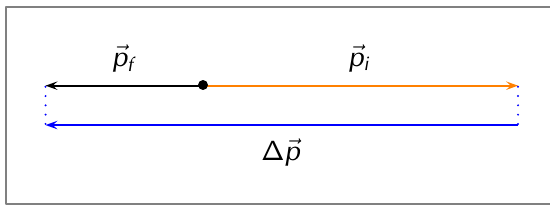
Case 1: Object bouncing off a wall
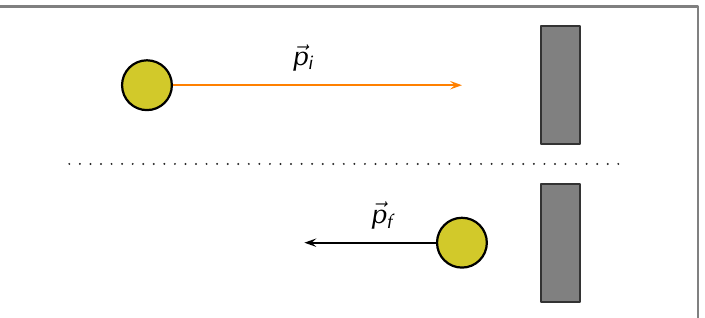
Consider a ball moving towards a wall with initial momentum pointing right.
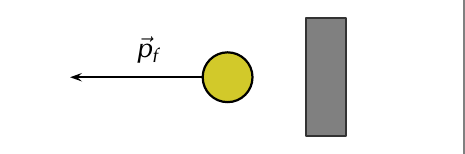
After bouncing, the ball moves away from the wall with final momentum pointing left.
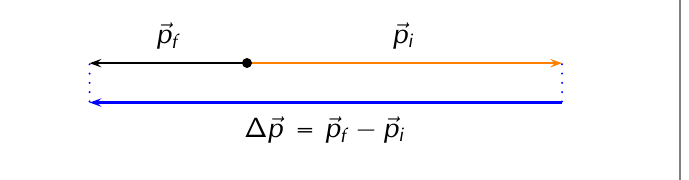
The change in momentum is the vector difference between final and initial momentum:
Note
Since the momentum vectors point in opposite directions, the change in momentum has a large magnitude even though the speeds might be similar.
Case 2: Object stops
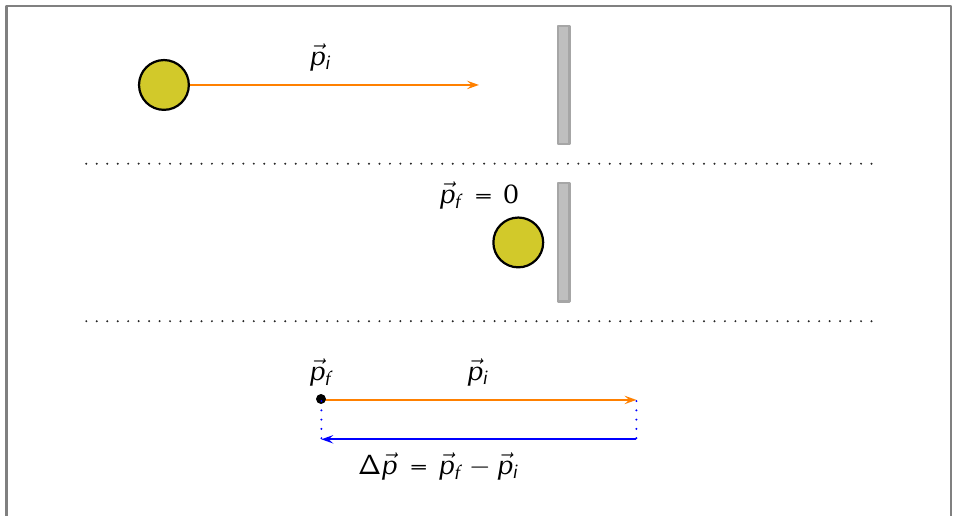
In some scenarios, an object may come to a complete stop (like a tennis ball hitting a net). When this happens:
- Initial momentum: (in original direction)
- Final momentum:
- Change in momentum:
Case 3: Object continues more slowly
Sometimes an object continues in the same direction but with reduced speed (like a ball hitting a glass window and going through, or sliding on a rough surface).
Note
In this case:
- Both initial and final momentum point in the same direction
- The magnitude of final momentum is less than initial momentum
- The change in momentum points opposite to the motion direction
Case 4: Object gets a boost
When an object interacts with something that increases its velocity without changing direction (like a squash ball bouncing off a back wall after being hit by a racquet):

- Both momenta point in the same direction
- Final momentum has greater magnitude than initial momentum
- Change in momentum points in the same direction as motion
Case 5: Vertical bounce

The same principles apply to vertical motion. When a basketball bounces off the floor:
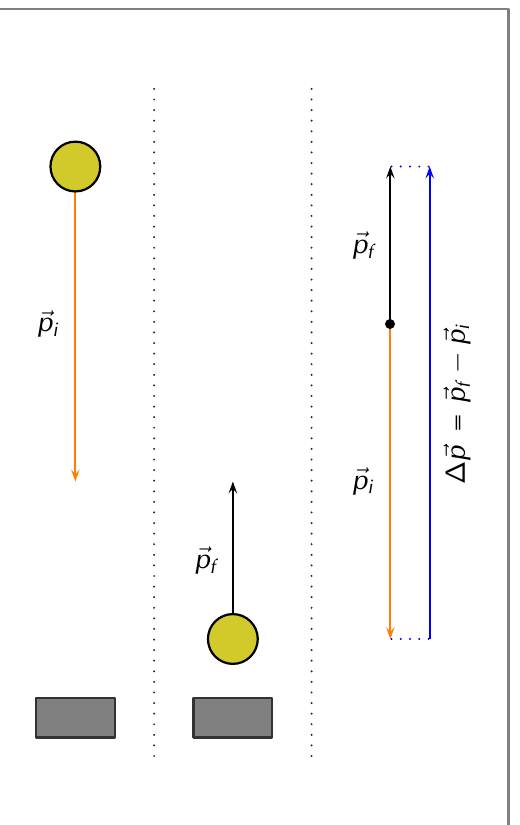
- Initial momentum points downward
- Final momentum points upward
- Change in momentum is large due to the direction change
Important
Important note: All these momentum change principles apply to motion in any direction - horizontal, vertical, or at any angle. The key is to always consider momentum as a vector quantity with both magnitude and direction.
Exam tips
Note
Essential exam strategies:
- Always convert masses to kilogrammes when using SI units
- Remember that momentum is a vector - include direction in your final answer
- For momentum change calculations, be careful with vector subtraction
- In collision problems, the direction of momentum change often tells you about the forces involved
- Practice identifying initial and final momentum vectors in different scenarios
Summary
Key Points to Remember:
- Momentum is mass times velocity:
- Momentum is always a vector - it has both size and direction
- Units of momentum are
- Change in momentum equals final momentum minus initial momentum:
- Direction matters - momentum change can be large even when speeds are similar if directions are opposite