Optical Phenomena and Properties of Matter (Grade 12 NSC Matric Physical Sciences): Revision Notes
📚Revision Notes
The Photoelectric Effect
Introduction and historical background
The photoelectric effect was one of the most important discoveries in physics that helped establish the quantum nature of light. Around the turn of the twentieth century, physicists including Heinrich Hertz, Philipp Lenard, and others observed that when light was shone onto a metal plate, electrons were emitted by the metal.
In 1887, Heinrich Hertz noticed that ultraviolet light incident on a metal plate could cause sparks. This was puzzling because metals are good conductors of electricity, so electrons should be able to move easily. Scientists expected that different metals would require different minimum frequencies of light to release electrons.
The initial expectation was that electrons would be emitted for any frequency of light after a delay, during which the electrons absorbed sufficient energy to escape from the metal surface. Scientists thought that higher intensity light would lead to shorter delays and higher electron velocities, based on the idea that light was a wave continuously delivering energy to the electrons.
Note
However, the observations did not match these expectations, creating a paradox that classical physics could not explain. This contradiction between wave theory predictions and experimental observations became one of the key pieces of evidence for the quantum nature of light.
Definition of the photoelectric effect
The photoelectric effect is the process whereby an electron is emitted by a substance when light shines on it.
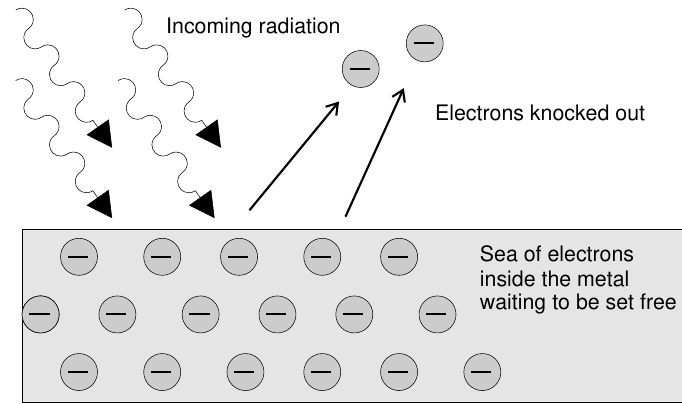
This phenomenon occurs when electromagnetic radiation strikes a metal surface containing a "sea of electrons." When the incoming radiation has sufficient energy, it knocks electrons out of the metal surface.
Key observations that puzzled scientists
Philipp Lenard made a crucial discovery in 1902: the maximum velocity of electrons ejected by ultraviolet light was entirely independent of the intensity of light.
Additionally, different metals required different minimum frequencies of light to eject electrons, regardless of the light's intensity.
Important
The experimental demonstration shows that red light incident on a zinc plate causes no change in the electroscope, even if the intensity is increased. However, ultraviolet light of low intensity causes the electroscope leaf to collapse.
Einstein's quantum explanation
Albert Einstein proposed that light is made up of packets of energy called quanta (now called photons).
Work function concept
The work function is the minimum energy needed to knock an electron out of a metal. It is represented by the symbol W₀.
Important
Where:
- = work function (J)
- = Planck's constant
- = threshold frequency (Hz)
The photoelectric equation
Important
Where:
- = photon energy =
- = work function
- = maximum kinetic energy
Note
Below the threshold frequency (), no emission occurs regardless of intensity.
Worked example 1: Maximum kinetic energy calculation
Example
Question: Ultraviolet radiation with wavelength 250 nm is incident on silver foil ( J).
Worked example 2: Threshold frequency analysis
Example
Worked example 3: NSC exam-style question
Example
Using :
Exam tips and common traps
Important
Make sure you can rearrange:
Summary
Key Points to Remember:
- Threshold frequency =
- Work function =
- Photon energy =