Equations of Motion (Grade 12 NSC Matric Physical Sciences): Revision Notes
📚Revision Notes
Equations of Motion
Understanding vertical projectile motion equations
Vertical projectile motion follows the same mathematical principles as the rectilinear motion you studied in Grade 10. The key difference is that we're dealing with motion in a straight vertical line where the only acceleration acting on the object is gravitational acceleration ().
Note
The beauty of physics is that the equations you learned for rectilinear motion in Grade 10 can be directly applied to vertical projectile motion. We simply replace the general acceleration () with gravitational acceleration ().
When an object moves vertically under the influence of gravity alone, we can use the familiar equations of motion by simply replacing the general acceleration () with gravitational acceleration ().
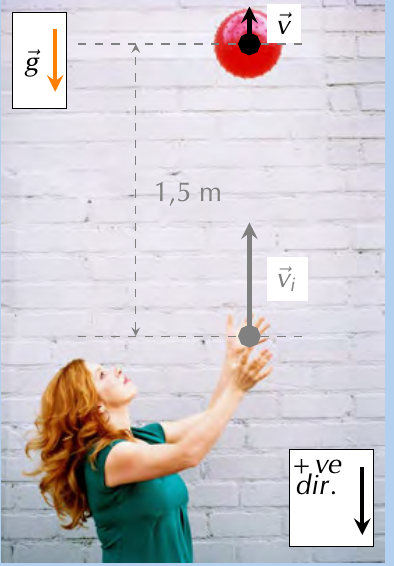
The four equations of motion
For vertical projectile motion, we use these four fundamental equations:
Equation 1:
- Links final velocity, initial velocity, acceleration and time
Equation 2:
- Links displacement, average velocity and time
Equation 3:
- Links displacement, initial velocity, acceleration and time
Equation 4:
- Links velocities, acceleration and displacement (time-independent)
Important
Choosing the Right Equation
Always select the equation that contains the fewest unknowns. This makes your calculations much simpler and reduces the chance of errors. If time is not given or needed, Equation 4 is often your best choice.
Key variables and definitions
- = initial velocity () at the start of motion
- = final velocity () at time
- = change in vertical position or displacement (m)
- = time elapsed (s)
- = acceleration due to gravity = (always acts downward)
Important considerations for problem solving
Sign conventions
Important
Always choose a positive direction at the start and maintain this convention throughout your solution. Consistency is crucial for getting the right answer.
Most students find it helpful to choose either:
- Upward as positive ()
- Downward as positive ()
Displacement vs position
Note
Remember that represents displacement (change in position), not the actual position. If your coordinate system isn't centred at the starting point, you need to account for this in your calculations.
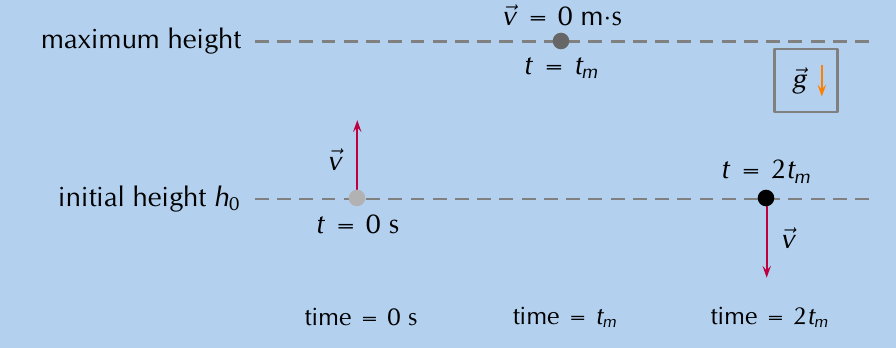
At maximum height
At the highest point of any vertical projectile's path, the velocity is always zero (). This is a crucial concept for solving maximum height problems and serves as an excellent checkpoint for your calculations.
Worked example 1: Finding maximum height
Example
Worked Example: Finding Maximum Height
Question: A ball is thrown vertically upwards with an initial velocity of 10 m·s. Determine the maximum height above the thrower's hand reached by the ball.
Solution:
Step 1: Choose sign convention and identify known values
- Choose upward as positive direction
- (upward)
- (at maximum height)
- (downward, so negative)
- (what we need to find)
Step 2: Select appropriate equation
Use (since we don't need time)
Step 3: Substitute and solve
Answer: The ball reaches a maximum height of 5.10 m above the thrower's hand.
Worked example 2: Time of flight calculation
Example
Worked Example: Time of Flight Calculation
Question: A cricketer hits a cricket ball vertically upwards. If the ball takes 10 s to return to the initial height, determine its maximum height above the initial position.
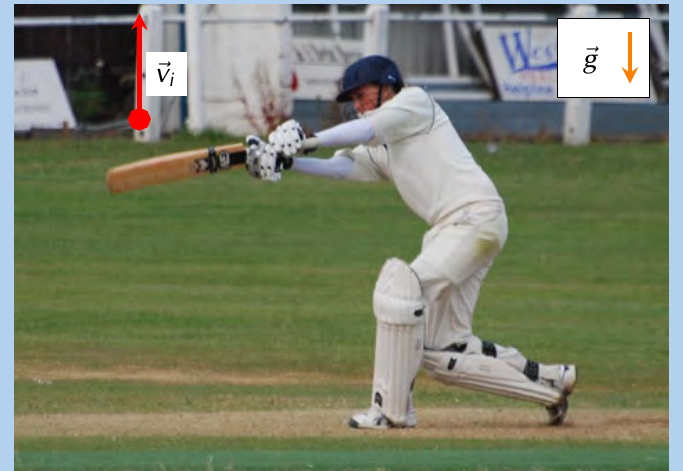
Solution:
Step 1: Understand the motion
The total flight time is 10 s, so time to reach maximum height is 5 s (due to symmetry).
Step 2: Identify known values
- Choose downward as positive
- (time to reach maximum height)
- (velocity at maximum height)
- (downward positive)
Step 3: Find initial velocity
(negative because upward motion)
Step 4: Find maximum height
Since displacement is negative (upward motion), the height is 122.5 m.
Answer: The maximum height is 122.5 m above the initial position.
Worked example 3: Multiple projectile problem
Example
Worked Example: Multiple Projectile Problem
Question: Balls are dropped from a tower at equal time intervals. When the ninth ball is released, the first ball hits the ground. Which ball is at 1/4 of the tower height when the first ball hits the ground?
Solution:
Step 1: Set up the problem mathematically
- Let the time interval between drops =
- Total time for first ball to fall = (since 9 balls released)
- Choose downward as positive direction
Step 2: Find tower height
For the first ball:
Since :
Step 3: Find which ball is at 1/4 height
The th ball falls for time and travels distance:
Setting this equal to 1/4 of tower height and solving:
Through algebraic manipulation:
Answer: The fifth ball is at 1/4 of the tower height when the first ball hits the ground.
Summary
Summary
Key Points to Remember:
- Choose a sign convention at the start and stick to it throughout the entire problem
- At maximum height, velocity is always zero — use this fact to solve height problems
- Gravitational acceleration is constant at and always acts downward
- Displacement () is not the same as position — be careful with your coordinate system
- Use the equation that contains the fewest unknowns to make solving easier