Motion in a Gravitational Field (Grade 12 NSC Matric Physical Sciences): Revision Notes
📚Revision Notes
Motion in a Gravitational Field
What is vertical projectile motion?
Vertical projectile motion occurs when objects are thrown, shot or dropped directly upward, downward, or when objects fall under gravity alone. This type of motion is something we observe daily - from dropping a ball to throwing something into the air.
Note
A projectile is defined as any body or particle that is launched and then moves under the influence of only gravity. The key point here is that once the object is in motion, gravity is the only force acting on it (we ignore air resistance in these calculations).
Understanding motion in Earth's gravitational field
According to Newton's Law of Universal Gravitation, any object in Earth's gravitational field experiences a force that pulls it towards the centre of the Earth. This creates a constant gravitational acceleration that we represent with the symbol g.
Note
Key facts about gravitational acceleration:
- g = 9.8 m⋅s⁻² (this value is constant for everyday problems)
- Gravity always acts downward towards Earth's centre
- The direction of gravity never changes, regardless of whether an object moves up or down
- In reality, g varies slightly with distance from Earth, but we treat it as constant for calculations

Important
The diagram shows an important principle: whether an object moves upward or downward, the gravitational acceleration g always points towards Earth's centre. This means that objects moving upward experience a downward acceleration, while objects moving downward also experience the same downward acceleration.
Characteristics of vertical projectile motion
Initial velocity vs gravitational acceleration
It's crucial to understand that initial velocity () and gravitational acceleration () are completely different quantities:
- Initial velocity depends on how the object was launched
- Gravitational acceleration is always constant at 9.8 m⋅s⁻² downward
The journey of a projectile
When an object is thrown upward with initial velocity, it follows a predictable pattern that demonstrates the constant influence of gravity throughout its motion.
Example
Worked Example: Motion of a Ball Thrown Upward
When an object is thrown upward with initial velocity:
Step 1: It starts with maximum upward velocity
Step 2: Gravity gradually reduces this upward velocity
Step 3: At maximum height, the velocity becomes zero ( m⋅s⁻¹)
Step 4: The object then begins falling downward
Step 5: Gravity accelerates it downward, increasing its speed
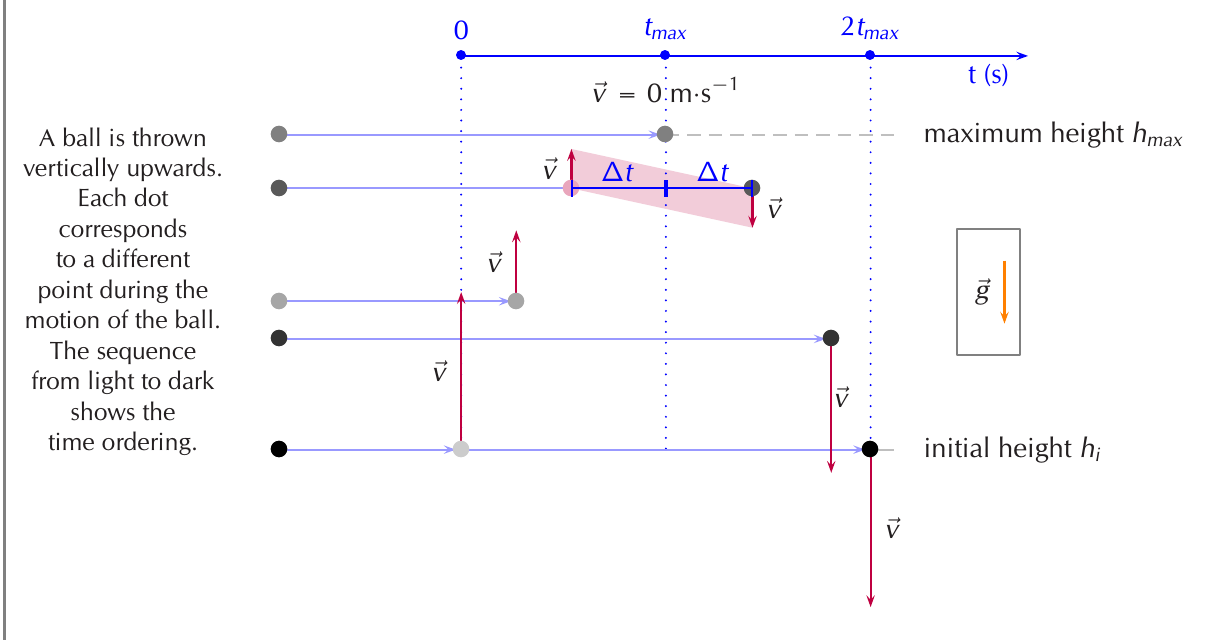
This diagram illustrates the complete motion of a ball thrown upward. Notice how:
- The velocity vectors (red arrows) show the changing speed and direction
- At maximum height (), the velocity is zero
- The motion is symmetric around the maximum height point
Time symmetry in projectile motion
One of the most useful principles in vertical projectile motion is time symmetry. This fundamental concept greatly simplifies calculations and provides insight into the nature of gravitational motion.
Important
Time to reach maximum height = Time to fall back to original position
This symmetry has two important implications:
Time intervals: The time taken to rise from initial position to maximum height equals the time taken to fall from maximum height back to the initial position
Magnitude of velocity: The magnitude (size) of velocity at corresponding points during upward and downward motion is the same. However, the direction is opposite (upward vs downward)
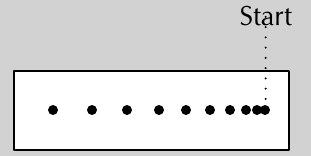
This simple diagram shows how an object's motion changes over time - starting slowly spaced (slow motion) and becoming more densely packed (faster motion) as gravity accelerates the object.
Applying equations of motion
The equations of rectilinear motion from Grade 10 can be directly applied to vertical projectile motion because:
- Motion occurs in a straight line (vertical direction only)
- Acceleration is constant ( m⋅s⁻²)
- We can treat this as one-dimensional motion
Important
Important reminders for calculations:
- Always choose a consistent positive direction (usually upward is positive)
- Remember that m⋅s⁻² if upward is positive (since gravity acts downward)
- Use vector concepts - magnitude and direction both matter
- Initial velocity and acceleration are independent quantities
Key equations to remember:
The fundamental kinematic equations for vertical projectile motion are:
- Final velocity:
- Displacement:
- Velocity-displacement relationship:
Exam tips for vertical projectile motion
Understanding common pitfalls and developing a systematic approach to problem-solving will significantly improve your performance on vertical projectile motion questions.
Note
Common exam traps to avoid:
- Don't confuse initial velocity with gravitational acceleration
- Remember that at maximum height, velocity = 0, but acceleration is still g
- Use time symmetry to solve complex problems more easily
- Always define your positive direction clearly
- Check that your final answers make physical sense
Example
Worked Example: Problem-solving strategy
Step 1: Identify what type of motion is occurring
Step 2: Choose your positive direction
Step 3: List known values and what you need to find
Step 4: Select the most appropriate equation
Step 5: Substitute values carefully, watching signs
Step 6: Check your answer makes sense
Summary
Key Points to Remember:
-
Projectile motion involves objects moving under gravity alone, with constant acceleration m⋅s⁻² downward
-
Time symmetry means the time to reach maximum height equals the time to return to the starting position
-
Gravitational acceleration is always constant and always points towards Earth's centre, regardless of the object's motion direction
-
At maximum height, velocity equals zero but acceleration is still (the object is still being pulled by gravity)
-
Kinematic equations from Grade 10 apply directly to vertical projectile motion since it's motion in a straight line with constant acceleration