Work, Energy, and Power (Grade 12 NSC Matric Physical Sciences): Revision Notes
📚Revision Notes
Conservation of Energy
What is a conservative force?
A conservative force is a special type of force where the work done depends only on where you start and where you finish - not on the path you take to get there. This is a fundamental concept that helps us understand how energy behaves in physical systems.
The most important example of a conservative force is gravity. Whether you walk up a mountain via a gentle winding path or climb straight up a cliff face, gravity does exactly the same amount of work on you. The only thing that matters is the change in height.
When a conservative force acts on an object, we can define something called potential energy for that force. The work done by a conservative force is always equal to the negative change in potential energy:
Note
This relationship tells us that when a conservative force does positive work on an object, the potential energy decreases by the same amount. When it does negative work, the potential energy increases.
Understanding work done by gravity on slopes
Let's examine how gravity works when objects move along different inclined surfaces. Consider pushing a ball up several slopes of different angles, all reaching the same height .
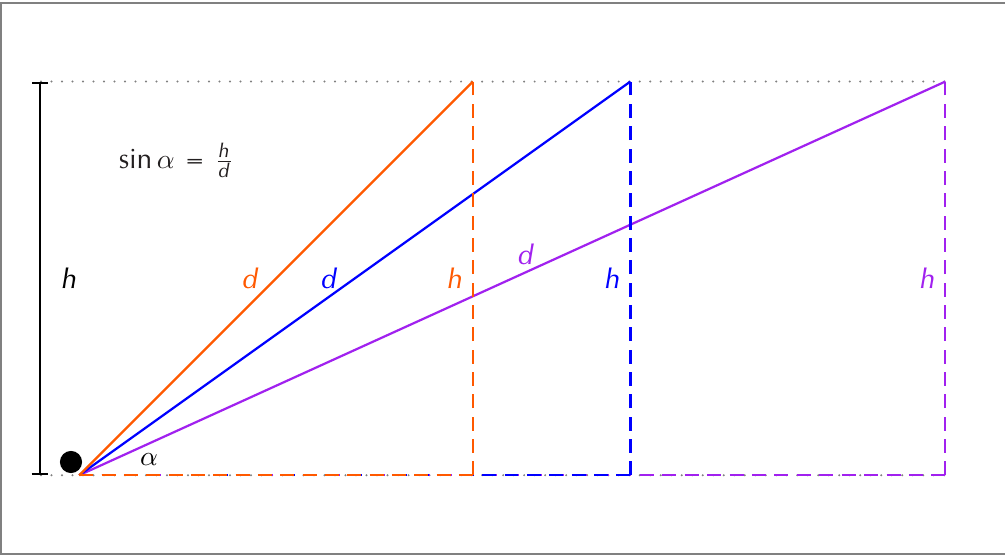
The diagram shows three different slopes with the same vertical height. Using trigonometry, we can see that for each slope, where is the length of the slope and is the angle.
When analysing forces on an inclined plane, we need to consider the components of gravitational force:
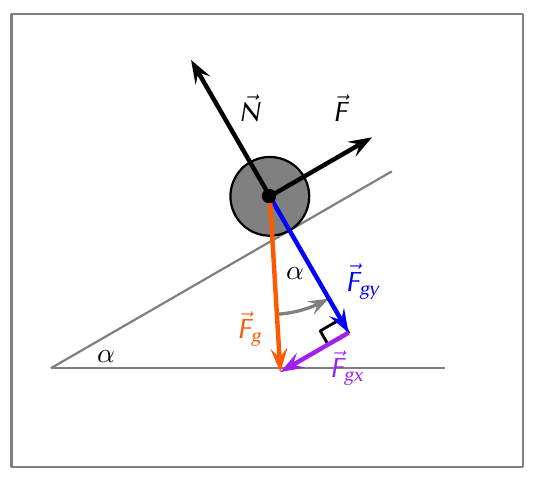
The component of gravitational force parallel to the slope is . When we push an object up the slope against gravity, the work done by gravity is:
Important
This final result is independent of the slope angle! This proves that gravity is indeed a conservative force - the work depends only on the height change , not on which path we take.
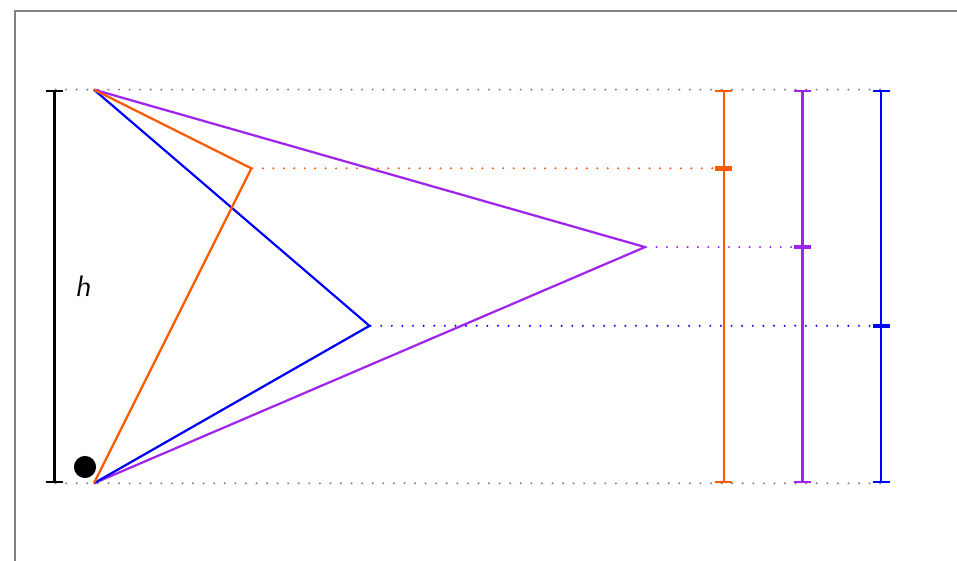
This diagram illustrates how different paths between the same two points result in the same work done by conservative forces.
What is a non-conservative force?
A non-conservative force is one where the work done depends on the specific path taken by the object. The most common example is friction.
Unlike conservative forces, non-conservative forces cannot have potential energy defined for them. When non-conservative forces do work, mechanical energy is typically converted to other forms like thermal energy, which cannot be easily recovered.
Important
Important note: Non-conservative forces do not mean that total energy is not conserved. Energy is always conserved in the universe! However, these forces mean that mechanical energy (kinetic + potential) is not conserved within the system being studied.
Effects of friction
Note
Friction is the classic example of a non-conservative force. When friction acts:
- Energy is removed from the mechanical system
- The "lost" mechanical energy is converted to thermal energy
- The amount of work done depends on the distance travelled, not just start and end points

This image shows a real example of friction in action - a football player sliding on grass, where friction gradually slows down the motion.
Work-energy theorem with non-conservative forces
When both conservative and non-conservative forces act on an object, we can derive a powerful relationship. The total work done by all forces equals the change in kinetic energy:
Since , we can substitute:
Rearranging this equation gives us:
This is the work-energy theorem for systems with non-conservative forces. It tells us that the work done by non-conservative forces equals the change in total mechanical energy of the system.
Note
Interpreting the work-energy theorem
- When non-conservative forces oppose motion (like friction), is negative, and mechanical energy decreases
- When non-conservative forces assist motion, is positive, and mechanical energy increases
- If no non-conservative forces act (), then mechanical energy is conserved
Example
Worked Example 1: Sliding Footballer
Question: A 65.0 kg football player slides to a stop on level ground. His initial speed is 6.00 m·s⁻¹ and the force of friction against him is a constant 450 N. Calculate the distance he slides.
Solution:
Step 1: Analyse the problem
- Friction converts the player's kinetic energy to thermal energy
- Using the work-energy theorem:
- Since motion is on level ground,
- Friction opposes motion, so and
Step 2: Apply conservation of energy Starting with:
Substituting values:
Solving for distance:
Step 3: Final answer The footballer slides 2.60 m before stopping.
Example
Worked Example 2: Sliding Up a Slope
Question: The same 65.0 kg footballer running at 6.00 m·s⁻¹ slides up an inclined embankment at 5°. The friction force is still 450 N. How far does he slide up the slope?
Solution:
Step 1: Analyse the problem
- Now both friction and gravity oppose the motion
- Height gained: , where is distance along slope
- Both kinetic and potential energy change
Step 2: Apply the work-energy theorem
We know:
- Work done by friction:
- Initial kinetic energy:
- Final kinetic energy:
- Initial potential energy:
- Final potential energy:
Substituting:
Solving for :
Step 3: Final answer The player slides 2.31 m up the slope before stopping.
Summary
Key Points to Remember:
-
Conservative forces do work that depends only on starting and ending positions - the path doesn't matter. Gravity is the most important example.
-
Non-conservative forces do work that depends on the path taken. Friction is the classic example, always opposing motion.
-
Mechanical energy is conserved only when no non-conservative forces act. When friction is present, mechanical energy decreases.
-
The work-energy theorem relates work done by non-conservative forces to changes in total mechanical energy: .
-
Energy is always conserved in the universe - non-conservative forces simply convert mechanical energy into other forms like thermal energy that cannot be easily recovered.