Mutually Exclusive Events (HSC SSCE Mathematics Advanced): Revision Notes
📚Revision Notes
Mutually Exclusive Events
What are mutually exclusive events?
Mutually exclusive events are two events that cannot happen at the same time in the same chance experiment. When one event occurs, the other cannot possibly occur in that same trial.
For example, when a fair coin is tossed twice, the events 'getting two heads (HH)' and 'getting two tails (TT)' cannot occur at the same time. These events are mutually exclusive.
When two events and are mutually exclusive, they have no outcomes in common. Mathematically, we write this as:
This means the intersection of events and is the empty set (contains no elements).
Note
The symbol represents the empty set, which contains no elements at all. When , it means there are absolutely no outcomes that belong to both events simultaneously.
Venn diagram representation
In a Venn diagram, mutually exclusive events are shown as separate circles that do not overlap within the sample space .
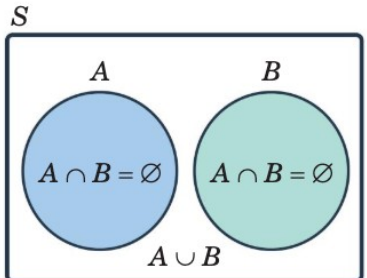
This Venn diagram illustrates mutually exclusive events and . Notice that:
- The two circles do not touch or overlap
- The intersection (empty set)
- The union includes all outcomes from both events
- Each circle sits within the universal set (the sample space)
Important
If , then the events are not mutually exclusive because they share at least one common outcome. In this case, the circles in a Venn diagram would overlap.
Understanding through examples
Card drawing example
Consider drawing a card from a standard deck of 52 cards. Let event be drawing a heart and event be drawing a spade.
Are these events mutually exclusive? Yes, because:
- A card cannot be both a heart and a spade simultaneously
- There are no cards that belong to both suits
- Therefore
This is an example of mutually exclusive events. If we instead defined event as drawing a face card, then and would not be mutually exclusive, since cards like the King of Hearts belong to both events.
Worked example 1: Identifying mutually exclusive events
Example
Worked Example: Identifying Mutually Exclusive Events with a Die
A fair six-sided die is rolled, with sample space .
Part a) Define event as rolling a number less than 3.
To find event , we identify all outcomes in that are less than 3.
Part b) Define event as rolling a number greater than 4. Show that and are mutually exclusive.
First, find event by identifying outcomes greater than 4:
Now check if :
Since the intersection is empty, events and have no common outcomes.
Therefore, and are mutually exclusive.
Part c) Find .
For mutually exclusive events, we can use the simplified addition rule:
First, calculate :
- and
Next, calculate :
- and
Now find :
Probability rules for events
Two important probability rules help us calculate the likelihood of events.
The complement rule
The complement rule states that the probability of an event not occurring is:
where:
- is the probability that event does not occur
- is the probability that event occurs
For example, if , then:
Note
The complement of an event includes all outcomes in the sample space that are not in . Since probabilities must sum to 1, we can find by subtracting from 1.
The addition rule
The addition rule for the union of two events is:
where:
- is the probability that or occurs
- is subtracted to avoid double-counting outcomes that appear in both events
Simplified addition rule for mutually exclusive events
For mutually exclusive events, because they share no common outcomes.
This simplifies the addition rule to:
Important
This is a key advantage when working with mutually exclusive events - we simply add the individual probabilities together without needing to adjust for overlap.
These rules can be visualised using Venn diagrams, where corresponds to the combined area of circles and , adjusted for any overlap.
Worked example 2: Applying probability rules
Example
Worked Example: Applying Complement and Addition Rules
A fair six-sided die is rolled, with sample space .
Part a) For event (even numbers), find .
Event consists of the even numbers on the die:
Calculate the probability:
- and
Part b) Find .
Use the complement rule , where from part (a).
Part c) Let be the numbers greater than 4. Find and .
Event consists of numbers greater than 4:
Calculate :
- and
Now find (outcomes in both and ):
So , and we can calculate:
Therefore, and .
Part d) Find .
Use the addition formula .
Convert to a common denominator of 6:
Summary
Key Points to Remember:
- Mutually exclusive events cannot occur simultaneously in the same experiment, so
- In Venn diagrams, mutually exclusive events are represented by non-overlapping circles within the sample space
- The complement rule is , giving the probability that event does not occur
- The addition rule is for any two events
- For mutually exclusive events, this simplifies to because