Investigation: Derive the Quadratic Formula (HSC SSCE Mathematics Advanced): Revision Notes
📚Revision Notes
Investigation: Derive the Quadratic Formula
This investigation explores a method for developing the quadratic formula through geometric visualization. We'll use the technique of completing the square to understand where the formula comes from and how it works.
Objectives
The main goals of this investigation are to:
- Develop the quadratic formula from first principles
- Find solutions to any quadratic equation in the form
A new way to solve quadratic equations
We will develop a method for solving quadratic equations using geometric reasoning. First, we'll work through a specific numerical example, then extend the method to create the general quadratic formula.
Working with a numerical example
Example
Worked Example: Solving by Completing the Square
Consider the quadratic equation:
We'll solve this equation by using the completing the square technique. While this equation could also be solved by factorising, we'll use completing the square with colour-coded geometric shapes to make the process clearer and more visual.
Step 1: Rearrange the equation
Starting with , move the constant term to the right-hand side:
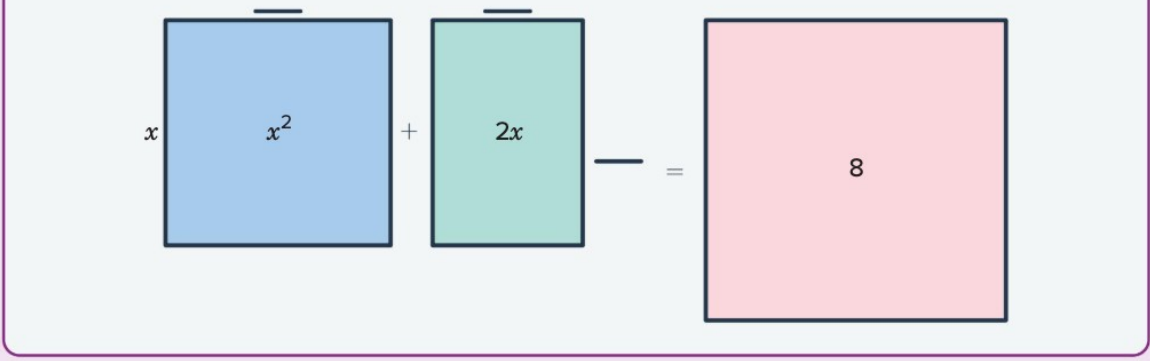
We can represent this equation visually using areas. Think of as the area of a square with side length units. The term represents a rectangle with side lengths units and units. Together, these equal a square with area square units.
Step 2: Split and rearrange the rectangle
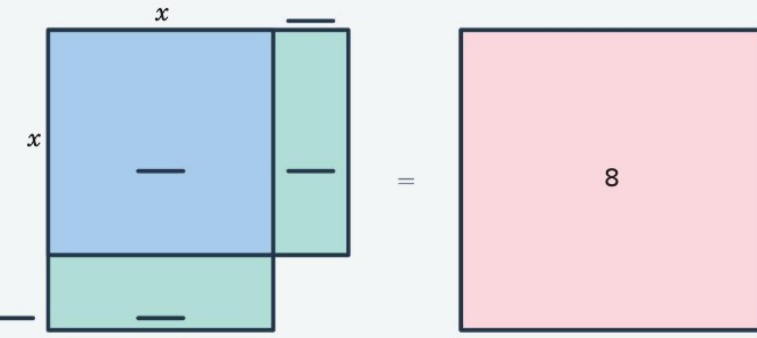
Divide the green rectangle into two equal parts and place one piece on each side of the blue square. This creates an L-shaped figure that still has the same total area.
Step 3: Complete the square
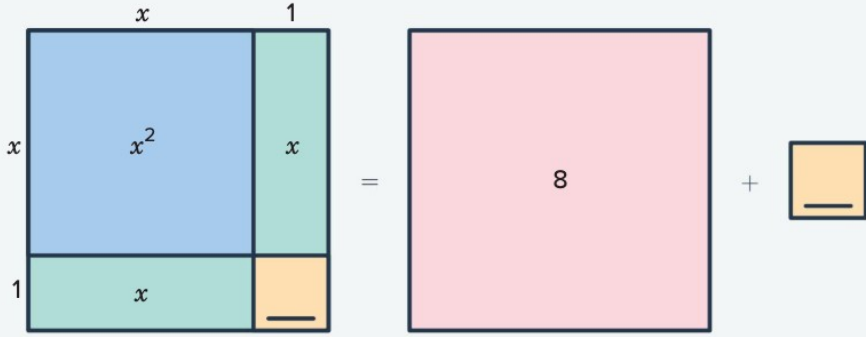
To create a perfect square on the left side, we need to add a small corner piece. When we add this corner square to the left side, we must also add it to the right side to keep the equation balanced.
The corner square has dimensions by , so its area is 1 square unit.
Step 4: Simplify and solve
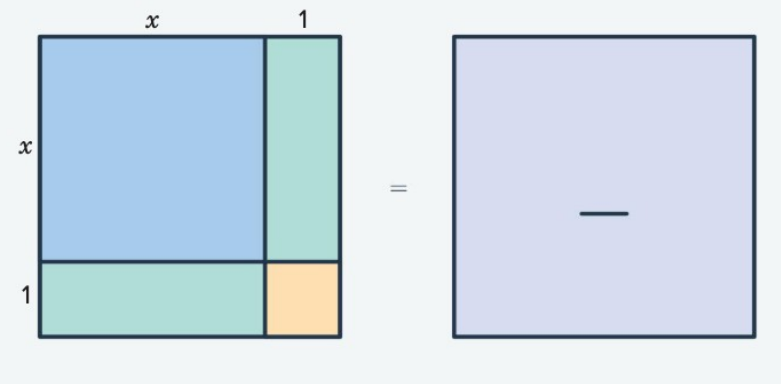
Now we can combine the terms on the right-hand side to form a single complete square:
Thus:
The side length units equals the side length of the grey square, which is units. Therefore:
For completeness, we must also consider the negative square root, giving us:
This gives us two solutions: x = 2 or x = -4.
Generalizing to derive the quadratic formula
Now we'll repeat this process using the general quadratic equation to develop the quadratic formula. Start with . First, divide every term by , then move the constant term to the right:
Note
We can represent this visually: a square with side length units plus a rectangle with side lengths units and units equals a square with area square units. This geometric representation helps us understand the algebraic process of completing the square.
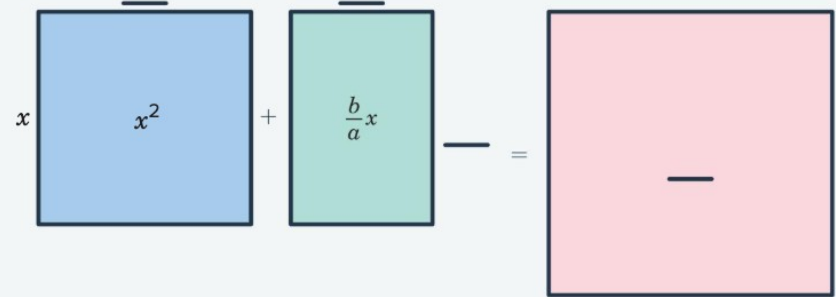
Following the same process
Step 1: Divide the green rectangle into two equal parts and place one on each side of the blue square.
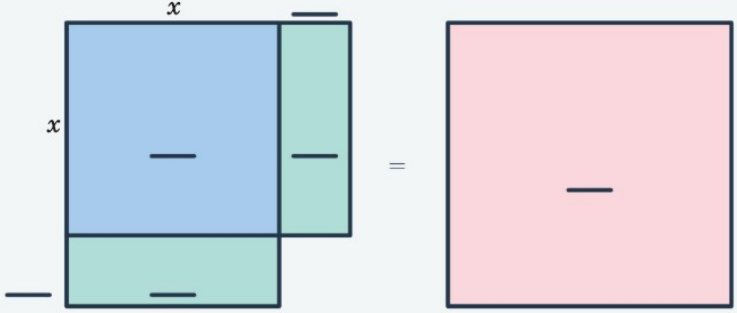
Step 2: Complete the square by adding the missing corner piece to both sides. The corner square has dimensions by , so its area is .
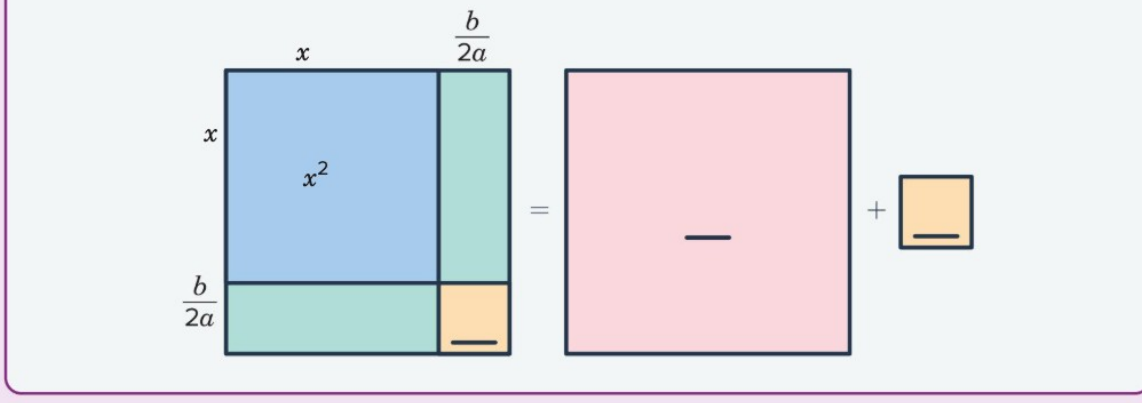
Step 3: Combine the right-hand side terms. The area of the new grey square is:
This is found by combining fractions using a common denominator.
Thus:
Algebraic rearrangement
To solve for , we need to rearrange this equation algebraically:
Step 1: Take the square root of both sides, remembering to include both positive and negative solutions:
Step 2: Simplify the fraction under the square root using :
Step 3: Isolate on the left side by subtracting from both sides:
Step 4: Combine into a single fraction:
The quadratic formula
Important
The Quadratic Formula
For any quadratic equation in the form , the solutions are:
This is the quadratic formula. It allows us to find solutions to any quadratic equation by substituting the values of , , and into this formula.
Note
Exam Tip
When using the quadratic formula:
- Always identify , , and carefully from your equation
- Remember that b and c can be negative
- The symbol means you'll get two solutions (or one repeated solution)
- The expression is called the discriminant and tells you about the nature of the solutions
Summary
Key Points to Remember:
- The quadratic formula is derived by completing the square on the general quadratic equation
- Completing the square can be visualized geometrically by representing terms as areas of squares and rectangles
- The formula works for any quadratic equation in standard form
- The geometric method helps us understand why we need to add when completing the square
- The symbol in the formula gives us both solutions to the quadratic equation