The Discriminant (HSC SSCE Mathematics Advanced): Revision Notes
📚Revision Notes
The Discriminant
What is the discriminant?
The discriminant is a powerful mathematical tool that helps us understand the nature and number of roots (solutions) of a quadratic equation without actually solving it. For any quadratic equation in the standard form , the discriminant is given by:
The value of the discriminant tells us important information about the roots of the equation and provides insight into what the graph of the quadratic function will look like. This makes it an essential concept when working with quadratic equations.
Note
The symbol (Greek letter "delta") is commonly used to represent the discriminant. Think of it as a "detector" that reveals the hidden nature of the roots before you solve the equation!
Understanding what the discriminant tells us
The discriminant can have three types of values (positive, zero, or negative), and each tells us something different about the solutions to the quadratic equation.
Case 1: Positive discriminant ()
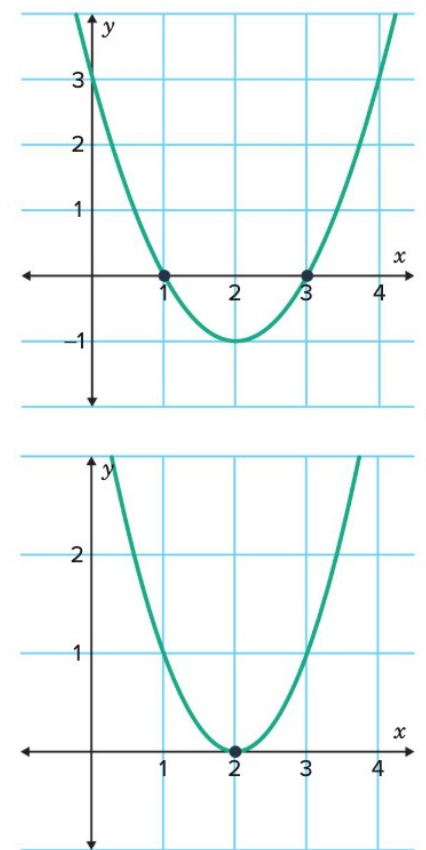
When the discriminant is greater than zero, the quadratic equation has two distinct real roots. This means the parabola crosses the x-axis at two separate points.
Important
An important additional detail: if the discriminant is a perfect square (like 4, 9, 16, 25, etc.), then the roots are rational numbers. If the discriminant is positive but not a perfect square (like 5, 7, 10, etc.), then the roots are irrational numbers.
Case 2: Zero discriminant ()
When the discriminant equals zero, the quadratic equation has one real root. This root is special because it's actually a repeated root (also called a double root or equal root). The parabola just touches the x-axis at exactly one point, which is the vertex of the parabola. We say this root has multiplicity 2 because it occurs twice in the factorised form.
Note
When , the quadratic expression can always be written as a perfect square trinomial, making factorising the most efficient solution method.
Case 3: Negative discriminant ()
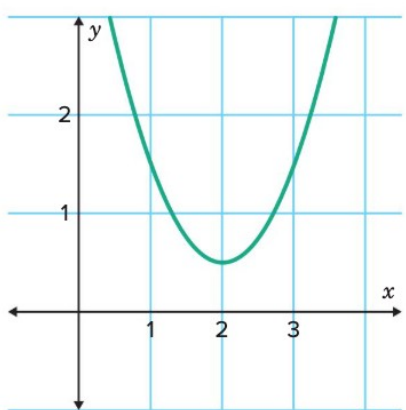
When the discriminant is less than zero, the quadratic equation has no real roots. This means the parabola does not intersect the x-axis at all - it either sits entirely above the x-axis (if the parabola opens upward) or entirely below it (if the parabola opens downward).
How to use the discriminant
The discriminant helps us choose the most efficient method for solving a quadratic equation. Here's a practical approach:
- Calculate the discriminant using
- Interpret the result to understand the nature of the roots
- Choose your solving method based on what you found:
- If , look for a perfect square trinomial
- If and is a perfect square, try factorising
- Otherwise, use the quadratic formula
Note
Strategic Approach: Always calculate the discriminant first! This simple calculation can save you time by directing you to the most efficient solution method and helping you avoid unnecessary work.
Worked examples
Example
Worked Example 1a: Equation with one repeated root
Question: Solve by first computing the discriminant.
Solution:
First, identify the coefficients: , ,
Calculate the discriminant:
Since , this equation has one real, repeated root. This means the equation can be written as a perfect square trinomial, making factorising the most efficient method.
Factorising the equation:
Answer: The solution is (a repeated root).
Note: We could verify this using the quadratic formula:
Example
Worked Example 1b: Equation with two distinct roots
Question: Solve by first computing the discriminant.
Solution:
First, identify the coefficients: , ,
Calculate the discriminant:
Since , which is a perfect square, this equation has two distinct, rational roots. Factorising will be an efficient method.
Factorising the equation:
Using the null factor law:
or
or
Answer: The solutions are and .
We can verify these solutions by substitution:
For :
- LHS = RHS ✓
For :
- LHS = RHS ✓
Example
Worked Example 2: Finding unknown values for equal roots
Question: Find if has equal roots.
Solution:
For a quadratic equation to have equal roots, the discriminant must equal zero.
First, identify the coefficients: , ,
Set up the discriminant formula:
For equal roots, set :
Using the null factor law:
or
or
Answer: The values of are or .
Exam tips
Note
Exam Strategy Tips:
- Always calculate the discriminant first to guide your choice of solution method
- Remember that often indicates a perfect square trinomial
- A positive discriminant that is also a perfect square suggests factorising will work well
- When verifying solutions, substitute them back into the original equation
- Watch for sign errors when squaring negative coefficients
Summary
Key Points to Remember:
- The discriminant formula is for the quadratic equation
- means two distinct real roots (rational if is a perfect square, irrational otherwise)
- means one real repeated root (also called a double root or equal roots with multiplicity 2)
- means no real roots (the parabola doesn't cross the x-axis)
- The discriminant helps you choose the most efficient solution method before you start solving