Derivatives as Rates of Change (HSC SSCE Mathematics Advanced): Revision Notes
📚Revision Notes
Derivatives as Rates of Change
Understanding the instantaneous rate of change
One of the most powerful applications of derivatives is understanding how quantities change at a specific moment in time. This concept is known as the instantaneous rate of change.
When we have a quantity that depends on a variable , written as , the derivative tells us the exact rate at which is changing with respect to at the precise point where .
Note
Instantaneous rate of change refers to the rate of change occurring at one particular moment. For a function that can be differentiated, the instantaneous rate of change at any point equals the derivative at that point. This value is also equal to the gradient of the tangent line touching the graph at that point.
This is fundamentally different from an average rate of change, which measures change over an interval. The average rate of change between two points is calculated using:
The instantaneous rate of change is what you get when you make that interval infinitesimally small, which is precisely what the derivative measures.
Applications to motion
Understanding rates of change becomes especially practical when studying motion. When an object moves along a straight path, we can describe its position as a function of time.
Displacement and velocity
Displacement represents the change in an object's position over a period of time, measured from its starting position. Displacement is a vector quantity, which means it has both magnitude and direction. The displacement can be positive (movement in the positive direction), negative (movement in the negative direction), or zero (no net change in position).
Velocity describes the rate of change of an object's position with respect to time. It is also a vector quantity, containing information about both how fast the object is moving and in which direction. The SI units for velocity are metres per second ( or ).
For a particle moving along the -axis with position at time , the velocity is given by:
Where:
- is the velocity at time
- is the derivative of displacement with respect to time
- is the derivative of the displacement function
- is the dot notation for the time derivative (this notation is typically reserved for derivatives with respect to time)
Important
The sign of the velocity reveals the direction of motion:
- If , the particle moves in the positive direction
- If , the particle moves in the negative direction
- If , the particle is momentarily at rest
Distance and speed
It's crucial to distinguish between vector quantities (which have direction) and scalar quantities (which only have magnitude).
Distance measures the length between two points. Distance is a positive scalar quantity, representing the total path travelled regardless of direction.
Speed represents the absolute value of velocity. It tells us how fast an object is moving without regard to direction. Speed is always non-negative. For an object moving along the -axis, the average speed is calculated as:
If the position at time is , the instantaneous speed is:
Note
The key distinction between vector and scalar quantities:
- Displacement (vector) vs Distance (scalar): Displacement measures the change in position from the origin, while distance measures the total path travelled
- Velocity (vector) vs Speed (scalar): Velocity includes direction (shown by positive or negative sign), while speed is the magnitude of velocity and is always non-negative
Worked examples
Example
Worked Example 1: Volume in a water tank
The volume (in litres) of water in a tank after minutes is given by for .
Part a: Calculate the average rate of change of volume between and minutes.
To find the average rate of change, we need to calculate at both times, then use the average rate formula.
For :
litres
For :
litres
For the average rate of change:
L/min
The average rate of change of volume is 13 L/min.
Part b: Calculate the instantaneous rate of change of volume at minutes.
To find the instantaneous rate of change, we need to find the derivative , then substitute .
For the instantaneous rate of change at :
The instantaneous rate of change at is 14 L/min.
Example
Worked Example 2: Particle displacement
The displacement of a particle from an origin is given by metres, where is the time in seconds.
Part a: Calculate the initial velocity of the particle.
The initial velocity occurs at . First, find the velocity function by differentiating the displacement function.
For the initial velocity:
m/s
The initial velocity is 9 m/s.
Part b: Determine when the particle is momentarily at rest.
A particle is at rest when its velocity equals zero. We need to solve for .
or
The particle is at rest at t = 1 s and t = 3 s.
Part c: Calculate the speed of the particle at seconds.
Speed is the absolute value of velocity. We substitute into the velocity function, then take the absolute value.
m/s
So the speed is m/s.
The speed at is 3 m/s.
Example
Worked Example 3: Interpreting a velocity graph
The graph shows the velocity of a particle over seconds.
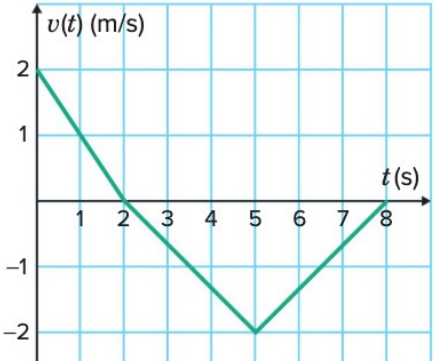
Part a: When is the particle at rest?
A particle is at rest when its velocity is zero. On the graph, this occurs when the line crosses the -axis.
The graph of crosses the -axis at and . Therefore, the particle is at rest at 2 seconds and 8 seconds.
Part b: During which time interval(s) is the particle's speed decreasing?
Speed is decreasing when the graph of velocity is moving towards the -axis, meaning when is decreasing.
The graph of is moving towards the -axis in two intervals:
- From to , the velocity decreases from to
- From to , the velocity increases from to . Although the velocity value is increasing, its magnitude (the speed) is decreasing from to
Therefore, the speed is decreasing for 0 ≤ t < 2 and 5 < t ≤ 8.
Important
Exam tip: When analysing motion graphs, remember that speed relates to the distance from the t-axis, not whether the line is going up or down. A line moving towards the -axis always indicates decreasing speed, regardless of whether the velocity is positive or negative.
Summary
Key Points to Remember:
- The instantaneous rate of change of a function at is given by the derivative , which equals the gradient of the tangent at that point
- Velocity is the instantaneous rate of change of displacement:
- Speed is the magnitude of velocity and is always non-negative: Speed
- Vector quantities (displacement, velocity) have both magnitude and direction; scalar quantities (distance, speed) have only magnitude
- A particle is at rest when its velocity equals zero ()
- The sign of velocity indicates direction: positive means moving in the positive direction, negative means moving in the negative direction