Exact Trigonometric Values (HSC SSCE Mathematics Advanced): Revision Notes
📚Revision Notes
Exact Trigonometric Values
Introduction to trigonometric ratios
In a right-angled triangle, we can describe the relationship between the sides using special ratios called trigonometric ratios. The three main ratios are sine, cosine, and tangent, which relate to an angle in the triangle.
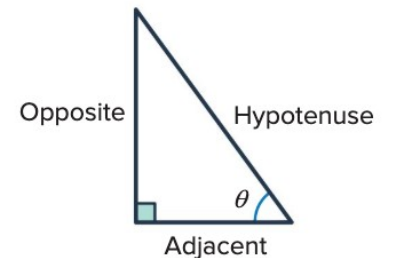
The three trigonometric ratios are defined as:
Note
SOHCAHTOA Mnemonic
A helpful way to remember these ratios is the mnemonic SOHCAHTOA:
- SOH: Sine = Opposite / Hypotenuse
- CAH: Cosine = Adjacent / Hypotenuse
- TOA: Tangent = Opposite / Adjacent
This mnemonic is your best friend when working with trigonometric ratios!
Pythagoras' theorem
Before we derive exact values, it's important to recall Pythagoras' theorem. For a right-angled triangle with hypotenuse and other sides and , the theorem states:
This fundamental relationship helps us calculate unknown side lengths when we know two sides of a right-angled triangle.
Deriving exact values for 45° angles
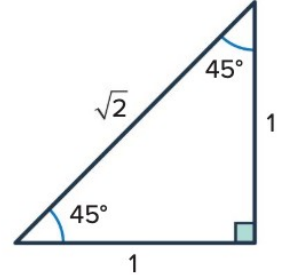
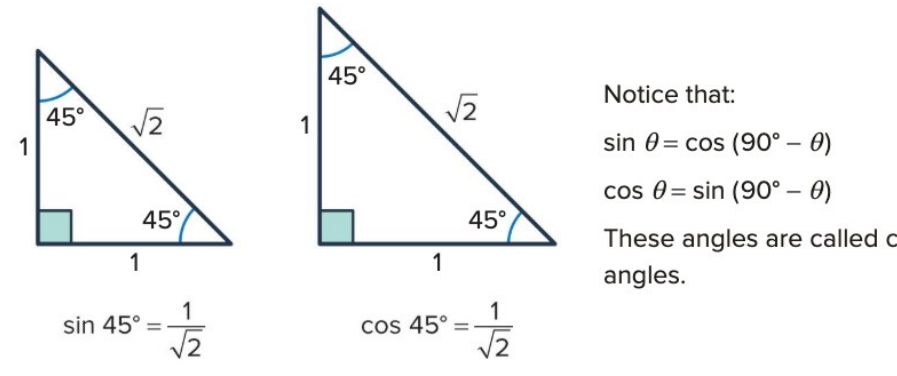
To find the exact trigonometric values for , we use a special triangle called an isosceles right-angled triangle. This triangle has two equal sides of length 1 unit and two equal base angles of each.
Example
Worked Example: Deriving the 45° Exact Values
Using Pythagoras' theorem, we can find the hypotenuse:
Now we can calculate the exact trigonometric ratios for :
Rationalising the denominator
When working with exact values, we prefer to write answers in rationalised form, which means removing any square roots from the denominator.
To rationalise , we multiply both the numerator and denominator by :
Therefore, the exact values for 45° in rationalised form are:
Important
Universal Property of Similar Triangles
The side lengths in this triangle are , , and , but these exact ratios apply to any isosceles right-angled triangle, regardless of size. The angles will always be , , and , so the ratios remain the same.
Deriving exact values for 30° and 60° angles
To find the exact values for and angles, we start with an equilateral triangle where all sides measure units and all angles measure .
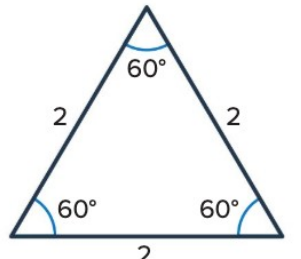
Next, we draw a line from the top vertex to the base, creating a perpendicular bisector. This divides the equilateral triangle into two congruent right-angled triangles.
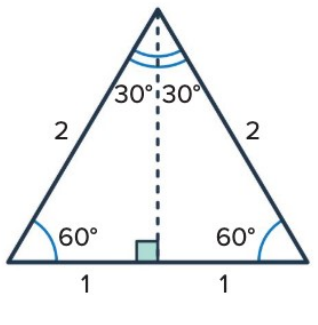
Each right-angled triangle now has:
- A base of unit (half of the original base)
- A hypotenuse of units (the original side)
- Two angles of and
Example
Worked Example: Finding the Height of the Triangle
Using Pythagoras' theorem, we can find the height:
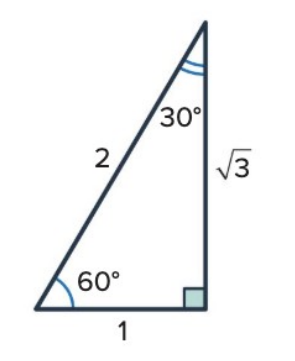
Now we have a 30°-60°-90° triangle with sides , , and . We can determine the exact trigonometric values:
For the 30° angle:
For the 60° angle:
Important
Universal Property of 30-60-90 Triangles
Just like with the triangle, any right-angled triangle with angles of 30° and 60° will have the same trigonometric ratios, regardless of the actual side lengths. The ratios are determined by the angles, not the size!
Complementary angles
Two angles are called complementary angles if they add up to . There is a special relationship between the sine and cosine of complementary angles.
Note
The Complementary Angle Relationship
For any angle :
This means that the sine of an angle equals the cosine of its complement, and vice versa.
Let's see this relationship in action with our exact values:
- (both equal )
- (both equal )
- (both equal )
Reference triangles
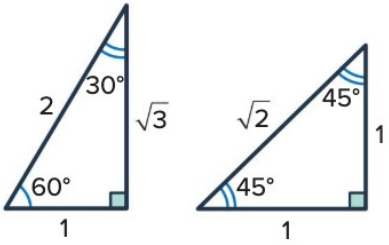
Here are the two special triangles side by side for easy reference:
Note
Special Triangle Ratios
- The 45-45-90 triangle has sides in the ratio
- The 30-60-90 triangle has sides in the ratio
These ratios are crucial for deriving exact values quickly!
Summary of exact values
Here is a complete table of exact trigonometric values for common angles:
Summary
Key Exact Values Table
| Angle | sin | cos | tan |
|---|---|---|---|
| or | or | ||
Special Cases at Boundary Angles:
| Angle | sin | cos | tan |
|---|---|---|---|
| Undefined |
Important
Exam Tip: Rationalisation
When presenting answers in surd form, always give the final result in rationalised form. This means no square roots should appear in the denominator. Examiners expect to see rather than .
Worked example 1: Finding cos 45°
Example
Worked Example: Finding cos 45°
Question: What is the exact value of ?
Solution:
We use the -- triangle to find this value.
Write the cosine ratio:
Substitute the values from the triangle:
Rationalise the denominator by multiplying by :
Perform the multiplication and simplify:
Therefore, the exact value is .
Worked example 2: Finding cos 60°
Example
Worked Example: Finding cos 60°
Question: What is the exact value of ?
Solution:
We use the -- triangle to find this value.
Write the cosine ratio:
Substitute the values from the triangle:
The answer is already in simplest form, so the exact value is .
Worked example 3: Finding an angle from its tangent
Example
Worked Example: Finding an Angle from its Tangent
Question: Find the angle in a right-angled triangle where .
Solution:
We need to identify which special angle has a tangent value of .
From the -- triangle, we know that:
This matches our given value, so the answer is .
Remember!
Summary
Key Points to Remember:
-
The three main trigonometric ratios are remembered using SOHCAHTOA: , ,
-
Exact values for 45° angles come from an isosceles right triangle with sides , ,
-
Exact values for 30° and 60° angles come from splitting an equilateral triangle, creating a right triangle with sides , ,
-
Complementary angles satisfy: and
-
Always rationalise denominators in your final answers by removing square roots from the bottom of fractions
-
Memorise the exact values table for quick reference in exams, or know how to derive them from the special triangles