Minimum Completion Time (HSC SSCE Mathematics Standard): Revision Notes
📚Revision Notes
Minimum Completion Time
What is minimum completion time?
The minimum completion time is the shortest possible time needed to finish an entire project. This time is determined by two key factors:
- The duration of each individual activity within the project
- The order in which activities must be completed (their predecessors)
We use critical path analysis to calculate the minimum completion time for a project. By examining the network diagram and identifying the critical path, we can determine exactly how long the project will take to complete.
Note
Key Principle
The minimum completion time equals the EST (Earliest Start Time) of the finish node in the network diagram. This value represents the earliest possible moment when all activities can be completed.
Understanding crashing
Sometimes project managers need to complete a project faster than originally planned. Crashing refers to the process of reducing the duration of one or more activities and then recalculating the project's minimum completion time.
Why crash activities?
There are several reasons why an activity might be completed in a shorter time than initially planned:
- Employing additional staff members to speed up the work
- Using alternative materials that are faster to work with
- Favourable weather conditions allowing outdoor work to proceed more quickly
- Improved equipment or methods becoming available
Which activities should you crash?
This is a crucial question. Not all activities are worth crashing. Here's the key principle:
Important
Critical Path Rule for Crashing
Only activities on the critical path will reduce the overall project completion time when crashed.
Activities that are not on the critical path have float time available. This means they could take longer without affecting the project's completion date. Therefore, reducing the duration of non-critical activities will not speed up the project overall.
When considering which activities to crash, you should:
- Identify the critical path (activities with zero float time)
- Only consider crashing activities on this critical path
- Be aware that crashing activities may change which path is critical
Worked example: Finding minimum completion time (simple project)
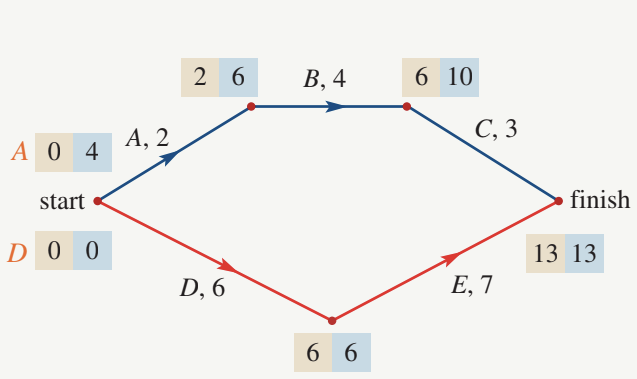
Let's examine a project with five activities: A, B, C, D, and E. The network diagram shows the duration (in hours) for each activity, along with the EST and LST values. The critical path is shown in red.
Example
Worked Example 11: Simple Project Analysis
Part a: What is the minimum completion time?
Solution:
The minimum completion time is found by looking at the EST value in the finish node of the network diagram.
From the diagram, we can see that the EST at the finish node is .
Therefore, the minimum completion time for this project is 13 hours.
Part b: Which activities would not reduce completion time if crashed?
Solution:
To answer this question, we need to identify which activities are NOT on the critical path.
Looking at the network diagram, the critical path (shown in red) runs through activities D and E.
Activities A, B, and C are on an alternative path and are not part of the critical path.
Therefore, if activities A, B, or C were reduced in duration individually, this would not result in an earlier completion of the project.
These activities have float time, meaning they could take longer without delaying the project. Conversely, making them shorter doesn't speed up the project overall.
Part c: Recalculating after crashing activity D
Now suppose activity D was reduced in time from hours to hours. What would be the new minimum completion time?
Solution:
When an activity is crashed, we need to update the network diagram and recalculate the EST and LST values for all activities.
Step 1: Update activity D's duration from to hours
Step 2: Recalculate the EST values by working forward through the network
Step 3: Recalculate the LST values by working backward through the network
Step 4: Find the new EST at the finish node
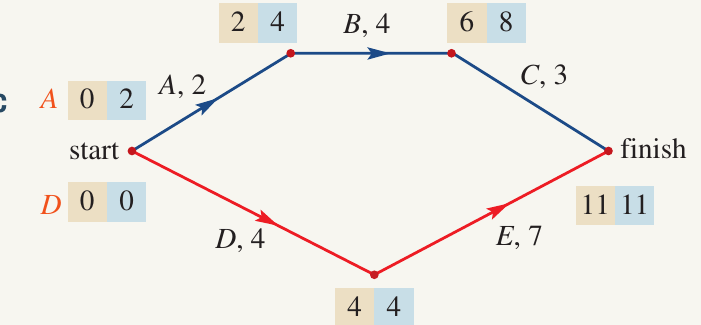
After recalculating, we can see that the EST at the finish node is now .
Therefore, the new minimum completion time is 11 hours.
Notice that crashing activity D reduced the project time by hours (from to hours). This worked because D was on the critical path. The critical path remains the same: D → E.
Worked example: Finding minimum completion time (complex project)
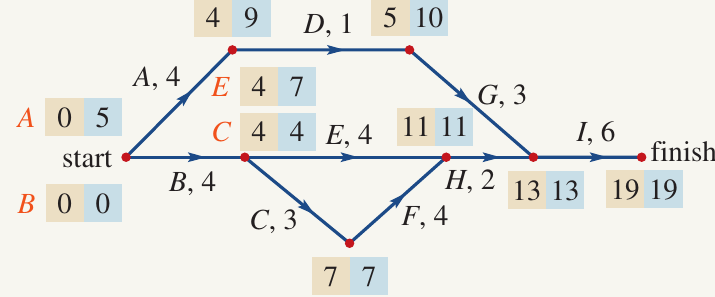
Let's examine a more complex project involving the construction of a community centre. This project has nine activities (A through I). The network diagram shows completion times in weeks, along with EST and LST values.
Example
Worked Example 12: Complex Project with Multiple Activities
Part a: Finding the critical path and minimum completion time
Solution:
To find the critical path, we look for activities that have zero float time. Float time is calculated as:
Activities with zero float are on the critical path because any delay to these activities will delay the entire project.
Examining the network diagram:
The critical path is: B → C → F → H → I
The minimum completion time is the EST value at the finish node.
The minimum completion time is 19 weeks.
Part b: Which activities would not reduce completion time?
The builders can potentially speed up activities A, C, F, and G at additional cost. However, not all of these would be worth crashing.
Solution:
We need to identify which of these four activities are NOT on the critical path.
From part a, we know the critical path is B → C → F → H → I.
Examining the given activities:
- Activity A is not on the critical path
- Activity C is on the critical path
- Activity F is on the critical path
- Activity G is not on the critical path
Additionally, activities D and E are also not on the critical path.
Therefore, activities A and G (from the given list) would not result in an earlier completion of the project if reduced individually.
We should only consider crashing activities C and F, as these are on the critical path.
Part c: Finding minimum time after crashing multiple activities
The project owner will pay to reduce activities on the critical path. Activities C and F can each be reduced by a maximum of weeks. What is the new minimum completion time?
Solution:
Step 1: Reduce activity C from weeks to week (reduction of weeks)
Step 2: Reduce activity F from weeks to weeks (reduction of weeks)
Step 3: Update the network diagram with these new durations
Step 4: Recalculate all EST and LST values
Step 5: Identify the new critical path
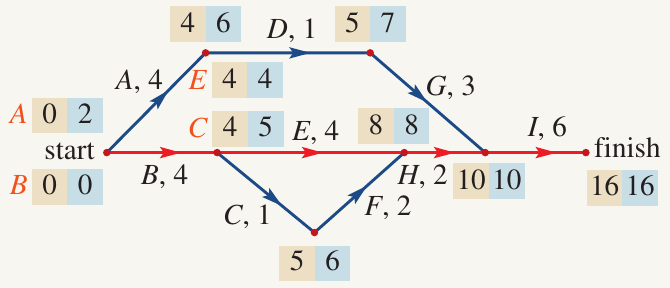
After recalculating, we can observe that:
The critical path has changed! The new critical path is: B → E → H → I
This is an important lesson: crashing activities can change which path is critical. Once we reduced C and F significantly, path B → E → H → I became longer than the original critical path.
The new minimum completion time is 16 weeks.
This represents a reduction of weeks from the original weeks. Even though we reduced C and F by weeks each (total weeks), the project was only shortened by weeks because the alternative path through E became the limiting factor.
Note
Understanding Critical Path Changes
When you crash activities on the critical path, always check whether the critical path itself has changed. An alternative path that previously had float time may become the new critical path once you reduce activities on the original critical path. This is why recalculating all EST and LST values is essential after crashing.
Key steps for solving minimum completion time problems
When working with minimum completion time problems, follow these steps:
- Identify the minimum completion time from the EST value at the finish node
- Find the critical path by identifying activities with zero float time (where EST = LST at each node)
- Determine which activities to crash by checking which ones are on the critical path
- Update the network diagram with new activity durations after crashing
- Recalculate EST values by working forward through the network
- Recalculate LST values by working backward through the network
- Check for changes in the critical path as crashing can make a different path critical
- Find the new minimum completion time from the updated EST at the finish node
Summary
Key Points to Remember
- Minimum completion time = EST at the finish node of the network diagram
- Only activities on the critical path affect the overall project completion time
- Crashing means reducing an activity's duration to speed up the project
- Non-critical activities (those not on the critical path) have float time and won't reduce project time if crashed individually
- The critical path can change after crashing activities, so always recalculate EST and LST values
- Zero float time indicates an activity is on the critical path
- To find the new minimum time after crashing, update the network diagram and recalculate all timing values