Diffraction of Waves (HSC SSCE Physics): Revision Notes
📚Revision Notes
Diffraction of Waves
What is diffraction?
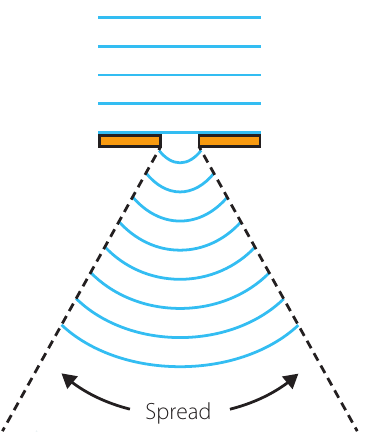
When waves encounter a gap or an obstacle, they don't simply stop or pass straight through—they spread out into the space beyond. This bending and spreading behaviour is called diffraction.
You can observe diffraction in everyday situations. For example, when you're sitting in one room, you can still hear a radio or television playing in another room, even though you can't see the source directly. The sound waves have bent around corners and spread through doorways to reach your ears.
Note
Definition: Diffraction is the spreading of waves into a space beyond a gap or an obstacle.
How diffraction works
When waves pass through an opening or around an obstacle, they spread out into the region beyond. The diagram below shows how this spreading occurs in different situations—around objects, through gaps, and around barriers.
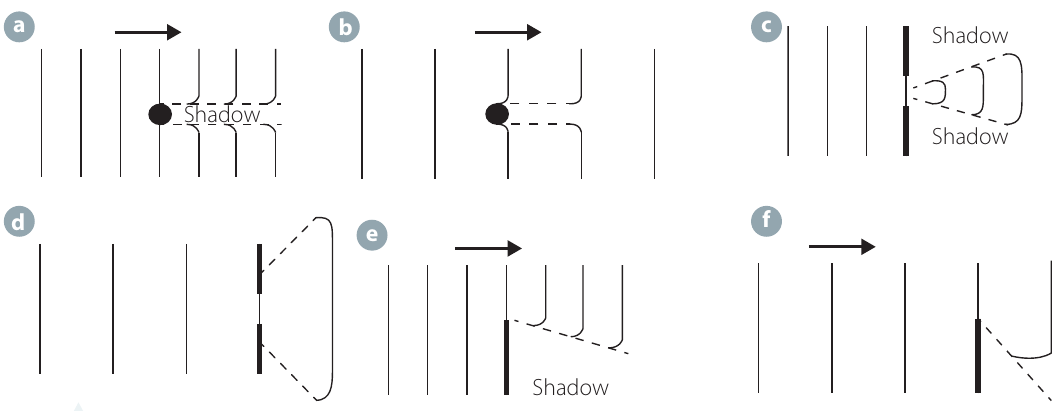
The key principle is that waves don't travel in perfectly straight lines when they encounter obstacles or openings. Instead, they bend and fill the available space. This is why you can hear someone calling you even when they're around a corner, or why sound from a radio travels throughout a house.
The relationship between wavelength and opening size
The amount of diffraction that occurs depends critically on the relationship between the wavelength () and the width of the opening (). We express this as the ratio .
Important
Two Fundamental Rules of Diffraction:
-
The smaller the opening compared to the wavelength, the greater the diffraction. When waves encounter a narrow gap, they spread out more dramatically into the space beyond.
-
The longer the wavelength compared to the opening size, the greater the diffraction. Waves with longer wavelengths bend and spread more readily than those with shorter wavelengths.
For substantial diffraction to occur, the wavelength must be similar in size to the aperture (opening) through which the wave passes. If the wavelength is much smaller than the opening, the wave passes through relatively straight with minimal spreading.
Frequency and diffraction
The frequency of a wave directly affects how much it diffracts, because frequency and wavelength are inversely related through the wave equation:
where is wave velocity, is frequency, and is wavelength.
High frequency sounds (short wavelengths)
Higher pitched sounds have shorter wavelengths. When you listen to a loudspeaker, these high frequency sounds:
- Are heard best directly in front of the speaker
- Are more directional (travel in straighter lines)
- Pass through openings with less bending and spreading
- Undergo less diffraction overall
Low frequency sounds (long wavelengths)
Lower pitched sounds have longer wavelengths. These sounds:
- Can be heard in front of and to the sides of the speaker
- Spread out more readily
- Bend more around corners and obstacles
- Undergo greater diffraction
Note
This explains why bass sounds from music systems seem to travel throughout buildings more easily than high-pitched sounds. The longer wavelengths of bass frequencies diffract more effectively through doorways and around corners.
Important property of diffraction
Important
Critical Concept: When sound waves (or any waves) are diffracted, there is no change to three key properties:
- Speed
- Wavelength
- Frequency
The wave simply spreads into the available space while maintaining its original characteristics.
Worked example: Sound through a car window
Let's examine why loud music from a car always sounds bass-heavy from outside, regardless of what's actually playing. Only low frequency sounds diffract effectively through car windows, whilst high frequency sounds do not.
Example
Worked Example: Sound Diffraction Through a Car Window
Part (a): Wavelength of low frequency sound
| Step | Working |
|---|---|
| Given data | , |
| Appropriate formula | |
| Rearrange for wavelength | |
| Substitute values | |
| Calculate |
Part (b): Wavelength of high frequency sound
| Step | Working |
|---|---|
| Given data | , |
| Appropriate formula | |
| Rearrange for wavelength | |
| Substitute values | |
| Calculate |
Comparison with car window width
A typical car window is approximately wide. Comparing our calculated wavelengths:
-
The low frequency sound () has a wavelength of , which is much longer than the window width. This wave diffracts extensively through the window.
-
The high frequency sound () has a wavelength of , which is about the same size as the window. This wave undergoes much less diffraction.
Conclusion: This is why music from cars always sounds bass-heavy from outside—only the low frequencies with long wavelengths diffract effectively through the windows.
Application: Diffraction and echolocation
Echolocation is a remarkable technique used by certain mammals, including bats and dolphins, to navigate and hunt in darkness or murky water. Instead of relying on light, these animals emit high-frequency sound waves and listen for the echoes that bounce back from objects.
How echolocation relates to diffraction
Sound waves can only reflect from an object if the wavelength is similar to or smaller than the size of the object. If a sound wave has a wavelength that's too long, it simply diffracts around the object without reflecting—there's no echo to detect.
Note
This principle sets a limit on the smallest prey that echolocating animals can detect. Bats use ultrasound frequencies ranging from up to specifically to detect small insects.
Worked example: Bat hunting mosquitoes
Let's calculate the smallest prey a bat can locate using echolocation at a frequency of (ultrasound).
Example
Worked Example: Bat Echolocation
| Step | Working |
|---|---|
| Given data | , |
| Appropriate formula | |
| Rearrange for wavelength | |
| Substitute values | |
| Calculate | |
| Express in scientific notation | |
| Convert to millimetres |
Interpretation: The bat can detect objects as small as —about the size of a mosquito. Objects smaller than this wavelength would cause too much diffraction, producing no useful echo for the bat to detect.
Exam tip
When solving diffraction problems:
- Always identify whether you're given frequency or wavelength
- Remember the wave equation:
- Check that your answer makes physical sense (e.g., ultrasound should have a very small wavelength)
- Include appropriate units in all steps
- For echolocation problems, the minimum detectable object size equals the wavelength
Remember!
Summary
Key Points to Remember:
-
Diffraction is the spreading of waves beyond a gap or around an obstacle into the space beyond.
-
The amount of diffraction depends on the ratio of wavelength to opening size (). Larger wavelengths and smaller openings produce greater diffraction.
-
Low frequency (long wavelength) sounds diffract more readily than high frequency (short wavelength) sounds, making bass sounds spread more throughout buildings.
-
During diffraction, the wave's speed, wavelength, and frequency remain unchanged—only the direction of propagation changes.
-
Echolocation relies on diffraction principles: animals can only detect objects similar in size to or larger than the wavelength they're using.