Regulation of Water Balance (VCE SSCE Biology): Revision Notes
📚Revision Notes
Regulation of Water Balance
Introduction
Ever wondered why hangovers make you feel so awful? One major contributor is dehydration. Ethanol (the alcohol in drinks) reduces the secretion of antidiuretic hormone (ADH), causing your kidneys to reabsorb less water. This means you lose much more water than normal, leading to that classic hangover feeling. Understanding how the body regulates water balance helps explain not just hangovers, but how your body maintains optimal conditions for all your cells to function properly.
Water in the body
The importance of water
The human body contains approximately 55-60% water. This water exists in different forms throughout the body, playing essential roles in maintaining health and normal cellular function.
Osmolality and cells
Cells are surrounded by extracellular fluid (the fluid outside of cells). The composition of this fluid must be maintained within a narrow optimal range for cells to function properly. Water plays a critical role in regulating the extracellular fluid to keep it "just right" for cells.
Inside cells, water exists as intracellular fluid (the fluid inside cells), forming the cytosol in which all the organelles are suspended. It's crucial that this water stays inside the cells.
The balance of water between inside and outside cells depends on osmolality (the total concentration of solute in a given weight of water). If the extracellular fluid has too high a solute concentration (making it hypertonic), water will rush out of cells via osmosis (the passive transport of a solvent, typically water, through a semipermeable membrane from a hypotonic solution to a hypertonic solution). When this happens, cells become crenate (distorted in shape) and cannot function normally.
Important
If extracellular fluid becomes hypertonic (too concentrated), cells lose water and crenate (shrink). If extracellular fluid becomes hypotonic (too dilute), cells gain water and can swell until they burst. Both situations are dangerous for cellular function!
Conversely, if the extracellular fluid has too low a solute concentration (making it hypotonic), water rushes into cells, causing them to swell and potentially burst.
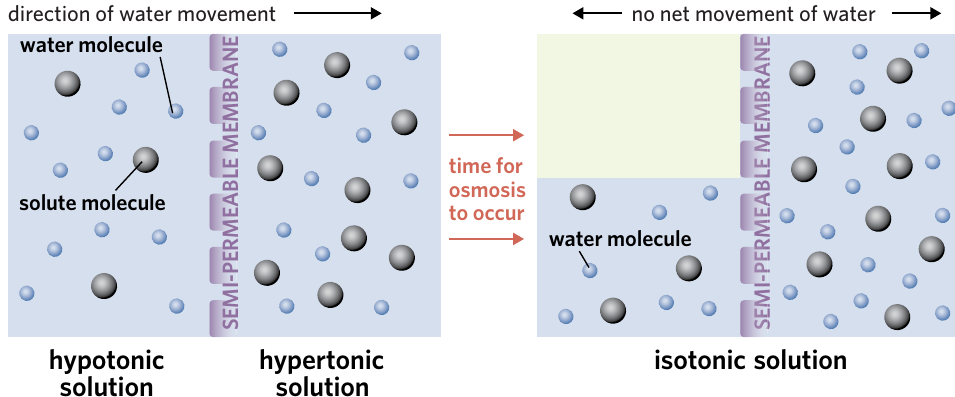
The diagrams above show how water moves between solutions of different concentrations. In the left panel, the hypotonic solution (lower solute concentration) loses water to the hypertonic solution (higher solute concentration) through the semi-permeable membrane. Over time, this creates an isotonic solution where both sides have equal concentrations, and there is no net movement of water.
Note
Think of osmosis like a balancing act: water always moves from areas of lower solute concentration (hypotonic) to areas of higher solute concentration (hypertonic) until equilibrium is reached. It's as if the water is trying to "even out" the concentration differences.
When we add or remove water from a solution, we change its concentration. Adding water to a solution decreases its concentration (dilutes it), whilst removing water increases its concentration.
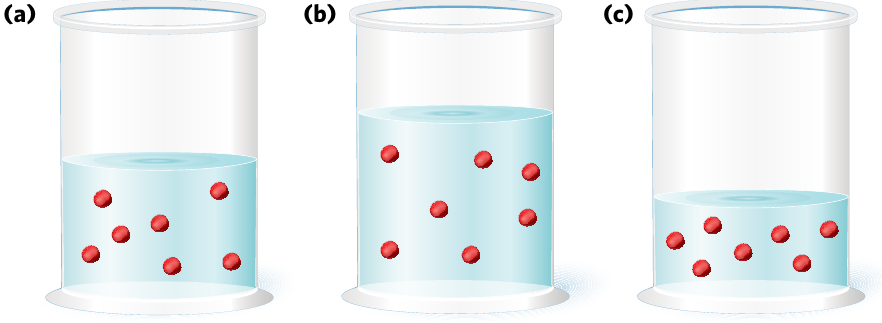
The body maintains water balance to ensure extracellular and intracellular fluids remain isotonic (having equal solute concentrations), preventing net gain or loss of water from cells. This regulation is called osmoregulation (the homeostatic regulation of osmolality in the body via the alteration of water and solute balance).
The body finds it easier to alter the amount of water in extracellular fluids than to change the amount of solutes. Therefore, osmoregulation primarily works by adding or removing water to maintain optimal osmolality.
Other functions of water
Beyond maintaining osmolality, water performs several vital functions:
Urine production: Water forms a large component of urine, allowing the body to eliminate waste products whilst regulating water balance.
Thermoregulation: Water in sweat evaporates from the skin surface, removing waste heat from the body. This evaporative cooling is a key mechanism for maintaining body temperature.
Note
When you exercise or feel hot, your body produces sweat. As the water in sweat evaporates from your skin, it takes heat energy with it, cooling you down. This is why sweating is so effective at temperature regulation, but also why it's important to replace lost fluids!
Blood volume maintenance: Blood plasma is 92% water. Adequate water levels are essential for maintaining proper blood volume and pressure within the circulatory system.
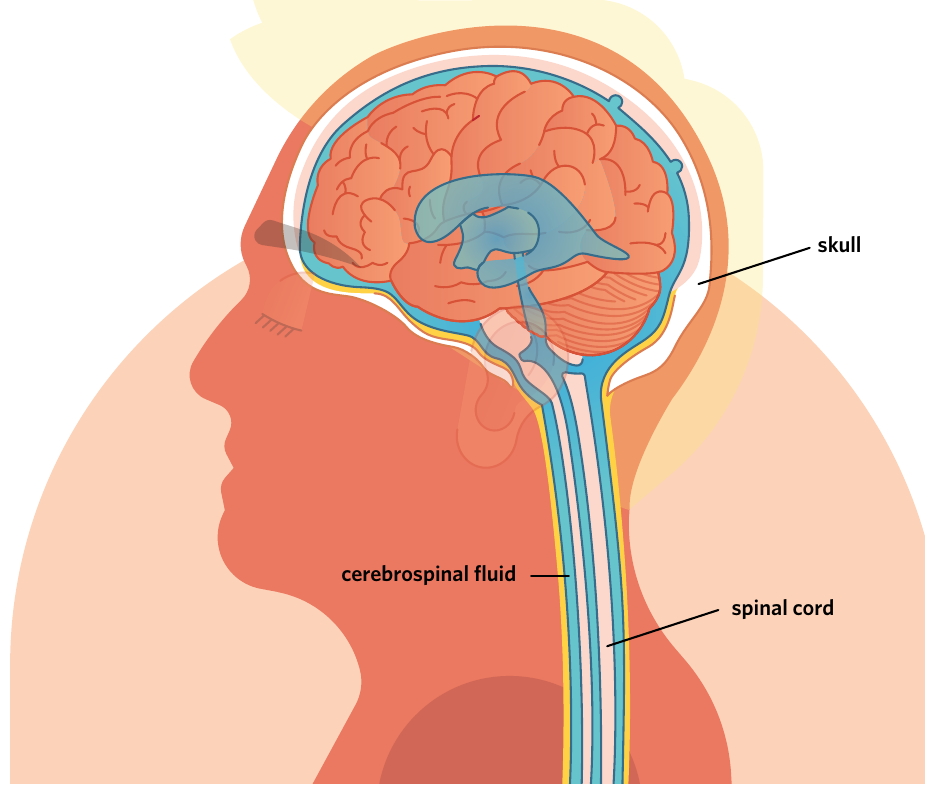
Protection of the brain and central nervous system: Cerebrospinal fluid, which is largely composed of water, surrounds the brain and spinal cord, protecting these delicate structures from injury.
Regulating water balance
Water balance equation
The total amount of water in the body represents a balance between water coming in, water produced metabolically, and water being lost:
total water change = water in + metabolic water – water out
Ideally, the water coming in plus metabolic water should equal the water going out, resulting in no net change in osmolality. However, various factors (like consuming large amounts of salt) can disrupt this balance, requiring homeostatic regulation to restore equilibrium.
The stimulus-response model
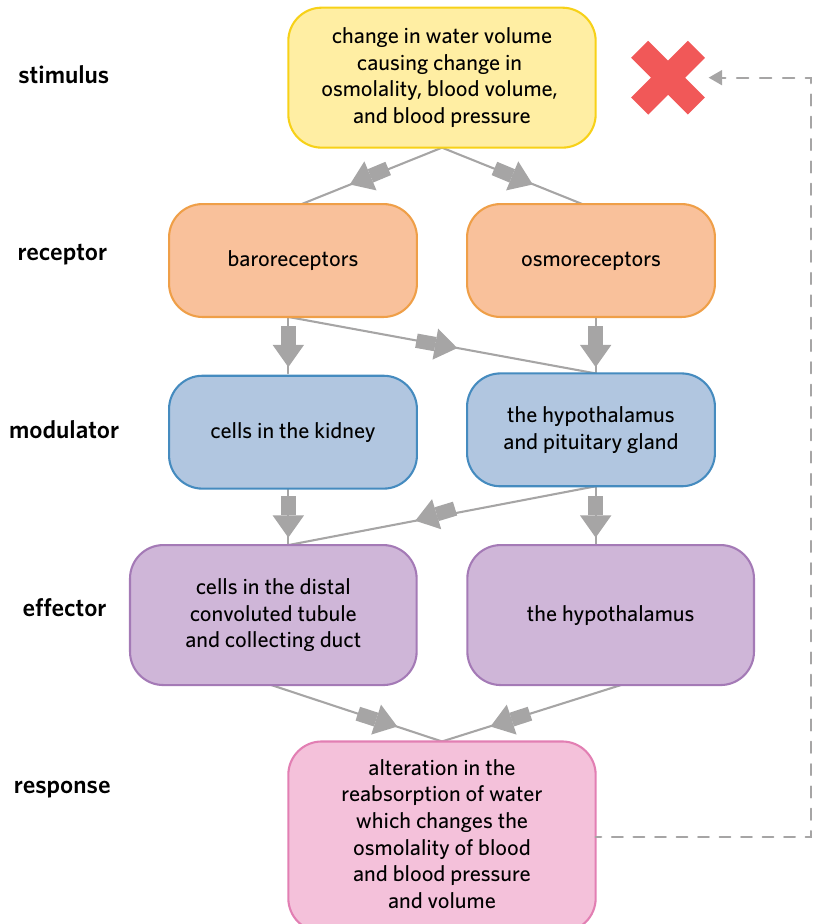
Like all homeostatic mechanisms, water balance regulation can be explained using a stimulus-response model involving five key components:
Stimulus: Changes in water volume cause changes in blood osmolality, blood volume, and blood pressure.
Receptors: Two types of receptors detect these changes:
- Osmoreceptors (found primarily in the hypothalamus) detect changes in osmolality
- Baroreceptors (found throughout the body, including the aortic arch, carotid artery, and kidneys) detect changes in blood pressure
Modulators: For the osmoreceptor pathway, the hypothalamus (a section of the brain controlling the body's internal environment) and pituitary gland (a gland controlling several other endocrine glands) serve as modulators. For the baroreceptor pathway, cells in the kidneys act as modulators.
Effectors: The primary effectors are cells of the distal convoluted tubule and collecting duct in the kidney nephrons, and the hypothalamus itself.
Response: These organs alter water reabsorption and consumption, returning water levels to the set point.
What happens when water levels decrease
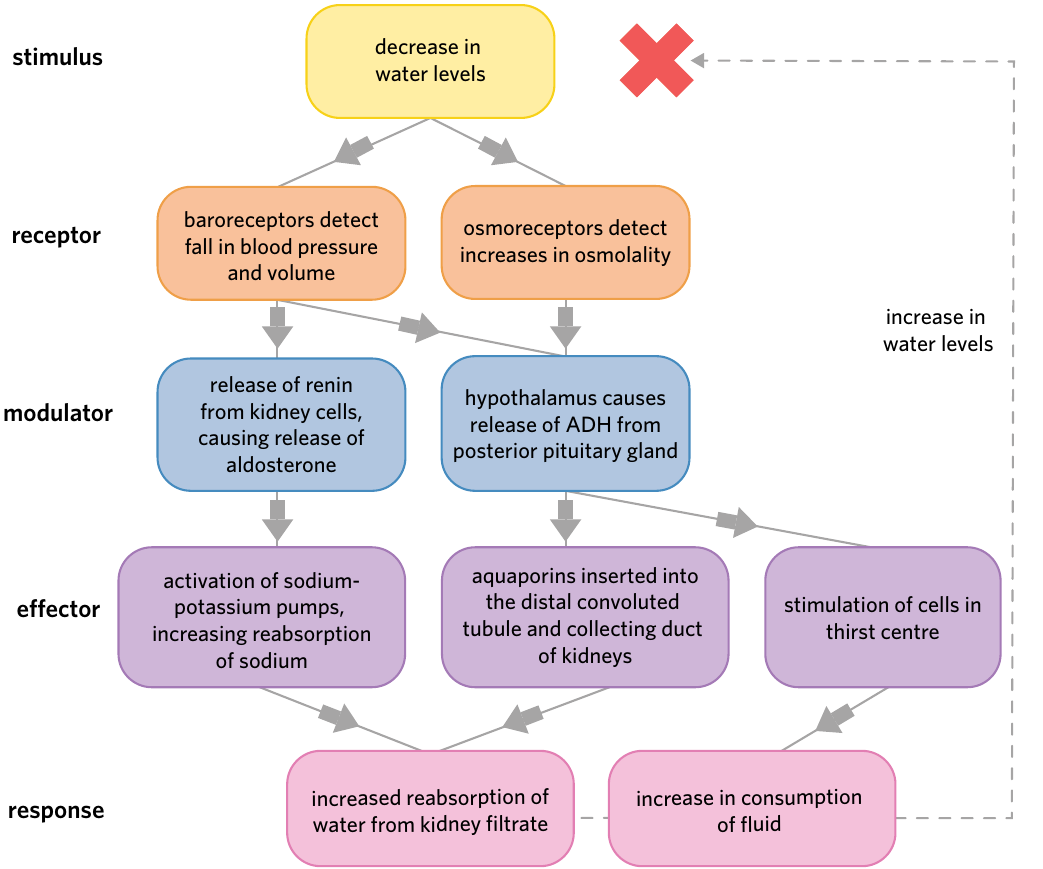
When the body loses water (through sweating, urination, or insufficient intake), both osmolality increases and blood pressure/volume decrease. The body responds through two main pathways: the ADH pathway and renin secretion.
The ADH pathway
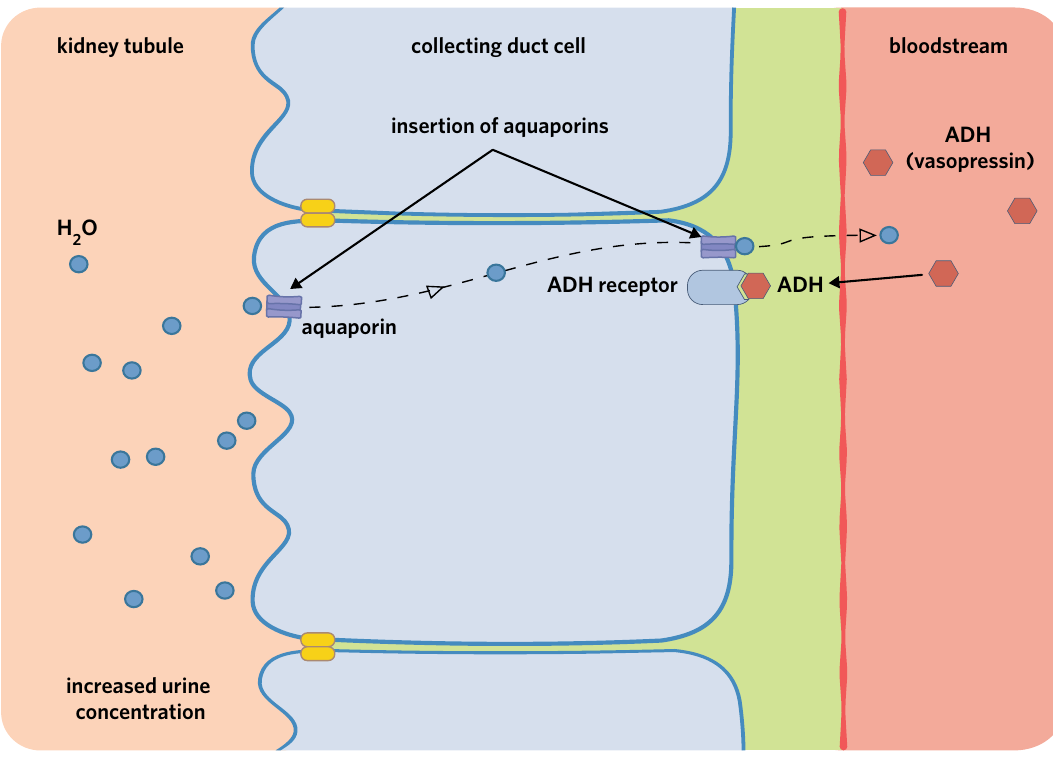
When osmoreceptors in the hypothalamus detect increased osmolality, they send signals to the posterior pituitary gland, triggering the release of antidiuretic hormone (ADH) (also known as vasopressin). This hormone has two primary effects:
Effect 1 - Increased water reabsorption: ADH increases the number of aquaporins (transmembrane proteins facilitating water transport) inserted into cells of the distal convoluted tubule and collecting duct in the kidney nephrons. More aquaporins mean more water can be reabsorbed from the kidney filtrate back into the bloodstream. This reduces urine output and makes urine much more concentrated. As the body retains more water, blood osmolality decreases back toward normal.
Example
Worked Example: The Dehydration Response
Imagine you've been exercising on a hot day and haven't drunk enough water. Here's what happens step by step:
Step 1: You lose water through sweat → blood osmolality increases
Step 2: Osmoreceptors in your hypothalamus detect the increased osmolality
Step 3: The hypothalamus signals the posterior pituitary to release ADH
Step 4: ADH travels to your kidneys and increases aquaporins in the collecting ducts
Step 5: More water is reabsorbed from urine back into your blood → your urine becomes dark and concentrated
Step 6: ADH also triggers the thirst centre → you feel thirsty and drink water
Result: Blood osmolality returns to normal through negative feedback
Effect 2 - Stimulation of thirst: ADH also acts on the thirst centre in the hypothalamus, generating the sensation of thirst. This prompts the person to drink fluids, increasing water intake.
Renin secretion
When baroreceptors detect decreased blood pressure and volume, they trigger two responses:
First response: Baroreceptors send signals to the hypothalamus, contributing to ADH release from the posterior pituitary gland (reinforcing the osmoreceptor pathway).
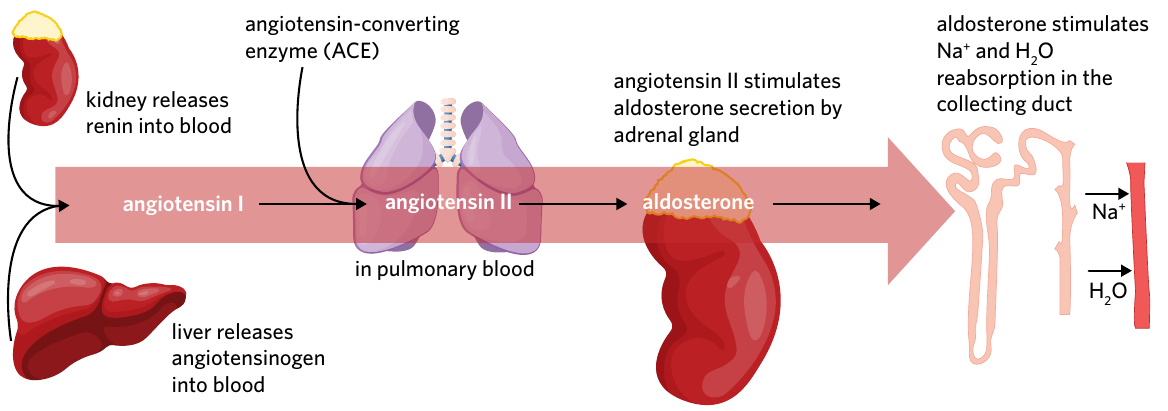
Second response: Baroreceptors trigger the release of renin (an enzyme from the kidneys that initiates water and sodium reabsorption). Through a series of biochemical reactions, renin causes the release of aldosterone (a steroid hormone from the adrenal glands). Aldosterone activates sodium-potassium pumps in cells lining the distal convoluted tubule and collecting duct. This increases sodium reabsorption and potassium excretion. Due to osmosis, water follows the movement of sodium from urine back into the bloodstream, increasing blood pressure and volume.
Note
The diagram above shows the complex renin-angiotensin-aldosterone system. Whilst you don't need to memorise all the intermediate steps (like angiotensinogen and angiotensin I/II), understand that renin ultimately leads to aldosterone release, which increases sodium and water reabsorption.
Important
Memory Aid:
- ADH is secreted when you Are DeHydrated
- renIN is secreted when you want more water IN your body!
Remember: Both ADH and renin-aldosterone pathways work together to increase water retention when you're dehydrated, but they do so through different mechanisms.
What happens when water levels increase
When someone consumes excess water, osmolality decreases and blood pressure/volume increase. Osmoreceptors and baroreceptors detect these changes and signal the hypothalamus to suppress ADH release from the posterior pituitary gland.
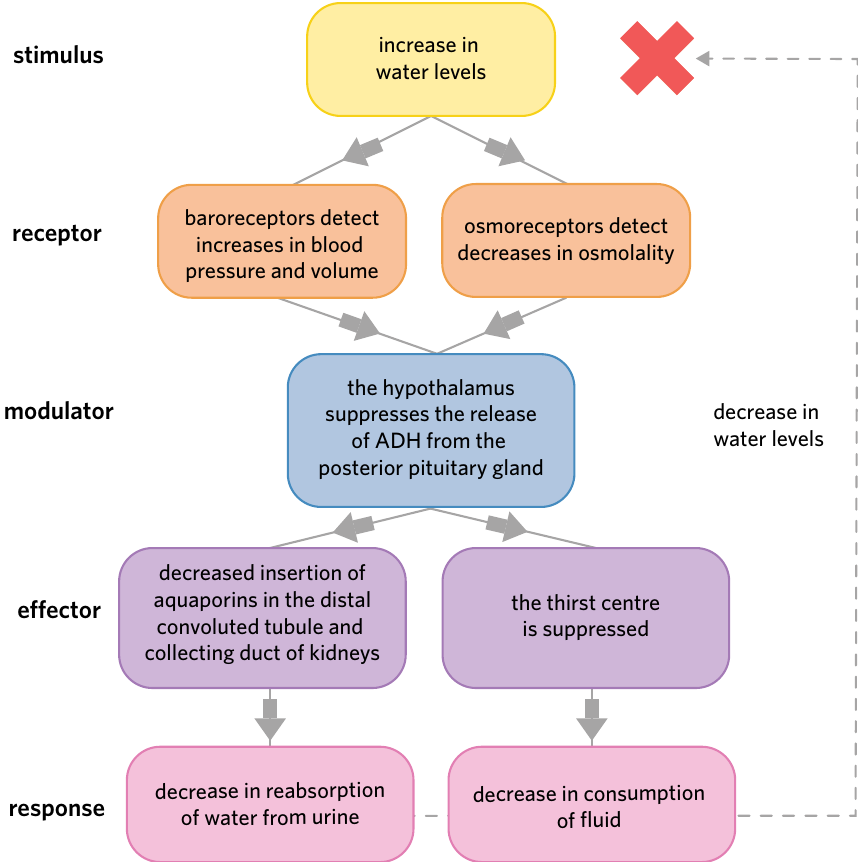
With less ADH present, fewer aquaporins are inserted into the distal convoluted tubule and collecting duct cells. This means less water is reabsorbed from kidney filtrate, so more water is excreted in urine. The urine becomes dilute and light-coloured. Additionally, the thirst centre in the hypothalamus is suppressed, making the person less likely to drink fluids.
These mechanisms work together through negative feedback to lower total water volume back to the set point.
Note
Comparing Low vs High Water Levels:
When water levels are LOW:
- ADH secretion increases
- More aquaporins inserted
- More water reabsorbed
- Urine is concentrated and dark
- Thirst is stimulated
When water levels are HIGH:
- ADH secretion decreases
- Fewer aquaporins inserted
- Less water reabsorbed
- Urine is dilute and light
- Thirst is suppressed
Exam tip
In exam questions about water balance:
- Always identify whether water levels are increasing or decreasing
- Trace the pathway from stimulus → receptors → modulators → effectors → response
- Remember that ADH and renin work through different but complementary mechanisms
- Be clear about which structures are receptors, modulators, and effectors
- Understand that these are negative feedback loops - the response opposes the initial change
Remember!
Summary
Key Points to Remember:
-
Water makes up 55-60% of the human body and is essential for maintaining osmolality, producing urine, regulating temperature, maintaining blood volume, and protecting the brain and spinal cord.
-
Osmoregulation maintains the balance between intracellular and extracellular fluids by controlling water levels, preventing cells from crenating (shrinking) or swelling.
-
When water levels decrease, osmoreceptors and baroreceptors detect the change, triggering ADH release (which increases water reabsorption in kidneys and stimulates thirst) and renin secretion (which activates the aldosterone pathway to reabsorb sodium and water).
-
When water levels increase, ADH secretion is suppressed, leading to increased water excretion in dilute urine and reduced thirst.
-
Water balance is maintained through negative feedback loops involving the hypothalamus, pituitary gland, and kidneys, ensuring osmolality and blood pressure remain within optimal ranges.