Nucleic Acids (VCE SSCE Biology): Revision Notes
📚Revision Notes
Nucleic Acids
Introduction to nucleic acids
Nucleic acids are large polymer molecules present in all living organisms on Earth. These essential macromolecules store genetic information and assist in producing the proteins necessary for survival.
Nucleic acid: the class of macromolecule that includes DNA and RNA. All nucleic acids are polymers made out of nucleotide monomers.
Polymer: a large molecule that is made up of small, repeated monomer subunits.
Note
Nucleic acids are fundamental to all life on Earth. Without these molecules, cells would be unable to store genetic information or produce the proteins necessary for survival and reproduction.
There are two main types of nucleic acids:
- DNA (deoxyribonucleic acid): a double-stranded nucleic acid chain made up of nucleotides. DNA carries the instructions for proteins which are required for cell and organism survival.
- RNA (ribonucleic acid): a single-stranded nucleic acid chain made up of nucleotides. Includes mRNA, rRNA, and tRNA.
Structure of nucleotides
Both DNA and RNA are constructed from nucleotide building blocks. Each nucleotide contains three essential components:
- A phosphate group
- A five-carbon (pentose) sugar
- A nitrogen-containing base
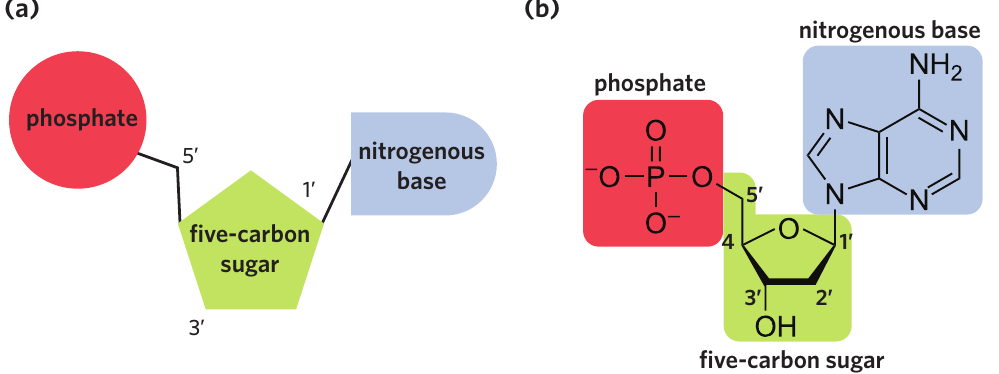
Nucleotide: the monomer subunit of nucleic acids. Made up of a nitrogen-containing base, a five-carbon sugar molecule (ribose in RNA and deoxyribose in DNA), and a phosphate group.
Monomer: a molecule that is the smallest building block of a polymer.
Note
Understanding Carbon Positions
The five-carbon sugar has numbered carbon positions ( to , read as "one prime" to "five prime"). Three positions are particularly important:
- carbon: attaches to the nitrogenous base
- carbon: attaches to the phosphate of the next nucleotide
- carbon: attaches the sugar to the phosphate group of the current nucleotide
The and ends give nucleic acids their directional nature, which is crucial for their function.
Phosphodiester bonds and the sugar-phosphate backbone
When multiple nucleotides join together, they form a polynucleotide chain. Nucleotides connect through strong covalent bonds called phosphodiester bonds.
Phosphodiester bond: a strong covalent bond linking a five-carbon sugar to a phosphate group.
These bonds form through condensation reactions, where two monomers join to create a larger molecule whilst releasing water as a by-product.
Important
Phosphodiester bonds are crucial for nucleic acid stability. These strong covalent bonds ensure that genetic information remains intact and can be reliably passed from cell to cell and generation to generation.
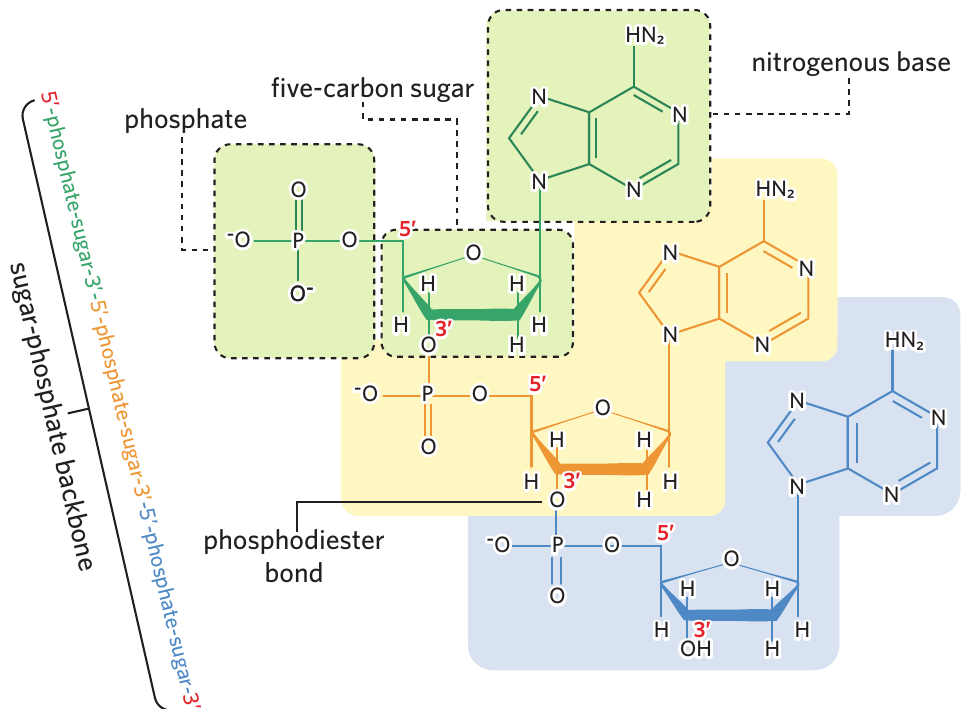
The alternating chain of sugar molecules and phosphate groups forms the sugar-phosphate backbone of nucleic acids.
Sugar-phosphate backbone: a strong covalently linked chain of five-carbon sugar molecules and phosphate groups in a nucleic acid chain.
DNA structure
Overview
DNA is located primarily in the nucleus of eukaryotic cells. In human cells, DNA is packaged into 46 chromosomes, each containing thousands of genes.
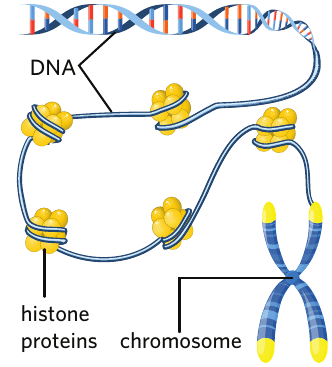
Chromosome: a structure made of protein and nucleic acids that carries genetic information.
Gene: a section of DNA that carries the code to make a protein.
Genome: the complete set of DNA housed within an organism.
DNA determines protein structure, and since proteins control cell and tissue structure and function, DNA is fundamental to life. DNA must be heritable and passed from parents to offspring for life to continue.
Double-stranded structure
DNA consists of two polynucleotide chains oriented in opposite directions (antiparallel). One strand runs in the to direction, whilst the other runs in the to direction.
Antiparallel: a characteristic of DNA strands describing how each strand runs in an opposite direction to the other. One strand runs in a direction and the other runs in a direction.
Complementary base pairing
The two DNA strands join together through hydrogen bonds between their nitrogenous bases. Each DNA nucleotide contains one of four possible bases:
- Adenine (A)
- Thymine (T)
- Cytosine (C)
- Guanine (G)
Important
Base Pairing Rules
These bases follow strict pairing rules called complementary base pairing:
- Adenine (A) always pairs with thymine (T)
- Guanine (G) always pairs with cytosine (C)
Remember: A pairs with T, C pairs with G. These rules are fundamental to DNA structure and function!
Complementary base pairing: describes which nucleotides can form hydrogen bonds with each other. C pairs with G, A pairs with T (or U in RNA).
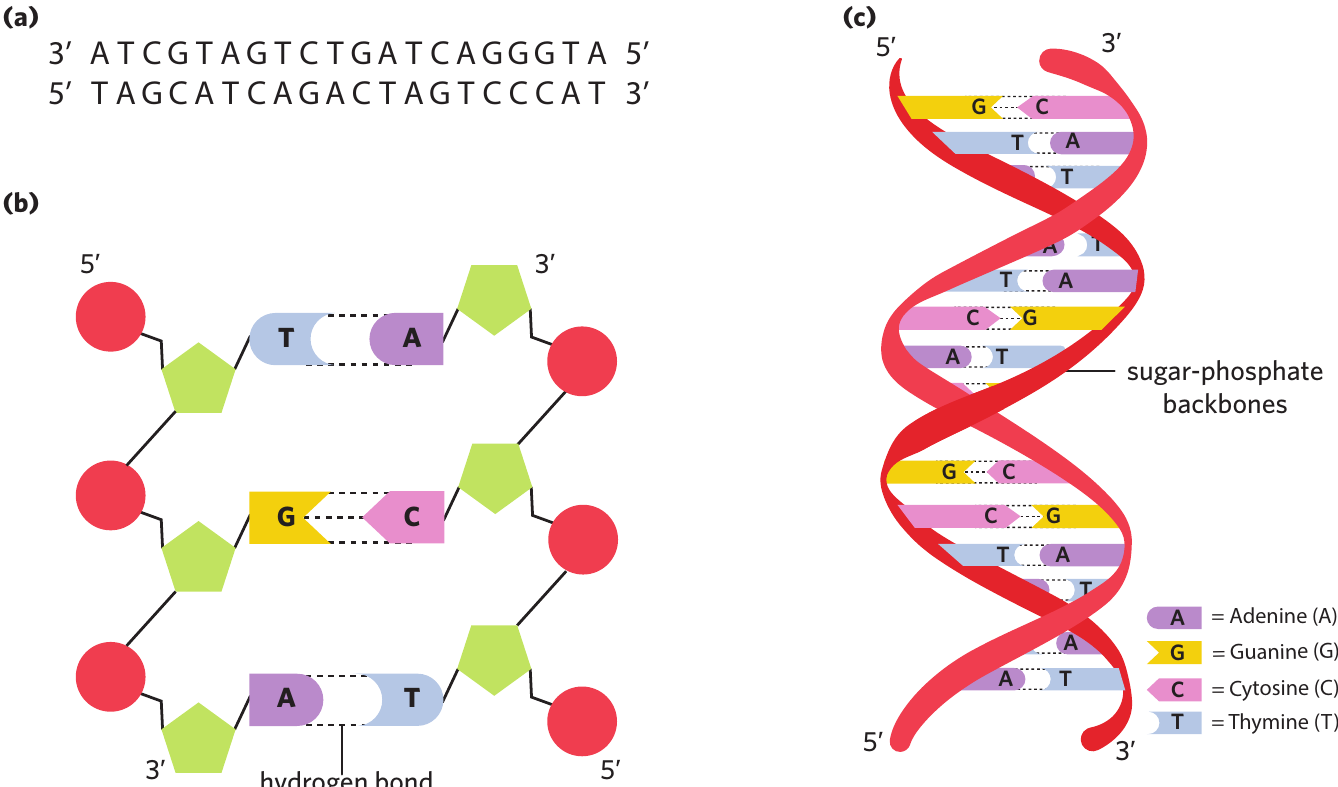
Understanding complementary base pairing allows you to predict the nucleotide sequence of one DNA strand if you know the sequence of its complementary strand. Additionally, in any double-stranded DNA molecule, there will always be equal numbers of A and T nucleotides, and equal numbers of G and C nucleotides.
Example
Worked Example: Predicting Complementary DNA Sequences
If one DNA strand has the sequence: -ATCGGTAC-
Step 1: Identify the complementary base for each nucleotide
- A pairs with T
- T pairs with A
- C pairs with G
- G pairs with C
Step 2: Write the complementary strand (remember it runs antiparallel) Complementary strand: -TAGCCATG-
The complementary strand always runs in the opposite direction!
Double helix formation
Human nuclear DNA is approximately three billion base pairs long (about 1.8 metres). To store this efficiently, the two DNA strands twist around each other, forming a double helix.
Double helix: the structure of double-stranded DNA in the nucleus of eukaryotic cells, where each DNA strand wraps around a central axis.
Nuclear DNA: DNA that is located in the nucleus of a cell.
In nuclear DNA, the double helix coils around proteins called histones, which then condense further to form tightly packed chromosomes.
Note
DNA packaging is remarkably efficient. If you stretched out all the DNA in a single human cell, it would measure about 2 metres long. Yet through coiling around histones and further condensation, this DNA fits into a nucleus that's only about 6 micrometres in diameter!
RNA structure
Overview
RNA is primarily involved in protein synthesis. Unlike DNA, RNA exists in several different forms and can be found in various cellular locations. The three main types of RNA are:
- Messenger RNA (mRNA)
- Transfer RNA (tRNA)
- Ribosomal RNA (rRNA)
Messenger RNA (mRNA): RNA molecules that are produced during transcription and carry genetic information from the nucleus to the ribosomes.
Transfer RNA (tRNA): RNA that recognises specific codons on the mRNA strand and adds the corresponding amino acid to the polypeptide chain during protein synthesis.
Ribosomal RNA (rRNA): RNA that is a key structural component of ribosomes, which assemble proteins.
Note
RNA's Multiple Roles
Each type of RNA has a specific function in protein synthesis:
- mRNA acts as the messenger, carrying genetic instructions from DNA
- tRNA acts as the translator, bringing amino acids to the ribosome
- rRNA acts as the factory, forming the structural core of ribosomes where proteins are assembled
Structural characteristics
RNA structure shares similarities with DNA but has several important differences. Like DNA, RNA is made of nucleotides with three components (phosphate group, five-carbon sugar, and nitrogenous base). However, RNA differs in the following ways:
- Sugar type: RNA contains ribose sugar instead of deoxyribose sugar
- Bases: RNA contains uracil (U) instead of thymine (T)
- Structure: RNA is single-stranded rather than double-stranded
- Lifetime: RNA molecules are temporary and synthesised on demand, whereas DNA is inherited and provides long-term storage
Whilst RNA is single-stranded, complementary base pairing still occurs within RNA molecules, helping them fold into specific structures. In RNA:
- Adenine (A) pairs with uracil (U)
- Guanine (G) pairs with cytosine (C)
Comparing DNA and RNA
Sugar differences
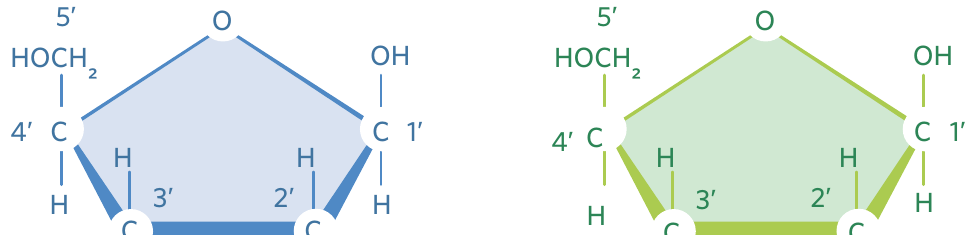
The key structural difference between DNA and RNA lies in their sugar molecules. DNA contains deoxyribose, whilst RNA contains ribose.
Note
The difference is the presence or absence of an oxygen atom at the position of the five-carbon sugar. The prefix "deoxy-" means "without oxygen", indicating that deoxyribose has one less oxygen atom than ribose at the carbon position.
Summary of differences
Important
Exam tip: When differentiating between DNA and RNA, identify the bases present first. DNA contains thymine, whilst RNA contains uracil. You can double-check by examining the five-carbon sugar - DNA has one less oxygen molecule than RNA at the carbon position.
Summary
Key Differences Between DNA and RNA:
- Structure: DNA is double-stranded, RNA is single-stranded
- Sugar: DNA contains deoxyribose, RNA contains ribose
- Bases: DNA has thymine (T), RNA has uracil (U)
- Function: DNA provides long-term genetic storage, RNA is temporary and involved in protein synthesis
- Location: DNA is mainly in the nucleus, RNA can be found throughout the cell
Remember!
Summary
Key Points to Remember:
-
Nucleic acids are polymers of nucleotide monomers that store genetic information and assist in protein production
-
Each nucleotide contains three components: a phosphate group, a five-carbon sugar, and a nitrogenous base
-
DNA is double-stranded, contains deoxyribose sugar and thymine, forms a double helix, and provides long-term genetic storage
-
RNA is single-stranded, contains ribose sugar and uracil, and exists as temporary molecules (mRNA, tRNA, rRNA) involved in protein synthesis
-
Complementary base pairing follows strict rules: A pairs with T in DNA (or U in RNA), and C pairs with G
-
Nucleotides are joined by phosphodiester bonds to form the sugar-phosphate backbone
-
DNA's antiparallel structure means the two strands run in opposite directions ( and )