The Protein Secretory Pathway (VCE SSCE Biology): Revision Notes
📚Revision Notes
The Protein Secretory Pathway
Introduction
The protein secretory pathway is a sophisticated cellular system that enables proteins to be transported out of the cell where they are made. Many proteins synthesised within cells don't remain there. Instead, they need to be exported to other parts of the body where they perform essential functions. For instance, the hormone insulin is produced by pancreatic cells but must be released into the bloodstream to reach target cells in the liver and other tissues.
This process involves multiple organelles working together in a coordinated sequence to produce, modify, package, and ultimately export proteins from the cell through a process called exocytosis.
Exocytosis
What is exocytosis?
Exocytosis is a type of bulk transport that moves large substances out of a cell. It enables the contents of a vesicle to be released into the extracellular environment. Since exocytosis is a form of active transport (the movement of molecules across a semipermeable membrane requiring an energy input), it requires energy in the form of ATP to function.
Note
Exocytosis is classified as both bulk transport and active transport. As bulk transport, it moves large molecules or groups of molecules. As active transport, it requires energy input to work against concentration gradients or to move large materials across the membrane.
The stages of exocytosis
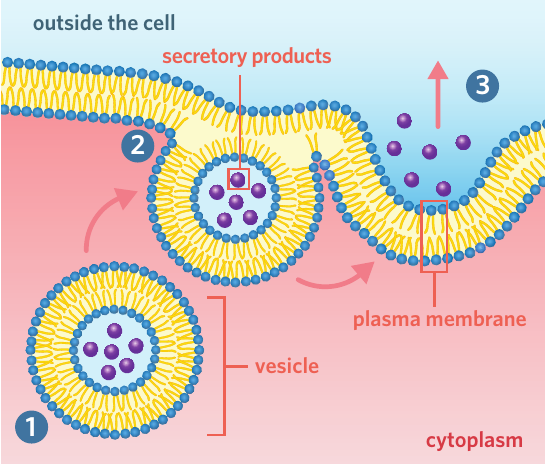
The process of exocytosis occurs in three main stages:
- Transport to the membrane: A vesicle containing secretory products moves through the cytoplasm towards the plasma membrane.
- Membrane fusion: The membrane of the vesicle fuses with the plasma membrane of the cell.
- Release of contents: The secretory products inside the vesicle are released into the extracellular environment outside the cell.
Important
Why the sequence matters: All three stages must occur in order for exocytosis to succeed. The vesicle cannot release its contents without first reaching the membrane and fusing with it. Understanding this sequence is crucial for grasping how cells export materials.
Why exocytosis is possible
Exocytosis can occur because of the fluid nature of the plasma membrane. The plasma membrane (the phospholipid bilayer with embedded proteins which separates the intracellular environment from the extracellular environment) is not a rigid, static structure. Instead, it is mobile and flexible, allowing it to fuse with vesicles. This fluidity enables the membrane of the vesicle to merge seamlessly with the plasma membrane, creating an opening through which the vesicle's contents can be released.
Beyond protein export, exocytosis also plays a role in removing waste products from cells, preventing the build-up of toxic substances in the intracellular environment.
The protein secretory pathway
Overview of the pathway
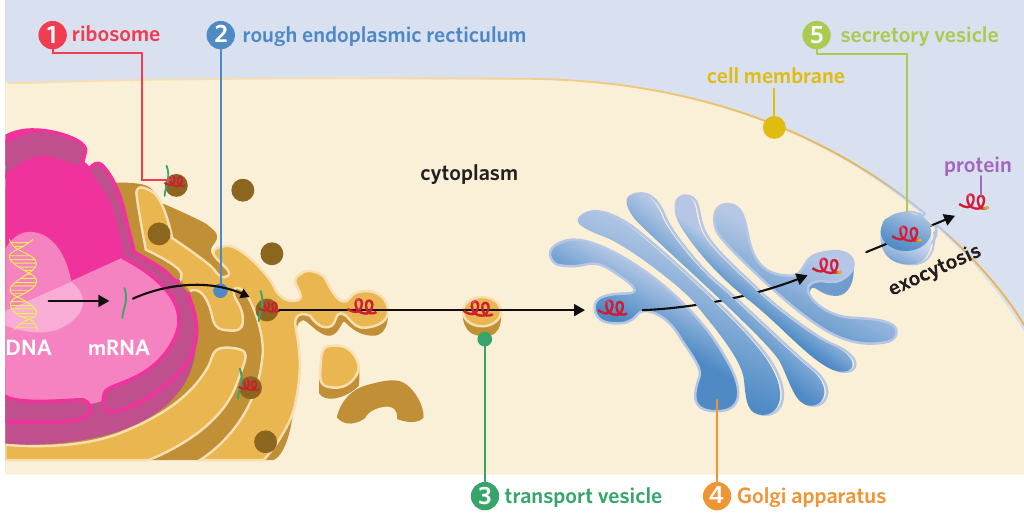
The protein secretory pathway involves several key organelles that work together sequentially. These include:
- Ribosomes: Sites of protein synthesis
- Rough endoplasmic reticulum (RER): Folds and transports proteins
- Transport vesicles: Carry proteins between organelles
- Golgi apparatus: Modifies and packages proteins
- Secretory vesicles: Transport proteins to the cell membrane for export
Note
Think of the pathway as an assembly line: Each organelle acts like a station on a production line, with proteins being passed from one station to the next. Just as each station in a factory has a specific job, each organelle performs a distinct function in preparing proteins for export.
Detailed roles of each organelle
Let's examine the specific function of each organelle in the protein secretory pathway:
| Organelle | Function | Description |
|---|---|---|
| Ribosome | Synthesises proteins | Ribosomes are the sites of protein synthesis. They assemble polypeptide chains from amino acids by translating mRNA. A ribosome is an organelle made of rRNA and protein that is the site of protein synthesis. It can be free in the cytosol or attached to the rough endoplasmic reticulum. |
| Rough endoplasmic reticulum | Folds and transports proteins | If a protein is destined to be secreted, the ribosome synthesising it is usually attached to the rough endoplasmic reticulum rather than being free in the cytosol. The rough endoplasmic reticulum (RER) is a membranous organelle shaped like a series of connected, flattened cylinders that folds and transports proteins via its attached ribosomes. The environment inside the RER allows for the correct folding of the newly formed polypeptide chain before being passed to the Golgi apparatus. |
| Transport vesicle | Transports proteins | A vesicle (a small fluid-filled organelle enclosed in a phospholipid membrane that transports substances around the cell) containing the protein buds off the rough endoplasmic reticulum and travels to the Golgi apparatus. The vesicle fuses with the Golgi membrane and releases the protein into its lumen. |
| Golgi apparatus | Modifies and packages proteins | The Golgi apparatus is an organelle made of flattened sacs of membrane involved in modifying, sorting, and packaging proteins (also known as the Golgi body or Golgi complex). Proteins can have chemical groups, such as sugar molecules, added or removed at the Golgi apparatus. They are then packaged into secretory vesicles for export or released directly into the cytosol for use by the cell. |
| Secretory vesicle | Transports proteins | Secretory vesicles containing proteins for export bud off the Golgi apparatus and travel through the cytoplasm, fusing with the plasma membrane. This releases the secretory products (the substances inside a vesicle that are being transported out of the cell) into the extracellular environment through the process of exocytosis. |
Important
Common mistake to avoid: Don't confuse transport vesicles with secretory vesicles. Transport vesicles carry proteins between the RER and Golgi apparatus (inside the cell), while secretory vesicles carry proteins from the Golgi to the plasma membrane for export (out of the cell).
The complete sequence
The protein secretory pathway follows this sequential process:
- Proteins are synthesised at ribosomes
- They are folded in the rough endoplasmic reticulum
- Transport vesicles carry them to the Golgi apparatus
- The Golgi apparatus modifies and packages them
- Secretory vesicles transport them to the plasma membrane
- Exocytosis releases them from the cell
Example
Worked Example: Insulin Secretion Pathway
Let's trace how insulin moves through the protein secretory pathway from synthesis to secretion:
Step 1: Ribosomes attached to the RER begin synthesising the insulin protein based on mRNA instructions.
Step 2: As the insulin polypeptide chain is produced, it enters the lumen of the RER where it folds into its correct three-dimensional structure.
Step 3: A transport vesicle containing the folded insulin buds off from the RER and moves through the cytoplasm to the Golgi apparatus.
Step 4: At the Golgi apparatus, the insulin undergoes final modifications and is packaged into secretory vesicles.
Step 5: The secretory vesicles travel to the plasma membrane of the pancreatic cell.
Step 6: Through exocytosis, the vesicle fuses with the plasma membrane, releasing insulin into the bloodstream where it can reach its target cells.
Supporting organelles
Whilst the organelles listed above are the primary players in the protein secretory pathway, other organelles contribute to the process:
- Mitochondria: These are double-membrane-bound organelles that are the site of the second and third stages of aerobic cellular respiration. They synthesise ATP, providing the energy required to move vesicles around the cell and to modify the proteins produced. Since exocytosis is an active transport process, it requires energy, which the mitochondria supply.
- Plasma membrane: This structure facilitates the final stage of the pathway by fusing with secretory vesicles during exocytosis, enabling the release of proteins from the cell.
- Nucleus: The nucleus stores DNA, which contains the genetic instructions for making mRNA. This mRNA is then used as a template during protein synthesis at the ribosomes.
Note
Without ATP from mitochondria, the entire protein secretory pathway would halt. The energy is needed not only for exocytosis itself but also for moving vesicles through the cytoplasm and for the chemical modifications that occur at the Golgi apparatus.
Summary
Key Points to Remember:
-
Exocytosis is active transport: It requires energy (ATP) to move large substances, including proteins, out of cells through bulk transport.
-
The secretory pathway follows a specific sequence: Ribosome → Rough ER → Transport vesicle → Golgi apparatus → Secretory vesicle → Exocytosis.
-
Each organelle has a distinct role: Ribosomes synthesise proteins, the RER folds them, transport vesicles carry them, the Golgi apparatus modifies and packages them, and secretory vesicles transport them for export.
-
The Golgi apparatus is the "processing centre": It modifies proteins by adding or removing chemical groups and packages them for their final destination.
-
Membrane fluidity enables exocytosis: The fluid nature of the plasma membrane allows it to fuse with vesicles, making it possible for secretory products to be released from the cell.