Crashing (VCE SSCE General Mathematics): Revision Notes
📚Revision Notes
Crashing
What is crashing?
Crashing is the process of reducing the time required to complete specific activities in a project, which can shorten the overall project completion time. Project managers use this technique when they need to finish a project more quickly than originally planned.
The completion time for a project depends on two main factors:
- The duration of individual activities
- The dependencies between activities (which activities must be finished before others can start)
Critical path analysis helps identify the minimum time needed to complete a project. By examining this analysis, managers can determine which activities could be shortened to reduce the overall project duration.
Note
Definition: Changing the conditions of an activity within a project, and recalculating the minimum completion time for the project, is called crashing.
Ways to crash an activity:
To crash an activity, managers might:
- Hire additional workers to speed up the work
- Use alternative materials that are faster to work with
- Take advantage of favorable weather or other external conditions
- Allocate more resources to the activity
Which activities should be crashed?
The critical path is key
Understanding which activities to crash is crucial for effective project management. Not all activities are equal when it comes to reducing overall project time.
Important
Only crash activities on the critical path!
Activities on the critical path directly determine the overall project completion time. Activities not on the critical path have slack time (extra time available), so reducing their duration won't shorten the total project time.
Spending money to crash non-critical activities is wasteful and won't achieve your goal of reducing project completion time.
Understanding slack time
Non-critical activities already have slack time built in. This means they can be delayed or take longer without affecting the project's overall completion time. This is why it's essential to focus your crashing efforts only on critical path activities.
A simple crashing example
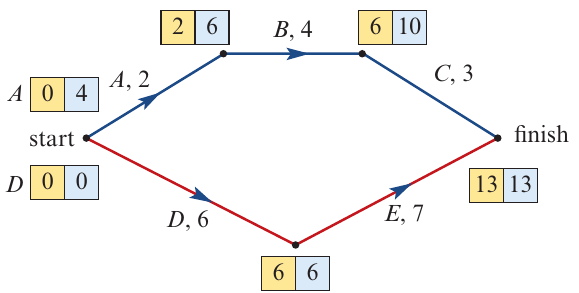
Consider the following activity network. The forward and backward scanning processes have been completed, and the critical path is shown in red.
Current situation:
- Minimum completion time: hours
- Critical path: Start Activity D Activity E Finish
Example
Worked Example: Analyzing Crashing Options
If we want to reduce the overall completion time, we need to consider which activities to crash:
Activities A, B, or C: These are not on the critical path. They already have slack time, so reducing their duration won't shorten the project's total time. Crashing these would be ineffective and wasteful.
Activities D or E: These are on the critical path. Reducing either of these activities will reduce the overall project time.
Example: If activity D is reduced from hours to hours, the project completion time decreases from hours to hours. This achieves the desired outcome.
Crashing with cost considerations
Crashing activities usually involves additional costs. For instance, hiring extra workers or using premium materials costs money. Therefore, when deciding which activities to crash, managers must consider both effectiveness and cost efficiency.
Note
Cost Considerations:
When deciding which activities to crash, managers must balance:
- Which activities are on the critical path (only these will reduce project time)
- The cost per day (or hour) of crashing each activity
- How to minimize the total cost while achieving the desired time reduction
Strategic approach:
When multiple critical activities could be crashed, choose the one with the lowest cost per time unit. In the simple example above:
- Crashing activity D by hour costs $150
- Crashing activity E by hour costs $18
Clearly, crashing activity E is more cost-effective if both activities are on the critical path.
Worked example: crashing one activity with cost
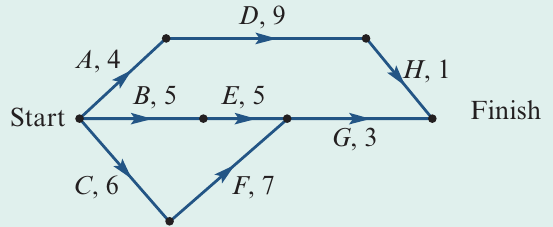
The following directed network shows a project with eight activities. The time (in days) for each activity is shown.
Example
Worked Example: Optimal Crashing Strategy
Part a: Identifying the critical path
To find the critical path, list all possible routes from Start to Finish and calculate each path's total duration:
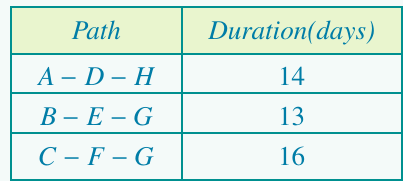
The critical path is C-F-G with a duration of days (the longest path).
Part b: Minimum completion time
The minimum completion time is days (the duration of the critical path).
Part c: New completion time after crashing
Activity F can be reduced by a maximum of days at a cost of $100 per day.
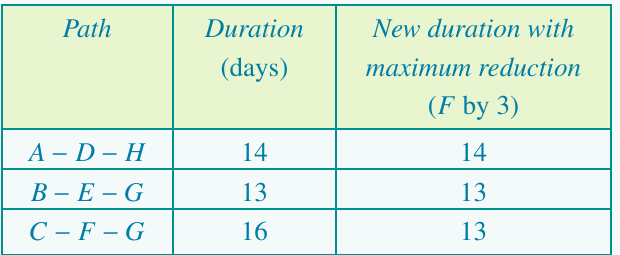
Let's examine what happens if we crash activity F by different amounts:
Analysis:
- If we crash activity F by the maximum days, the path C-F-G reduces from to days
- However, this creates a new critical path: A-D-H with days
- The overall project time becomes days (limited by the new critical path)
Strategic decision:
Crashing activity F by only days is more efficient:
- Path C-F-G becomes days
- This equals the path A-D-H ( days)
- We now have two equal critical paths
- We achieve the same result ( days total) but save $100 compared to crashing by days
The new minimum completion time is days.
Part d: Minimum cost for maximum reduction
To achieve the new minimum completion time of days, we need to crash activity F by days only.
Cost calculation:
The minimum cost is $200.
Important
Watch for new critical paths!
When you crash an activity, always check whether a new critical path emerges. You may not need to apply the maximum reduction to achieve your desired completion time, which can save significant costs.
Worked example: crashing multiple activities with cost
The following directed network shows a project with nine activities (including a dummy activity). The time (in days) for each activity is shown.
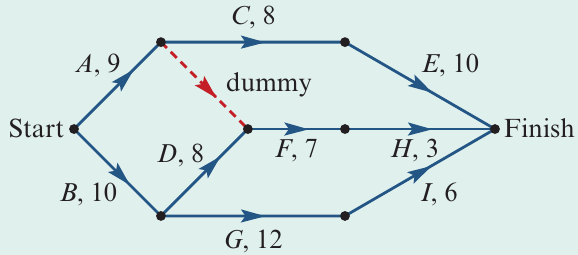
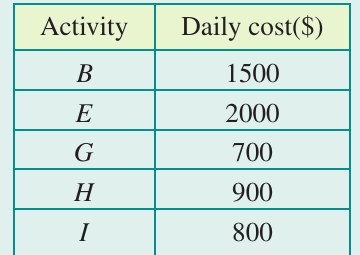
The minimum completion time is currently days. Five activities (B, E, G, H, and I) can be reduced by a maximum of days each. The costs associated with crashing these activities are:
Example
Worked Example: Complex Multi-Activity Crashing
Part a: New minimum completion time
First, list all possible paths and their durations:
| Path | Duration (days) | New duration after maximum reduction (B, E, G, H, I by 2) |
|---|---|---|
| A-C-E | ||
| A-F-H | ||
| B-D-F-H | ||
| B-G-I |
After applying the maximum reduction to all five activities:
- Path A-C-E becomes the new critical path
- The new minimum completion time is days
Part b: Minimum cost for maximum reduction
Now we need to determine the cheapest combination of crashes that achieves the -day completion time.
Step-by-step approach:
Step 1: Consider the new critical path A-C-E
- Activity E must be crashed by days to achieve the -day target
- Cost: 2000 =
Step 2: Ignore path A-F-H
- This path only takes days
- It's already well below the critical path duration
- No crashing needed
Step 3: Consider path B-D-F-H ( days)
- This must be reduced to days (a reduction of days)
- Options: Crash B by and H by , or crash B by and H by
- Activity B costs $1500 per day; activity H costs $900 per day
- Although H is cheaper per day, crashing B is strategic because...
Strategic insight: Crashing activity B affects two paths (B-D-F-H and B-G-I)
- This makes crashing B more cost-effective overall
- Decision: Crash B by days and H by day
- Cost: 1500) + (1 \times 3900$`
Step 4: Consider path B-G-I ( days)
- Already reduced by days due to crashing B (now days)
- Needs one more day of reduction to reach days
- Options: Crash G or I
- Activity G costs $700 per day; activity I costs $800 per day
- Choose G (cheaper)
- Cost: 700 =
Total cost calculation:
The minimum cost to achieve maximum reduction is $8600.
Note
Strategic Tip:
When crashing multiple activities, look for activities that appear in multiple paths. Crashing these activities can reduce several paths simultaneously, often resulting in a more cost-effective solution overall.
Remember!
Summary
Key Points to Remember:
-
Crashing is the process of reducing activity durations to shorten overall project completion time
-
Only crash activities on the critical path - crashing non-critical activities wastes money because they have slack time and won't reduce the project's total duration
-
When multiple activities can be crashed, create a table showing all paths and their durations to identify which activities need crashing
-
Minimize costs by choosing the cheapest activities to crash, and consider activities that appear in multiple critical paths (crashing these affects multiple paths at once)
-
Always check if a new critical path emerges after crashing - you might need to crash additional activities to achieve the desired reduction, or you might save money by crashing less than the maximum amount