Antidifferentiation of Polynomial Functions (VCE SSCE Mathematical Methods): Revision Notes
📚Revision Notes
Antidifferentiation of Polynomial Functions
What is antidifferentiation?
Antidifferentiation is the reverse process of differentiation. When we differentiate , we get . Working backwards, if we know that a function has a derivative of , we can determine that the original function was . This reverse process is called antidifferentiation.
Note
However, there's an important catch: antidifferentiation doesn't give us a single unique answer. Consider these two functions:
When we differentiate both functions, we get:
Both functions have the same derivative!
Important
If two functions have the same derivative, they differ only by a constant.
The family of antiderivatives
Since many functions can have the same derivative, we call any function whose derivative is an antiderivative of . The diagram below shows several different antiderivatives of :
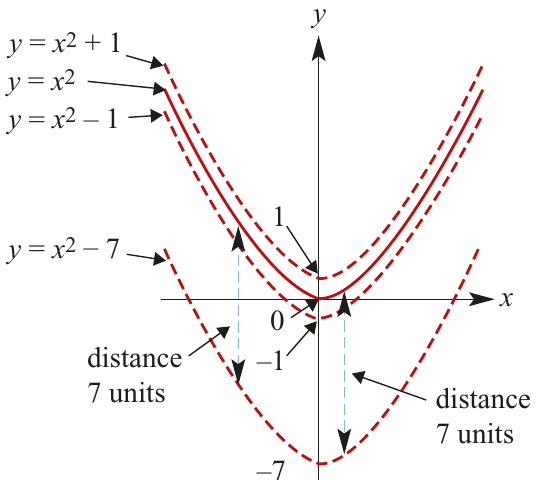
Each parabola is a vertical translation of . They all belong to the same family of curves, and each one differs from the others by a constant amount.
Notation for antiderivatives
We write the general antiderivative of as:
This notation uses the integral symbol (∫) introduced by Leibniz. We read this as "the indefinite integral of with respect to equals plus " or "the general antiderivative of with respect to is ".
Note
The constant is called the constant of integration and can be any real number. This single expression represents the entire family of antiderivatives.
General notation
More generally, if we know that , then:
where is an arbitrary real number (the constant of integration).
Rules for antidifferentiation
The power rule
From differentiation, we know that if , then . Reversing this process gives us the power rule for antidifferentiation:
Important
Power Rule for Antidifferentiation:
In other words: increase the power by one, then divide by the new power.
For example:
(since , we get )
Linearity properties
Antidifferentiation follows three important linearity rules that mirror the rules for differentiation:
Sum rule:
Difference rule:
Constant multiple rule:
where is any real number.
Note
These rules mean we can antidifferentiate term by term in polynomial expressions.
Worked examples
Example
Worked Example: Finding the General Antiderivative of a Power Function
Find the general antiderivative of .
Solution:
(taking the constant outside)
(applying the power rule)
Example
Worked Example: Antidifferentiating a Polynomial
Find the general antiderivative of .
Solution:
Notice that we only need one constant at the end, not a separate constant for each term.
Finding specific antiderivatives
When we're given additional information about a function, we can find a specific antiderivative instead of the general family. This involves using the extra information to determine the value of the constant .
Example
Worked Example: Using a Boundary Condition to Find a Specific Antiderivative
It is known that and . Find .
Solution:
First, find the general antiderivative:
So for some constant .
Now use the condition :
Therefore:
Example
Worked Example: Finding a Curve from its Gradient
If the gradient of the tangent at a point on a curve is given by , and the curve passes through , find the equation of the curve.
Solution:
Let the curve have equation . We're told that .
Find the general antiderivative:
So
This describes a family of curves. We need to find which specific member passes through .
Since the curve passes through , we have :
Therefore:
Example
Worked Example: Finding y in Terms of x
Find in terms of if , and when .
Solution:
Find the general antiderivative:
So
Use the condition that when :
Therefore:
Using technology
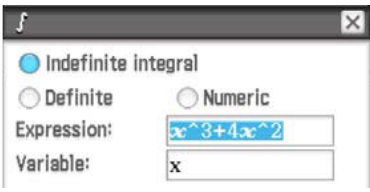
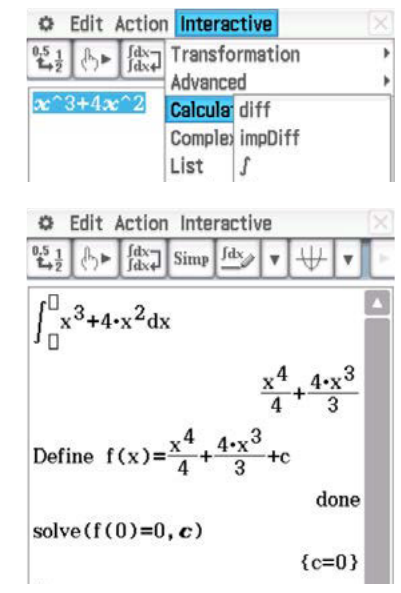
Modern calculators and computer algebra systems can help with antidifferentiation:
Note
When using technology:
- Select "indefinite integral" to find the general antiderivative
- Remember to add the constant to the answer (calculators often omit this)
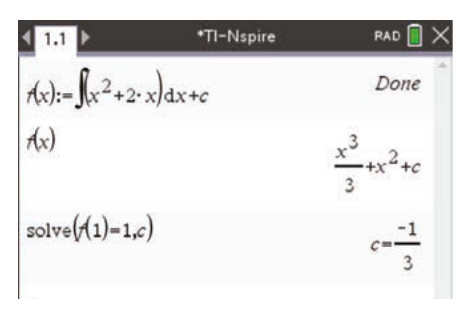
- To find specific antiderivatives, define the function family and then solve for using the given condition
Summary
Summary
Key Points to Remember:
- Antidifferentiation is the reverse of differentiation – it finds a function from its derivative
- The constant of integration is crucial – always add when finding indefinite integrals
- Functions with the same derivative differ by a constant – this is why we get a family of antiderivatives
- The power rule for antidifferentiation: (add one to the power, divide by the new power)
- Use boundary conditions to find specific antiderivatives – extra information about a point on the curve allows you to determine the value of