Derivatives of Circular Functions (VCE SSCE Mathematical Methods): Revision Notes
📚Revision Notes
Derivatives of Circular Functions
Introduction
In this section, we learn how to find the derivatives of the circular functions: sine, cosine and tangent. These are fundamental results that allow us to work with trigonometric functions in calculus.
Note
Understanding these derivatives is essential for many applications in physics, engineering, and advanced mathematics. They form the foundation for analyzing oscillatory motion, waves, and periodic phenomena.
The key derivatives we will establish are:
- The derivative of is
- The derivative of is
- The derivative of is
The derivative of
Basic result for sine
The fundamental result for the sine function is:
If , where , then f'(θ) = cos θ
This can be proved using first principles and relies on an important limit result.
Important limit result
Important
A crucial limit needed for proving the derivative of sine is:
This is one of the most important limits in calculus and underpins all trigonometric differentiation.
This result can be understood geometrically using the unit circle. Consider a point on the unit circle where the angle .
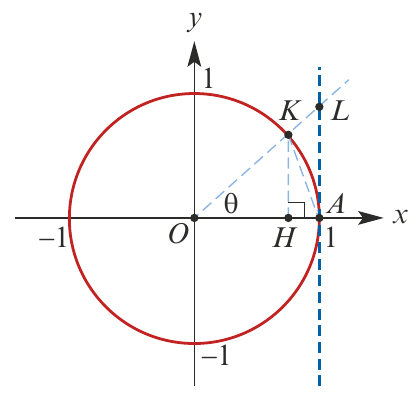
Note
In the diagram:
- has coordinates on the unit circle
- Point is on the -axis such that is a right angle
- A tangent line is drawn to the circle at
- Line intersects this tangent at
By comparing areas, we can show that for :
Dividing through by (which is positive in this range):
As approaches , approaches . This squeezes towards , which means approaches .
Proving the derivative of sine
Using the limit result above, we can prove that the derivative of is using first principles.
We also need the limit:
The proof uses the identity and considers the gradient of the secant between points and .
General case using chain rule
For the more general function , we use the chain rule.
Let and let
Then , and:
Important
Key Formula:
For , where
, where f'(θ) = k cos(kθ)
Notice that the coefficient multiplies the derivative result.
The derivative of
Complementary angle relationships
To find the derivative of cosine, we use these complementary angle identities:
Derivation
Let
Let
Then
Using the chain rule:
General formula
Important
Key Formulas:
For , where
, where f'(θ) = -sin θ
For , where
, where f'(θ) = -k sin(kθ)
Notice the negative sign - this is a key difference from the sine derivative.
The derivative of
The secant function
For working with tangent derivatives, we introduce the secant function:
Note
We also use the notation:
This power notation is standard in trigonometry and makes expressions more compact.
Derivation from first principles
The derivative of can be found using first principles. Consider points and on the graph.
The gradient of the secant is:
After algebraic manipulation using , this simplifies to:
As :
Therefore:
General formula using chain rule
For , using the chain rule gives:
Important
Key Formula:
If , then f'(θ) = k sec²(kθ)
Worked examples
Example
Worked Example: Finding Derivatives of Circular Functions
Find the derivative with respect to of each of the following:
a
b
c
d
e
f

Solution:
a Let
Using the derivative formula for sine:
b Let
Using the derivative formula for tangent:
c Let and
Then
Using the chain rule:
d Let and
Then
Using the chain rule:
e Let and
Then
Using the chain rule:
Note
In part e, notice the negative sign that appears because we're differentiating a cosine function. This is a common source of errors, so always remember: cosine differentiates to negative sine.
f Let and
Then
Using the chain rule:
Example
Worked Example: Finding Gradients at Specific Points
Find the -coordinate and the gradient of the tangent at the points on the following curves corresponding to the given values of :
a at and
b at and
Solution:
a Let
Then:
When :
So the gradient at is
When :
The gradient at is
b Let
Then:
When :
The gradient at is
When :
The gradient at is
Summary of formulas
Summary
Key Derivative Formulas for Circular Functions:
-
If , where , then , where f'(θ) = k cos(kθ)
-
If , where , then , where f'(θ) = -k sin(kθ)
-
If , then f'(θ) = k sec²(kθ)
Exam tip: When differentiating circular functions with composite arguments (like ), always use the chain rule and remember to multiply by the derivative of the inner function.
Remember!
Summary
Key Points to Remember:
- The derivative of is - sine differentiates to cosine with a positive sign
- The derivative of is - cosine differentiates to negative sine
- The derivative of is where
- Always use the chain rule when the argument is more complex than just
- The coefficient k multiplies the derivative result