Differentiating Rational Powers (VCE SSCE Mathematical Methods): Revision Notes
📚Revision Notes
Differentiating Rational Powers
Introduction to rational powers
When working with differentiation, we need to handle not just integer powers like or , but also rational (fractional) powers such as or . These are also written using root notation, for example or .
To develop our understanding of how to differentiate these functions, we'll first explore the process using first principles, then learn a more efficient method using the chain rule.
Differentiating by first principles
Note
When we differentiate from first principles, we use the fundamental definition of the derivative:
Let's see how this works for two important fractional powers.
Example
Worked Example: Differentiate each of the following by first principles:
a) ,
b) ,
Solution
a) For , we start with the difference quotient:
To simplify this expression, we multiply by the conjugate:
Using the difference of squares pattern :
Taking the limit as :
b) For , we need to use a different algebraic identity. Recall that:
Notice that if we cube both sides of , we get . Similarly for . This means we can write:
Rearranging this gives:
Now we can work with the difference quotient:
Taking the limit:
Note
A similar identity exists for any positive integer :
We could use this to find the derivative of from first principles, but the chain rule method we'll see next is more efficient.
Using the chain rule
The reciprocal derivative relationship
The chain rule provides us with a powerful relationship. If is a one-to-one function of , then:
Setting , we get:
This can be rearranged to give the reciprocal relationship:
This reciprocal relationship is the key to efficiently finding derivatives of fractional powers.
Deriving the formula for
Let , where (that is, is a non-zero integer) and .
Raising both sides to the power of :
Now differentiate both sides with respect to :
Using the reciprocal relationship:
Substituting back:
Important
Formula for fractional powers with unit numerator:
For , we have:
where and .
Extending to general rational powers
We can now extend this result to any rational power of the form , where .
Let .
We can write this as:
Let . Then .
Using the chain rule:
Substituting :
Combining the powers of :
This shows that the power rule extends to rational powers.
Important
General power rule for any real power:
For , we have:
where and .
In fact, this formula works for any non-zero real number , not just rational numbers.
Domain and graphs of fractional powers
Why ?
Note
The restriction is important because expressions like are not defined in the real numbers (since we cannot take the square root of a negative number). However, is defined because we can take the cube root of a negative number.
To avoid complications, when differentiating fractional powers, we generally restrict the domain to positive real numbers.
Graphs of fractional power functions
The following graph shows three fractional power functions with their domain restricted to (positive real numbers):
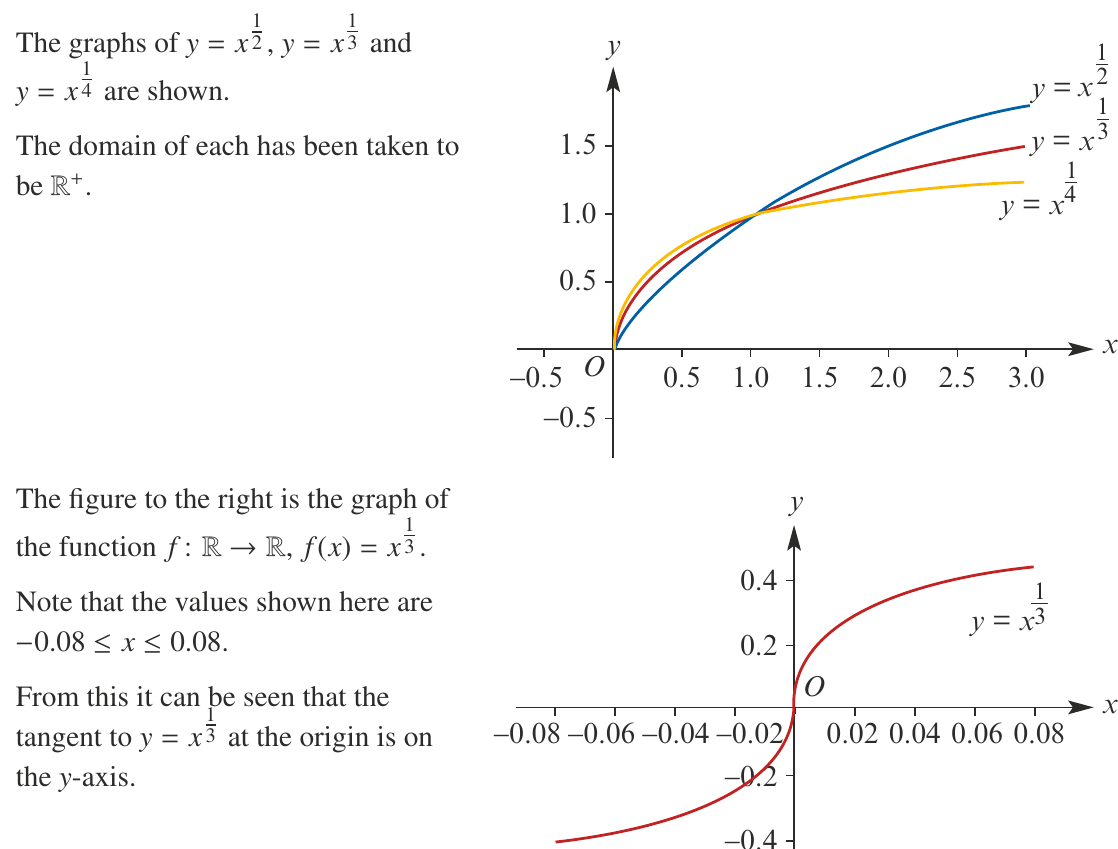
Key observations from the graphs:
- All three functions pass through the origin
- All three functions are increasing
- As the denominator of the fractional power increases, the function grows more slowly
- grows fastest, then , then
Special case: vertical tangent at the origin
The second part of the diagram shows a zoomed-in view of near the origin (range ).
From this enlarged view, we can see that the tangent to at the origin is vertical (it lies along the -axis).
Important
Why is there a vertical tangent?
This makes sense mathematically. The derivative at would be:
which is undefined because we're dividing by zero. When the derivative is undefined in this way, it indicates a vertical tangent.
Applying the differentiation rules
Example
Worked Example: Find the derivative of each of the following with respect to :
a)
b)
Solution
a) We differentiate each term using the power rule:
For the first term:
For the second term:
Therefore:
b) First, rewrite using fractional power notation:
Now we use the chain rule. Let , so .
We have:
Therefore:
Substituting back:
This can be written as:
or
Remember!
Summary
Key Points to Remember:
-
Power rule for rational powers: For any non-zero rational number , if , then
-
Domain restriction: When working with fractional powers, we generally require to ensure all expressions are defined in the real numbers
-
Chain rule application: When differentiating composite functions involving rational powers, use the chain rule: differentiate the outer function, then multiply by the derivative of the inner function
-
Vertical tangents: If the derivative becomes undefined at a point (such as at the origin for ), this may indicate a vertical tangent line
-
Converting between notations: Remember that and , which helps when applying the differentiation rules