Differentiation of Different Functions (VCE SSCE Mathematical Methods): Revision Notes
📚Revision Notes
Differentiation of Different Functions
Understanding exponential functions and their derivatives
When working with exponential functions, we discover that one particular base has remarkable properties that make it especially important in calculus. This special number is Euler's number, denoted as .
Note
The exponential function with base has a unique property that sets it apart from all other exponential functions - it is its own derivative. This remarkable characteristic makes it fundamental to calculus and appears throughout mathematics, physics, and engineering.
Investigating the derivative of exponential functions
To understand why is special, let's explore what happens when we differentiate exponential functions with different bases.
Consider the function . Using first principles to find its derivative:
Through numerical investigation, we find that f'(0) ≈ 0.6931, which means .
Similarly, for , we can show that , where g'(0) ≈ 1.0986.
This leads us to an important question: can we find a number between and such that if , then and therefore ?
Finding Euler's number
Through systematic numerical investigation, we can narrow down this special value. The investigation involves calculating as approaches , for various values of .
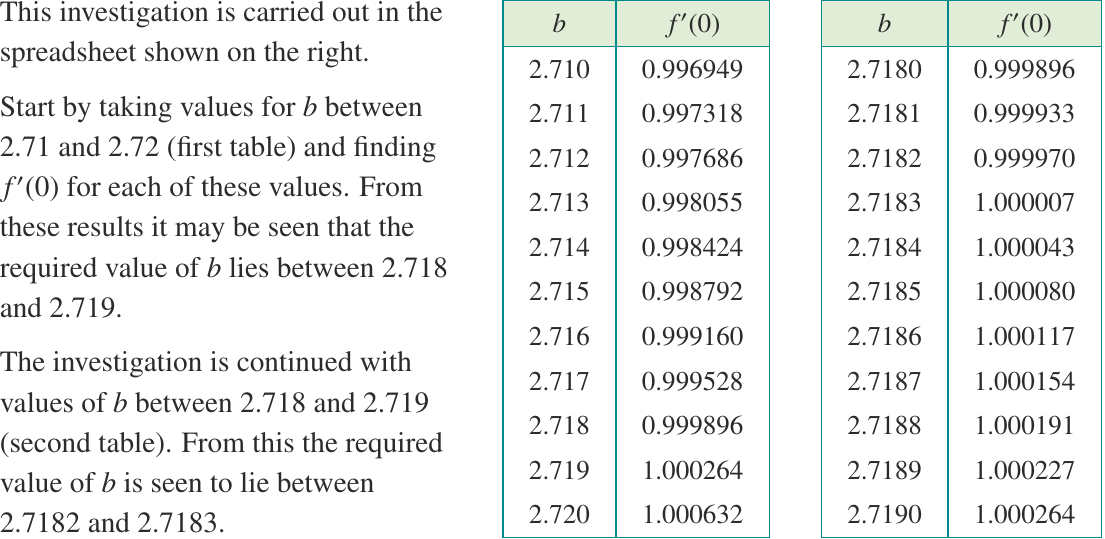
This investigation reveals that the special number is Euler's number . This gives us our first important result:
Important
For ,
This means the exponential function with base is its own derivative - a truly remarkable property that makes it fundamental in calculus.
Differentiating functions involving
The derivative of
When we have an exponential function of the form where is a constant, we use the chain rule to find the derivative.
Let . Then .
Using the chain rule:
Important
For , where
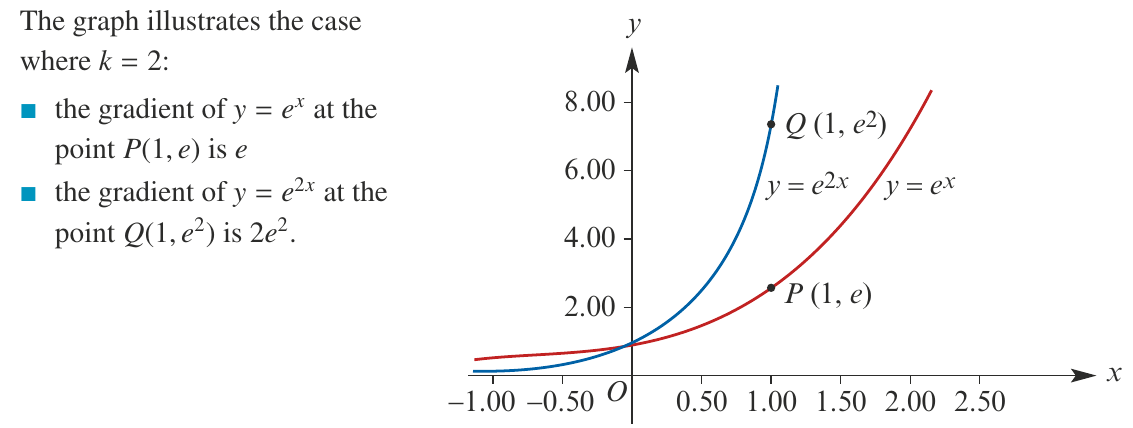
The graph illustrates this concept with . Notice that:
- The gradient of at point is
- The gradient of at point is
Example
Worked Example: Basic Exponential Derivatives
Find the derivative of each function with respect to :
a)
Let
b)
Let
c)
We can rewrite this as
d)
First, rewrite:
Using the chain rule with composite exponential functions
For more complex exponential functions where the exponent is itself a function, we apply the chain rule.
Important
For , the chain rule gives
Example
Worked Example: Composite Exponential Functions
Find the derivative of each function with respect to :
a)
Let and
Then
Using the chain rule:
b)
Let and
Then
Using the chain rule:
Example
Worked Example: Finding Gradients of Tangent Lines
Find the gradient of the tangent to the curve at the point:
a)
First, find the derivative:
When :
The gradient at is 2.
b)
Using
When :
The gradient at is 2e².
Example
Worked Example: Derivatives with Given Function Values
For each expression, find the derivative with respect to , then evaluate at , given that , , and .
a)
Let and . Then .
Using the chain rule:
When :
b)
Let and . Then .
Using the chain rule:
When :
Differentiation of the natural logarithm function
The natural logarithm function, written as or , is the inverse of the exponential function . This relationship helps us find its derivative.
Deriving the derivative of
Let where , and solve for :
Since we know that and :
Therefore:
Important
For where ,
Notice that the constant doesn't affect the derivative - the result is simply .
The derivative of
For linear expressions inside the logarithm, we use the chain rule.
Important
If for , then
This is a particularly useful result that appears frequently in differentiation problems.
Example
Worked Example: Differentiating Logarithmic Functions
Find the derivative of each function with respect to :
a) ,
Method 1: Direct application
Let for
Method 2: Using the chain rule
Let . Then
b) ,
Let and
Then
Using the chain rule:
Using the chain rule with composite logarithmic functions
When the logarithm contains a more complex function, we apply the chain rule systematically.
Important
For , the chain rule gives
This means: differentiate what's inside and divide by what's inside.
Example
Worked Example: Composite Logarithmic Functions
Differentiate each function with respect to :
a)
Let and
Then
Using the chain rule:
b) ,
Let and
Then
Using the chain rule:
Note
Important Note About Logarithms of Negative Arguments
For where , using the chain rule with gives:
This shows that the derivative is still , even when the argument is negative (as long as the argument itself is positive).
Key formulas summary
Summary
Key Formulas for Exponential and Logarithmic Differentiation
Exponential functions:
For exponential functions involving :
-
-
where
-
(using the chain rule)
Natural logarithm functions:
For natural logarithm functions:
-
where
-
where
-
(using the chain rule)
Summary
Key Points to Remember:
-
The exponential function is unique because it is its own derivative:
-
When differentiating , multiply by the coefficient to get
-
For composite exponential functions , use the chain rule: the derivative is
-
The derivative of is simply , regardless of the constant (provided )
-
For composite logarithmic functions , the derivative is - differentiate the inside and divide by the inside
-
Always check the domain when working with logarithms - the argument must be positive