Limits and Continuity (VCE SSCE Mathematical Methods): Revision Notes
📚Revision Notes
Limits and Continuity
Understanding limits
A limit describes the value that a function approaches as the input approaches a particular point. This is a fundamental concept in calculus that helps us understand the behaviour of functions.
The notation tells us that as gets closer and closer to the value , the function approaches the value . We can make as close as we like to by choosing values of sufficiently close to .
For many functions, particularly polynomial functions, finding the limit at a point is straightforward - we simply substitute the value into the function.
Example
Worked Example: Finding a Simple Limit
Find .
Solution:
Explanation: As gets closer and closer to , the value of gets closer and closer to .
Limits when functions are undefined
When a function is not defined at a particular value, we need a different approach. Often this involves algebraic manipulation, such as factoring and cancelling common terms.
Example
Worked Example: Limit with Undefined Function
For , where , find .
Solution:
Observe that:
Hence .
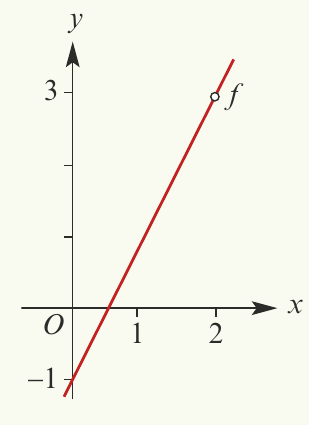
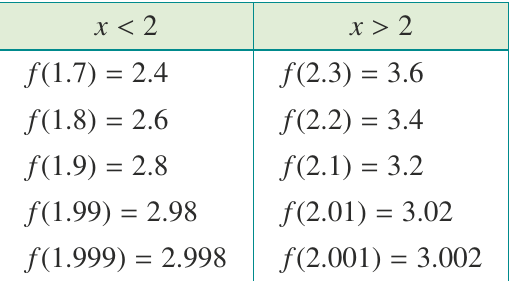
From the table, we can see that as takes values closer to from either the left or the right, the function values approach .
Important
The limit exists even though the function is not defined at . This is a crucial distinction - the limit describes the behaviour near a point, not necessarily at the point itself.
Algebra of limits
When working with limits, we can use several important rules that make calculations easier. These rules assume that both and exist.
Sum rule
The limit of the sum is the sum of the limits.
Multiple rule
where is a constant. We can take constant factors outside the limit.
Product rule
The limit of the product is the product of the limits.
Quotient rule
provided
Note
The limit of the quotient is the quotient of the limits, as long as the denominator's limit is not zero. This restriction is essential to avoid division by zero.
Example
Worked Example: Applying Limit Rules
Find the following limits:
a)
b)
c)
Solution:
a)
b)
c)
Example
Worked Example: Factoring to Find Limits
Find the following limits by factoring first:
a)
b)
c)
Solution:
a)
b)
c)
Left and right limits
Sometimes it's useful to consider what happens when we approach a value from one side only. This is particularly important for piecewise-defined functions.
Right-hand limit
If approaches the value as approaches from the right (from values greater than ), we write:
Left-hand limit
If approaches the value as approaches from the left (from values less than ), we write:
Existence of limits
Important
The limit exists only if both the left-hand and right-hand limits exist and are equal. In that case, we can write .
Piecewise-defined functions
For piecewise-defined functions, the limit may not exist at certain points, even though the function is defined there.
Consider the function:
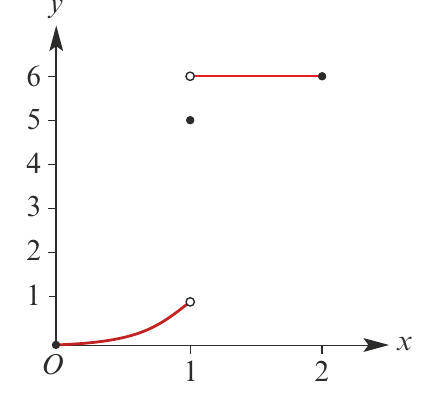
From the graph, we can see that does not exist. However, if we approach from the left, approaches , and if we approach from the right, approaches . Also note that .
Note
This shows that the function value, the left-hand limit, and the right-hand limit can all be different. This is a key characteristic of discontinuous functions.
Asymptotic behaviour and the rectangular hyperbola
Limit notation is useful for describing how functions behave near vertical and horizontal asymptotes.
Consider the function for .
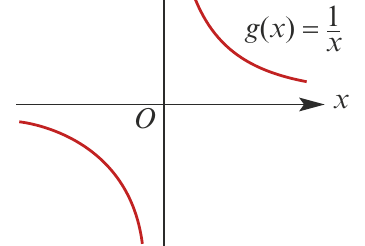
As approaches from the left, the function decreases without bound, while from the right it increases without bound. We write:
As increases towards positive infinity, the function values approach zero from above, and as decreases towards negative infinity, the values approach zero from below:
Note
The notation indicates approaching zero from positive values (from above), while indicates approaching zero from negative values (from below).
Continuity at a point
Understanding continuity helps us identify where functions have breaks or gaps in their graphs.
Intuitive definition
A function is continuous at if we can draw the graph through the point without lifting our pen. If we cannot do this, there is a discontinuity at .
Formal definition
A function is continuous at the point if:
- is defined at
Important
Both conditions must be satisfied for the function to be continuous at that point. If either condition fails, the function is discontinuous at that point.
A function is discontinuous at a point if it is not continuous there.
A function is continuous everywhere if it is continuous for all real numbers. All polynomial functions are continuous everywhere.
Example
Worked Example: Identifying Discontinuities from Graphs
State the values of for which the functions shown below have a discontinuity:
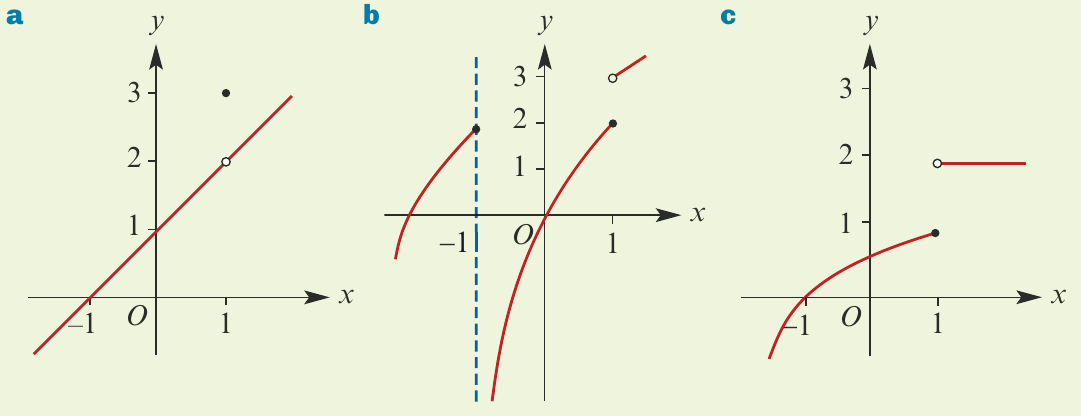
Solution:
a) Discontinuity at , as but .
b) Discontinuity at , as and but ,
and a discontinuity at , as and but .
c) Discontinuity at , as and but .
Example
Worked Example: Analyzing Continuity of Piecewise Functions
For each function, state the values of for which there is a discontinuity, and explain why using limits:
a)
b)
c)
d)
e)
Solution:
a) but , therefore there is a discontinuity at .
b) but , therefore there is a discontinuity at .
c) but , therefore there is a discontinuity at .
but , therefore there is a discontinuity at .
d) No discontinuity.
e) No discontinuity.
Summary
Key Points to Remember:
-
The limit means that approaches as approaches .
-
For continuity at , two conditions must be met: the function must be defined at , and .
-
The algebra of limits allows us to split complex limits into simpler parts: sums, products, quotients, and constant multiples can all be separated.
-
Left and right limits may differ at a point, particularly for piecewise-defined functions. The overall limit exists only when both one-sided limits exist and are equal.
-
All polynomial functions are continuous everywhere, making them particularly well-behaved mathematical objects.