Rules for Differentiation (VCE SSCE Mathematical Methods): Revision Notes
📚Revision Notes
Rules for Differentiation
The power rule
When we differentiate using first principles, we discover a pattern. Looking at some simple examples:
- For , we get
- For , we get
- For , we get
This pattern reveals a fundamental relationship between the power and its derivative, leading us to one of the most powerful tools in calculus.
Note
Notice the pattern: in each case, the power becomes the coefficient, and the power itself decreases by 1. This consistent behavior is what makes the power rule so useful.
This pattern leads us to the power rule, one of the most important rules in differentiation:
Important
The Power Rule
For , we have , where
In other words, to differentiate raised to a power:
- Bring the power down as a coefficient
- Reduce the power by 1
This result can be proven using the binomial theorem, but you don't need to memorize the proof for your exam.
Rules for differentiating polynomials
The following rules are essential tools when finding derivatives of polynomial functions. Understanding these will make differentiation much easier and allow you to tackle more complex problems with confidence.
Constant function rule
If (where is a constant), then .
This makes sense because a constant function is a horizontal line, which has zero gradient.
Multiple rule
If (where is a constant), then .
The derivative of a number multiple is simply the multiple of the derivative. Constants can be factored out of the differentiation process.
Example: If , then
Sum rule
If , then .
The derivative of a sum equals the sum of the derivatives. This means we can differentiate each term separately and then add the results.
Example: If , then
Difference rule
If , then .
The derivative of a difference equals the difference of the derivatives. Like the sum rule, we can differentiate each term separately.
Example: If , then
Note
The process of finding the derivative function is called differentiation. These rules work together to let us differentiate any polynomial function quickly and efficiently.
Worked examples
Example
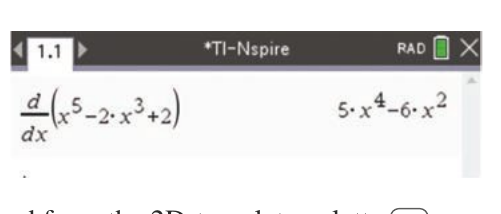
Worked Example: Differentiating a Polynomial
Differentiate with respect to .
Solution:
Let
Then
Explanation: We apply the power rule to each term. The derivative of is , the derivative of is (using the multiple rule), and the derivative of the constant 2 is 0.
Example
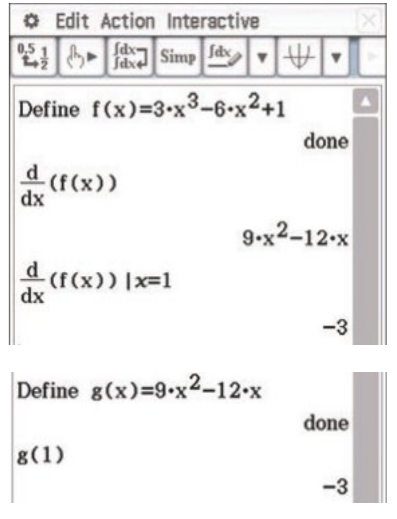
Worked Example: Finding a Specific Derivative Value
Find the derivative of and thus find .
Solution:
Let
Then
Therefore
Alternative notation systems
There are different ways to write derivatives. It's important to recognize and use both systems, as different textbooks and exams may use different notations. Being fluent in multiple notation systems will help you understand mathematics from various sources.
Leibniz notation
An alternative way to denote derivatives uses the symbol .
If , then the derivative can be written as
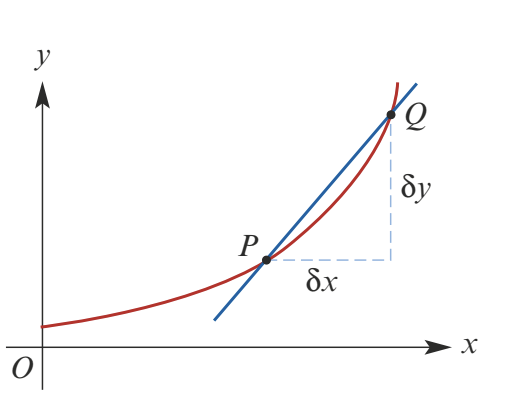
In general, if is a function of , then the derivative of with respect to is denoted by .
Similarly, if is a function of , then the derivative of with respect to is denoted .
Important
Important Warning About Leibniz Notation
In Leibniz notation, the symbol is not a factor and cannot be cancelled. The notation represents a single entity—the derivative—not a fraction.
Do not treat as if it were a fraction with numerator and denominator .
Note
Historical Context
The notation originated in the eighteenth century when mathematicians used to mean a small difference in and to mean a small difference in , where (delta) is the lowercase Greek letter d. This historical connection helps explain why we use in the derivative notation.
Example
Worked Example: Using Leibniz Notation
a) If , find
b) If , find
c) If , find
Solution:
a)
b)
c)
Example
Worked Example: Simplifying Before Differentiating
a) For , find
b) For , find
c) For , find
d) Differentiate with respect to
Solution:
a) First expand:
Therefore
b) Expand the expression:
Therefore
c) First simplify: (for )
Therefore (for )
d)
Therefore
Operator notation
There's another way to express "find the derivative with respect to ". This notation emphasizes the operation of differentiation itself.
Instead of writing "find the derivative of with respect to ", we can write "find ".
In general:
Here, acts as an operator that tells us to differentiate whatever follows it with respect to .
Example
Worked Example: Using Operator Notation
Find:
a)
b)
c)
Solution:
a)
b)
c)
Finding the gradient of a tangent line
Remember that the tangent line to the graph of function at point is the line through that point with gradient .
This connection between derivatives and tangent lines is fundamental to calculus. The derivative at a point gives us the exact slope of the tangent line at that point.
This means we can find the gradient of any tangent line by:
- Finding the derivative
- Substituting the -coordinate of the point into
Example
Worked Example: Finding the Gradient of a Tangent
For the curve determined by the rule , find the gradient of the tangent line to the curve at the point .
Solution:
First find the derivative:
Then evaluate at :
The gradient of the tangent line at the point is .
Finding coordinates from gradient conditions
Sometimes we need to find points on a curve where the tangent has a specific gradient. This is the reverse problem—instead of finding the gradient at a given point, we know the gradient and need to find the point(s).
This involves:
- Finding
- Setting equal to the required gradient
- Solving for
- Finding the corresponding -coordinate
Example
Worked Example: Finding Points with Given Gradient
For each curve, find the coordinates of points where the gradient of the tangent line has the given value:
a) , gradient = 8
b) , gradient = 0
c) , gradient =
Solution:
a) implies
Set
When :
When :
The points are and
b) implies
Set
When :
The only point is
c) implies
Set
When :
When :
The points are and
Angles and gradients
The gradient of a curve at a point is the gradient of the tangent at that point. Each point on a curve has an associated tangent line, and we can describe that tangent using either its gradient or the angle it makes with the horizontal axis.
If is the angle a straight line makes with the positive direction of the -axis, then the gradient of the line equals . That is:
Example: If , then , so the gradient is .
Example
Worked Example: Using Angles to Find Points
Find the coordinates of points on the curve at which the tangent line:
a) makes an angle of with the positive direction of the -axis
b) is parallel to the line
Solution:
First find the derivative:
a) Since the angle is , the gradient is
Set
When :
The coordinates are
b) The line has gradient
Set
When :
The coordinates are
Increasing and decreasing functions
A function's behavior—whether it's going up or down—is directly related to the sign of its derivative. This connection gives us a powerful tool for analyzing functions without having to draw their graphs.
Important
Key Definitions
- A function is strictly increasing on an interval if implies
- A function is strictly decreasing on an interval if implies
The derivative provides a direct test for whether a function is increasing or decreasing on an interval.
Important results:
If for all in an interval, then the function is strictly increasing on that interval. Think of the tangents at each point—they each have positive gradient, meaning the function is rising.
If for all in an interval, then the function is strictly decreasing on that interval. Think of the tangents at each point—they each have negative gradient, meaning the function is falling.
Note
Special Case
A function can be strictly increasing even if the derivative equals zero at some points. For example, is strictly increasing everywhere, but . What matters is that the derivative is non-negative throughout the interval and positive on most of it.
Sign of the derivative
The gradient of a tangent can be positive, negative, or zero, and this tells us important information about the function's behavior at each point.
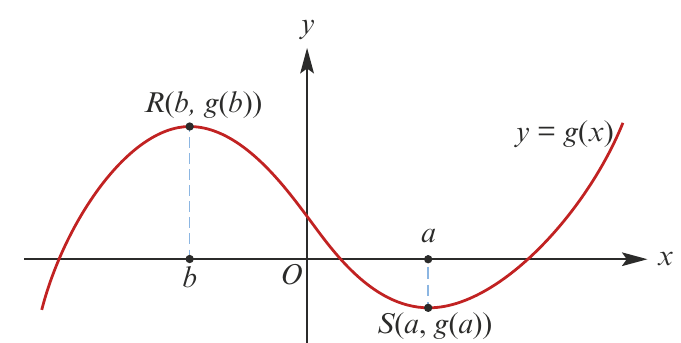
Looking at a typical graph, we can identify several features based on the tangent lines:
- Where the tangent slopes upward (positive gradient):
- Where the tangent is horizontal (zero gradient):
- Where the tangent slopes downward (negative gradient):
At points where the gradient is zero, the function often has a local maximum or minimum (turning point).
Example
Worked Example: Identifying Where Derivatives are Positive, Negative, or Zero
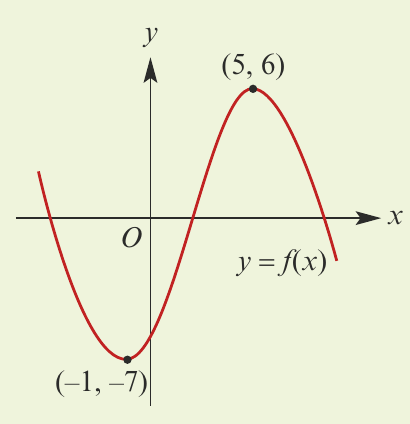
For the graph of , find:
a) (where the derivative is positive)
b) (where the derivative is negative)
c) (where the derivative is zero)
Solution:
a)
The function is increasing (has positive gradient) between and .
b)
The function is decreasing (has negative gradient) before and after .
c)
The gradient is zero at the turning points and .
Summary
Key Points to Remember:
- Power rule: For , we have — bring the power down and reduce by 1
- Basic rules: The derivative of a constant is 0; the derivative of a sum is the sum of derivatives; the derivative of a difference is the difference of derivatives; constants can be factored out
- Notation: You can write derivatives as , , or — they all mean the same thing
- Tangent gradients: The gradient of the tangent at point is found by evaluating
- Sign matters: If , the function is increasing; if , the function is decreasing; if , there may be a turning point