The Chain Rule (VCE SSCE Mathematical Methods): Revision Notes
📚Revision Notes
The Chain Rule
Introduction to composite functions
Sometimes we need to differentiate functions that are built from simpler functions combined together. For example, consider . We could expand this and differentiate term by term, but this becomes very tedious for something like .
Instead, we can recognise that is made up of two simpler functions "chained" together:
Let (the inside function)
Let (the outside function)
This creates a chain:
We write this as or , which is called a composite function. The chain rule gives us an efficient method to differentiate such functions.
Note
The ability to recognize composite functions is crucial for applying the chain rule effectively. Always look for a function within another function - the "inside" and "outside" structure.
The chain rule formula
If is differentiable at and is differentiable at , then the composite function is differentiable at and:
Important
This can be thought of as: derivative of the outside function (evaluated at the inside) times the derivative of the inside function.
Using Leibniz notation, where and :
This form makes it easy to remember - the terms appear to "cancel".
Understanding the chain rule
The chain rule works because when we have a composite function, the rate of change of with respect to depends on:
- How fast changes with respect to (which is )
- How fast changes with respect to (which is )
Note
The Chain of Changes
The proof uses the limit definition of the derivative and considers how small changes propagate through the chain of functions. The key insight is that if is continuous (which it must be if it's differentiable), then as , we have as well.
Worked examples
Example
Worked Example: Differentiating a Composite Power Function
Differentiate
We can solve this using either Leibniz notation or function notation. Let's see both approaches:
Method 1: Using Leibniz notation
Let
Then
Find the derivatives:
Apply the chain rule:
Substitute back :
Method 2: Using function notation
Let
Let
Then
Find the derivatives:
Apply the chain rule:
Both methods give the same answer, so use whichever notation you find clearer.
Example
Worked Example: Finding the Gradient of a Tangent
Find the gradient of the tangent to the curve with equation at the point
First, rewrite the function in a form suitable for the chain rule:
Let , then
Find the derivatives:
Apply the chain rule:
Substitute back :
At the point where :
Therefore, the gradient of the tangent at is .
Using technology to verify your work
You can use a calculator to check your chain rule calculations:
TI-Nspire calculator:
- Define your functions and separately
- Define the composite function
- Use menu > Calculus > Derivative to find
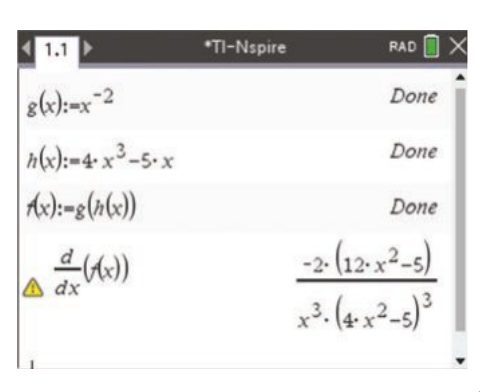
Casio ClassPad calculator:
- Define and separately
- Define
- Use the differentiation function to find
The calculator will apply the chain rule automatically and give you the derivative in simplified form.
Important
Exam tip: While calculators are useful for checking, you must be able to apply the chain rule by hand in exams. Practice writing out the steps clearly, showing which function is (or the inside function) and which is (or the outside function).
Summary
Key Points to Remember:
- The chain rule allows us to differentiate composite functions efficiently without expanding them
- Formula: If and , then
- Think of it as: derivative of outside × derivative of inside
- Both Leibniz notation () and function notation () give the same result
- Always identify the "inside" and "outside" functions first before applying the rule
- The chain rule only works when both functions are differentiable at the relevant points