The Derivative (VCE SSCE Mathematical Methods): Revision Notes
📚Revision Notes
The Derivative
This note introduces the fundamental concept of the derivative, which measures how a function changes at any given point. Understanding derivatives is essential for analysing rates of change in mathematical models and solving real-world problems.
Average rate of change
When working with a function , we can calculate how much the function changes on average over a particular interval. This is called the average rate of change.
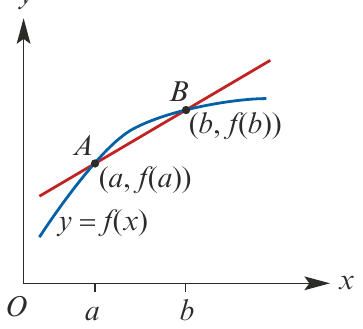
For any function , the average rate of change over the interval is found by calculating the gradient (slope) of the line connecting two points on the curve: and .
The formula is:
This formula calculates how much the -value changes divided by how much the -value changes. Geometrically, this represents the slope of the secant line through the two points.
Note
The average rate of change tells us the overall trend of the function over an interval, but it doesn't tell us what's happening at any specific point within that interval. Think of it as the average speed on a journey - it doesn't capture whether you were stopped at traffic lights or speeding on the motorway.
Example
Worked Example: Finding Average Rate of Change
Let's find the average rate of change of as changes from to .
We need to find the change in divided by the change in :
First, calculate the function values:
Now apply the formula:
The average rate of change is 4. This means that, on average, the function increases by 4 units for each unit increase in over this interval.
The tangent to a curve at a point
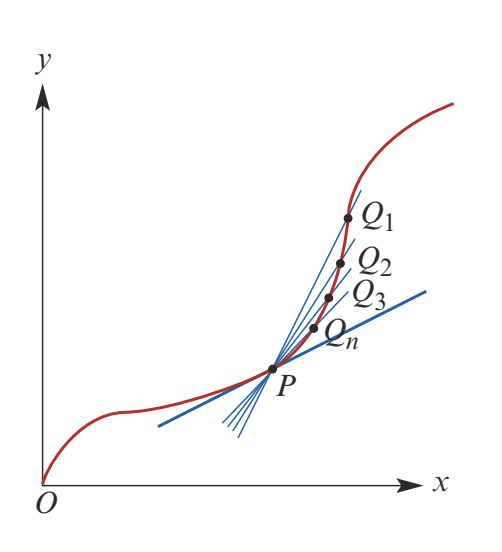
To understand derivatives, we need to distinguish between different types of lines related to curves:
- A chord is a line segment joining two points on a curve
- A secant is a line passing through two points on a curve
- A tangent is a line that touches the curve at exactly one point
Important
The instantaneous rate of change at a point is different from the average rate of change. To find it, imagine drawing secant lines through and another point on the curve. As we choose points that get progressively closer to , the secant lines approach a limiting position. This limiting line is the tangent at .
Finding the derivative of
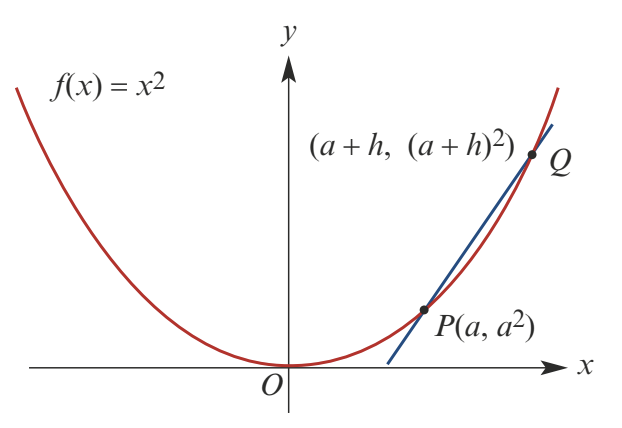
Let's develop this idea using the function .
Consider a point and another point on the curve, where is a small number.
The gradient of the secant line is:
Expanding the numerator:
As gets closer and closer to , the expression approaches . We say that the limit of as approaches is .
Therefore, the gradient of the tangent at point P is 2a.
This result works for any value on the curve, not just at the specific point . The gradient of the tangent to at any point is .
We say that the derivative of x² with respect to x is 2x, or simply, the derivative of is .
Limit notation
In mathematics, we use special notation to describe limits. The notation for "the limit of as approaches " is:
This limit equals because as gets very close to , the expression gets very close to .
To find the derivative of a function , we follow this process:
- Find an expression for the gradient of the secant line through points and
- Calculate the limit of this expression as approaches
Example
Worked Example: Gradient of Tangent for
Consider the function . Let's find the gradient of the tangent at the point by first finding the gradient of the secant through and .
The gradient of is:
Expanding :
Factoring out from the numerator:
Taking the limit as approaches :
The gradient of the tangent line at is 12.
Evaluating limits
Example
Worked Example: Evaluating Limits
Find the following limits:
a)
As approaches , both terms containing vanish:
b)
First simplify by factoring from the numerator:
c)
Since this expression doesn't contain , it remains constant:
d)
Similarly, a constant remains unchanged:
Note
Modern calculators can evaluate limits directly, which is useful for checking your work or handling more complex expressions.
Definition of the derivative
Now we can state the formal definition of the derivative.
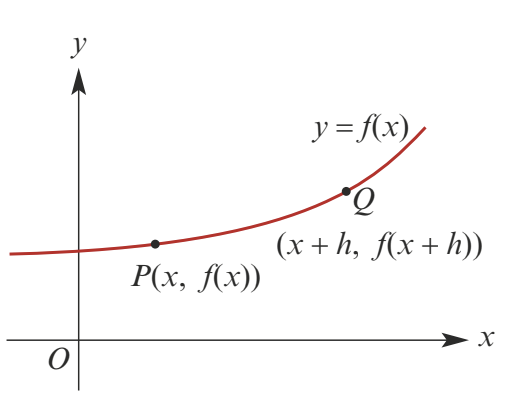
Consider a function with graph .
The gradient of the secant line connecting points and is:
The gradient of the tangent line at point is the limit of this expression as approaches .
Derivative of a function
Important
Definition of the Derivative
The derivative of the function is denoted and is defined by:
This formula gives us the gradient of the curve at any point .
The tangent line to the graph of function at point is the line passing through with gradient .
Important
Important Note: Existence of Derivatives
This definition assumes that the limit exists. For polynomial functions, these limits always exist at every point. However, not every function has a derivative at every point in its domain. Some functions have points where the derivative is undefined (such as sharp corners or vertical tangents).
Differentiation by first principles
Finding the derivative of a function by directly evaluating the limit in the definition is called differentiation by first principles. This method involves algebraic manipulation followed by taking a limit.
Example
Worked Example: Differentiation by First Principles
Find for the following functions:
a)
First, calculate :
Now find the difference quotient:
Factor out :
Taking the limit:
Therefore, f'(x) = 6x + 2.
b)
Calculate :
Find the difference quotient:
Taking the limit:
Therefore, f'(x) = -3x².
Note
Calculators can help verify these results by evaluating the limits symbolically, which is particularly useful for checking your work with more complex functions.
Approximating the value of the derivative
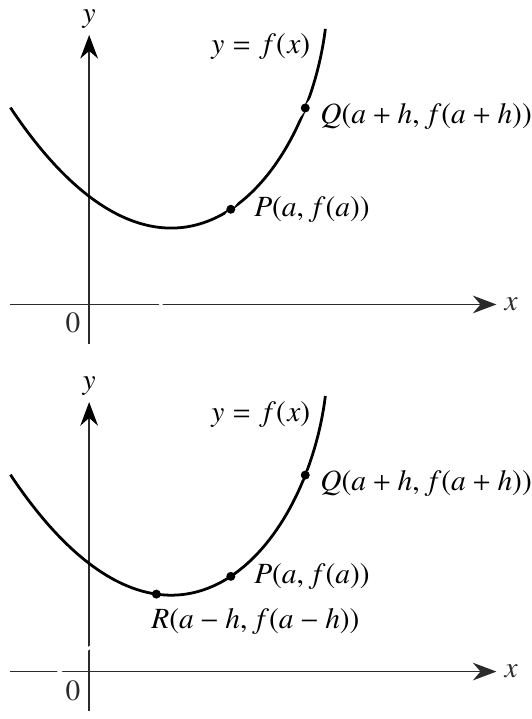
From the definition of the derivative, we can see that for a small value of :
This formula approximates the derivative by calculating the gradient of the secant line through points and . This is called the forward difference approximation.
However, we can often get a better approximation using the central difference approximation:
This formula calculates the gradient of the secant line through points and .
Note
Why Central Difference is Often Better
The central difference method is often more accurate because it considers values on both sides of the point of interest, providing a more balanced estimate. When you need numerical accuracy, prefer the central difference approximation over the forward difference.
These approximation methods are particularly useful when working with functions that are difficult to differentiate analytically, or when estimating derivatives from numerical data.
Summary
Key Points to Remember:
-
The average rate of change over an interval is , which represents the gradient of the secant line.
-
The derivative measures the instantaneous rate of change and is defined as .
-
The tangent line at point has gradient and represents the best linear approximation to the curve at that point.
-
Differentiation by first principles involves directly applying the limit definition to find derivatives through algebraic manipulation.
-
For numerical work, you can approximate using either or the more accurate central difference formula for small values of .