The Product Rule (VCE SSCE Mathematical Methods): Revision Notes
📚Revision Notes
The Product Rule
Introduction
When differentiating expressions that involve the product of two functions, we cannot simply multiply the derivatives of each function separately. Instead, we need to use a special rule called the product rule.
Note
Why can't we just multiply the derivatives? Consider . If we could multiply derivatives separately, we'd get , but the correct answer is . This shows we need a special rule for products.
The product rule is one of the essential differentiation techniques that allows us to find the derivative of a function that is the product of two other functions.
The product rule in function notation
When we have a function that is the product of two functions and , the product rule states:
If and both and exist, then:
Note
In words: The derivative of a product equals the first function times the derivative of the second function, plus the second function times the derivative of the first function.
Memory aid: "Keep the first, differentiate the second; keep the second, differentiate the first; then add"
Example
Worked Example: Simple Product
Consider . This is a product of two functions:
Using the product rule:
Note: This could also be found by expanding the brackets first and then differentiating, but the product rule becomes essential when dealing with more complex functions where expansion isn't practical.
Proof of the product rule
Starting from the definition of the derivative:
To evaluate this limit, we add and subtract :
Since and are differentiable, as :
This completes the proof.
The product rule in Leibniz notation
An alternative way to express the product rule uses Leibniz notation. If , where both and are functions of , then:
Geometric interpretation
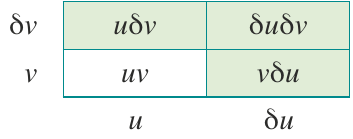
The product rule can be understood geometrically by considering small changes in and .
Note
Understanding the geometry
In this diagram, the white region represents and the shaded regions represent the change .
When both and change by small amounts and :
Dividing by :
As , the term , and we obtain:
Worked examples
Example
Worked Example: Differentiating Polynomial Products
Differentiate each of the following with respect to :
a)
b)
Solution
a) Let
Set and
Then and
Using the product rule:
b) Let
Set and
Then and (using the chain rule)
Using the product rule:
Example
Worked Example: Products with Negative Powers
For , , find .
Solution
Let and
Then and (using the chain rule)
By the product rule:
Example
Worked Example: Products with Exponential Functions
Differentiate each of the following with respect to :
a)
b)
Solution
a) Let
Using the product rule:
b) Let
Using the product rule and chain rule:
Example
Worked Example: Products with Trigonometric Functions
Find the derivative of each of the following with respect to :
a)
b)
c)
Solution
a) Let
Applying the product rule:
b) Let
Applying the product rule:
c) Let
The product rule gives:
Exam tips
Important
Critical Tips for Success
- Always identify both functions in the product before applying the rule
- Remember to use the chain rule when differentiating composite functions within the product
- Check whether you can simplify your answer by factoring common terms
- For products of more than two functions, apply the product rule repeatedly
- When dealing with exponential or trigonometric functions, be careful with the chain rule coefficients
Remember!
Summary
Key Points to Remember:
- The product rule states: if , then
- In Leibniz notation: if , then
- Use the mnemonic: "first times derivative of second, plus second times derivative of first"
- The product rule is essential when you cannot easily expand the product
- Often combine the product rule with the chain rule when differentiating composite functions
- Always simplify your final answer by factoring common terms where possible