Applications of Polynomial Functions (VCE SSCE Mathematical Methods): Revision Notes
📚Revision Notes
Applications of Polynomial Functions
Introduction to polynomial applications
Polynomial functions can be used to model many real-world situations. In this topic, we use Computer Algebra System (CAS) calculators to find maximum and minimum values of polynomial functions that have restricted domains. These applications often involve optimization problems where we need to find the best possible outcome within given constraints.
When working with polynomial applications, you'll typically:
- Create a polynomial model from a real-world situation
- Identify appropriate domain restrictions based on physical constraints
- Use technology to find intersection points, maximum values, or minimum values
- Interpret your mathematical results in the context of the original problem
Note
Polynomial applications are particularly useful in engineering, economics, and physics where relationships between variables can be modeled using polynomial functions. The key is translating the real-world problem into mathematical language, then using technology to find optimal solutions.
Worked example: Box volume optimization
Example
Worked Example: Optimizing Box Volume from a Square Sheet
Problem setup
A square sheet of tin measures 12 cm × 12 cm. Four equal squares of edge cm are cut out from the corners, and the sides are folded up to form an open rectangular box.
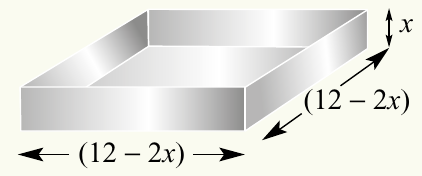
We need to find:
- The values of for which the volume is 100 cm³
- The maximum possible volume of the box
Creating the polynomial model
When we cut out squares of side length from each corner and fold up the sides, the resulting box has:
- Length: cm
- Width: cm
- Height: cm
The volume of the box can be expressed as:
Since the squares must fit within the original sheet, we have the domain restriction:
This is a cubic polynomial model. The restriction exists because cannot be negative (no physical meaning) and cannot exceed 6 cm (otherwise the cuts would overlap).
Finding when volume equals 100 cm³
To find when , we need to solve:
Using a CAS calculator, we can:
- Graph the function
- Graph the horizontal line on the same axes
- Find the intersection points
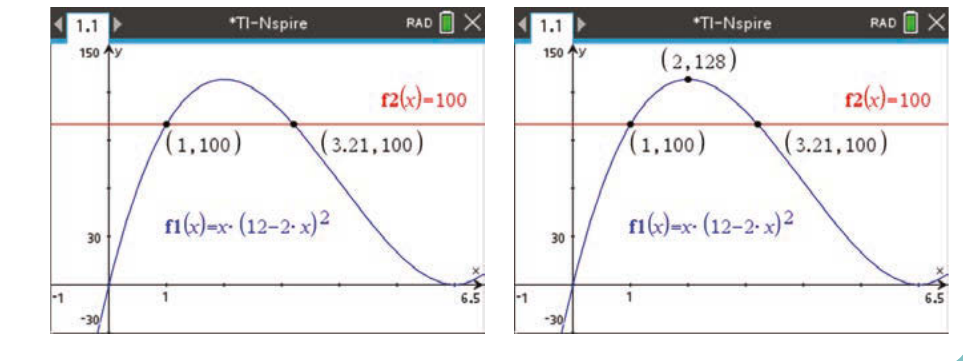
The calculator shows that the volume equals 100 cm³ when:
Both values make physical sense within our domain restriction.
Finding the maximum volume
To find the maximum volume, we use the calculator's maximum function. The graph shows that the maximum volume occurs at:
This means the optimal box has a height of 2 cm and a maximum volume of 128 cubic centimetres.
Important
Always check that your solutions make sense in the real-world context. For example, a negative value for would have no physical meaning in this problem. Similarly, values outside the domain restriction should be rejected even if they satisfy the equation mathematically.
Worked example: Modeling a stream path
Example
Worked Example: Finding a Cubic Model for Stream Deviation
Problem setup
A 250-metre section of a stream's path can be modeled by a cubic function. The cubic passes through the points , , , and .
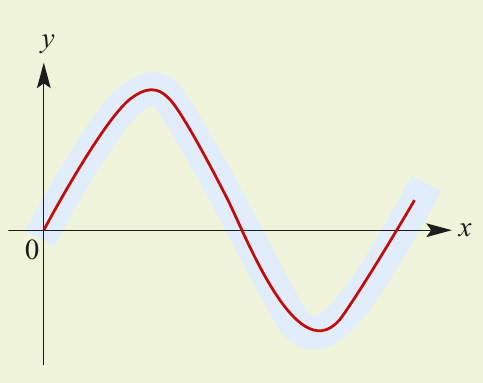
We need to:
- Find the equation of the cubic function
- Find the maximum deviation from the -axis for
Finding the cubic equation
We start with a general cubic function:
Since the function passes through , we know that , which means .
Our function becomes:
Now we use the other three points to create a system of equations:
Using a CAS calculator, we can solve this system of equations:
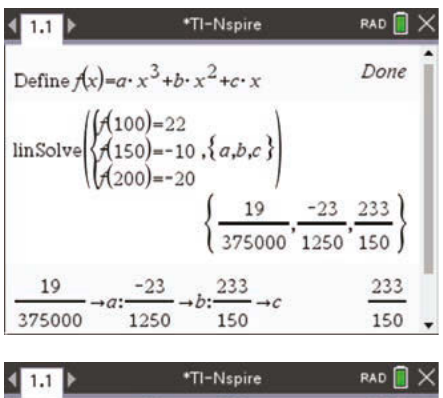
The calculator gives us:
Therefore, the equation modeling the stream path is:
Finding maximum deviation
The maximum deviation from the x-axis means finding the largest absolute value of the function over the interval . We need to find both the maximum and minimum values.
Using the calculator's optimization functions:
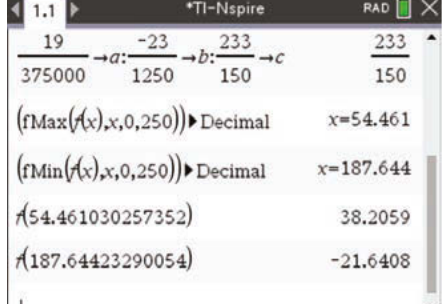
The results show:
- Maximum value: approximately 38.21 metres (occurring at )
- Minimum value: approximately metres (occurring at )
The maximum deviation from the -axis is 38.21 metres.
Important
Key insight about deviation: When finding maximum deviation, we must consider both positive and negative values, as "deviation" refers to distance from the axis regardless of direction. The maximum deviation is the larger of the absolute values of the maximum and minimum.
Key calculator techniques
Note
Essential CAS Calculator Skills for Polynomial Applications
When solving polynomial application problems using a CAS calculator:
Finding intersection points:
- Graph both functions on the same axes
- Use the intersection command to find where they meet
- Multiple intersection points may exist for polynomial functions
Finding maximum values:
- Use the maximum function with specified domain
- Alternatively, graph the function and use trace/analyze features
- Always verify the result makes sense in context
Finding minimum values:
- Use the minimum function with specified domain
- Check endpoints of the domain as well as turning points
- Consider physical constraints when interpreting results
Solving systems of equations:
- Set up equations based on given points
- Use the system solver to find coefficients
- Store values for use in further calculations
Remember!
Summary
Key Points to Remember:
-
Real-world constraints create domain restrictions: Always identify the valid range for your variable based on the physical situation. Not all mathematical solutions are physically meaningful.
-
CAS calculators are powerful tools: Use them to find intersections, maxima, and minima, but always interpret results in context. Technology gives mathematical answers; you must provide the real-world interpretation.
-
Systems of equations determine polynomials: When you know points on a polynomial curve, you can find the equation by solving simultaneous equations. The number of points needed equals the number of coefficients to find.
-
Maximum deviation considers both directions: When finding deviation from an axis, check both maximum and minimum values. The greatest absolute value represents the maximum deviation.
-
Verify solutions make sense: Mathematical solutions must be physically meaningful in application problems. Always check that your answers fit the constraints of the real-world situation.