Cubic Functions of a Particular Form (VCE SSCE Mathematical Methods): Revision Notes
📚Revision Notes
Cubic Functions of a Particular Form
Introduction
This note focuses on cubic functions that can be written in the form:
Unlike quadratic functions, which all have the same basic parabola shape, not all cubic functions look alike. However, cubic functions of the form share a common characteristic: they can all be created by applying transformations to the basic cubic graph .
Note
Understanding transformations is key to working with cubic functions. Each parameter in the form controls a specific transformation:
- controls dilation and reflection
- controls horizontal translation
- controls vertical translation
For example, the graph of is obtained from the graph of by translating it 1 unit to the right and 3 units up.
Transformations of the graph of
Dilations and reflections
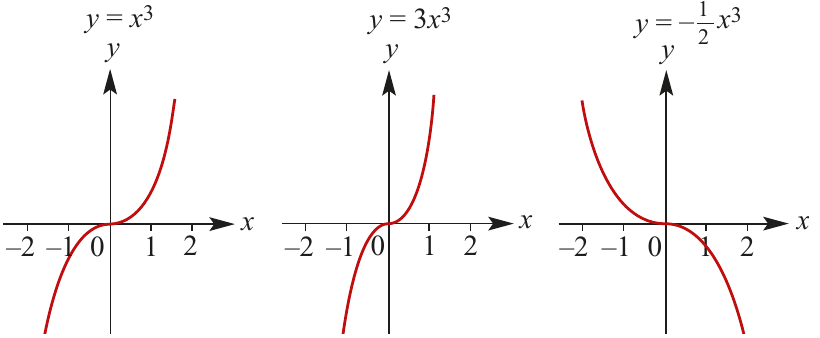
The value of in the function affects how narrow or broad the graph appears, without changing its fundamental S-shape.
When a > 1, the graph becomes steeper (narrower).
When 0 < a < 1, the graph becomes less steep (broader).
When a < 0, the graph is reflected in an axis.
Note
An Interesting Property of Cubic Functions
Reflecting in the -axis produces the same result as reflecting in the -axis. This happens because:
This unique property makes cubic functions behave differently from other polynomial functions.
The following graphs illustrate these dilations:
Important
Domain and Range of Cubic Functions
The implied domain of all cubic functions is (all real numbers) and the range is also .
This means cubic functions can accept any real number as input and can produce any real number as output.
Point of inflection
The most important feature of these cubic graphs is the point of inflection. This is the point where the gradient (slope) is zero - you can think of it as the "flat point" of the graph.
For the basic cubic function , the point of inflection is at the origin .
Vertical translations
When you add or subtract a constant to , the graph moves up or down vertically.
The graph of is the basic cubic graph moved k units upward (when ) or downward (when ).
After a vertical translation, the point of inflection becomes .
This represents a translation of units in the positive -axis direction.
Horizontal translations
The graph of is the basic cubic graph moved h units to the right (when ) or to the left (when ).
After a horizontal translation, the point of inflection moves to .
This represents a translation of units in the positive -axis direction.
General form and sketching technique
For the graph of a cubic function of the form:
Important
Point of Inflection Formula
The point of inflection is at .
The values in the brackets and the added constant directly give you the coordinates of the point of inflection!
Sketching technique: When sketching cubic graphs of this form:
- First identify the point of inflection
- Find the -axis intercept by setting
- Find the -axis intercept by setting
- Draw the smooth S-shaped curve passing through these points
Worked example: Sketching a cubic function
Example
Worked Example: Sketching a Cubic Function
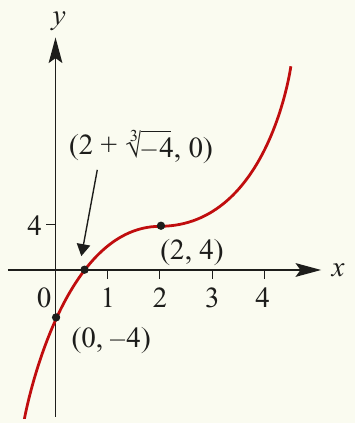
Sketch the graph of the function .
Solution:
The graph of is translated 2 units to the right and 4 units up.
Point of inflection is (2, 4).
Finding the -axis intercept:
Let
Finding the -axis intercept:
Let
The graph passes through the points , , and .
The cube root function
Functions with rules of the form are one-to-one functions. This means each of these functions has an inverse function.
The inverse function of is:
This can also be written as (the cube root of ).
Note
Inverse Functions Relationship
The cube root function "undoes" the cubing operation. If you cube a number and then take the cube root, you get back to the original number:
Similarly, if you take the cube root and then cube the result:
The following graph shows both functions:
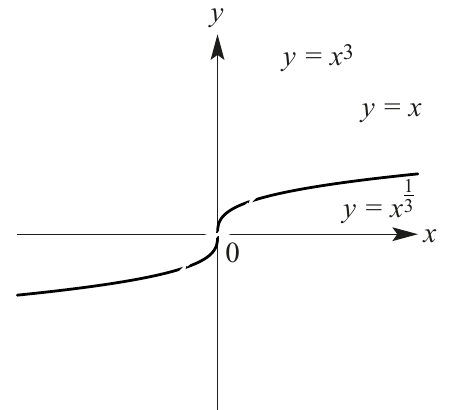
The graph of is instantaneously vertical at . The graphs of and intersect at and .
Worked example: Sketching a cube root function
Example
Worked Example: Sketching a Cube Root Function
Sketch the graph of .
Solution:
Finding the -axis intercept:
When :
Finding the -axis intercept:
When :
Understanding the transformation:
The graph of is the graph of translated 1 unit to the right and 2 units down.
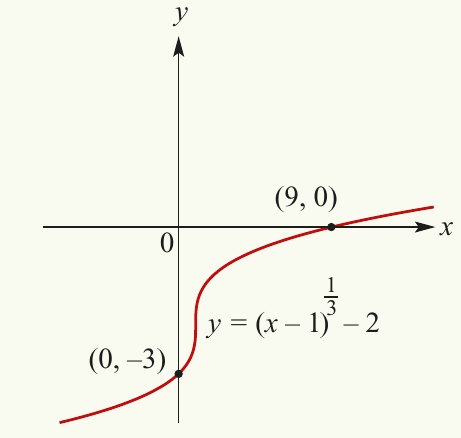
The graph passes through and .
Worked example: Finding inverse functions
Example
Worked Example: Finding the Inverse Function
Find the inverse function of , .
Solution:
Step 1: Interchange and
Remember that if and only if .
Starting with:
Interchange:
Step 2: Solve for
The opposite operation to cubing is taking the cube root:
Answer:
Therefore: ,
Remember!
Summary
Key Points to Remember:
-
Cubic functions of the form have their point of inflection at .
-
The graph of is the graph of translated units horizontally and units vertically.
-
To sketch these cubic graphs: identify the point of inflection first, then find the -axis and -axis intercepts.
-
The domain and range of all cubic functions is (all real numbers).
-
The inverse function of is (the cube root function). These are inverse operations that "undo" each other.