Determining the Rule for a Parabola (VCE SSCE Mathematical Methods): Revision Notes
📚Revision Notes
Determining the Rule for a Parabola
Introduction
Finding the equation of a parabola from information about its graph is a fundamental skill in working with quadratic functions. The key is identifying what information you have available and choosing the most appropriate form to use.
Note
The strategy you choose depends entirely on what information is given. Before starting any problem, always identify what you know: Are there x-intercepts? Do you know the turning point? Or just three random points?
The three useful forms
There are three main forms you can use to find the rule of a quadratic function, depending on what information you have:
Form 1: Factored form
Use this form when you know the two x-axis intercepts and the coordinates of one other point on the parabola.
In this form:
- and are the x-intercepts (where the parabola crosses the x-axis)
- is a coefficient that determines the shape and direction of the parabola
Form 2: Vertex form
Use this form when you know the coordinates of the turning point (vertex) and one other point on the parabola.
In this form:
- are the coordinates of the turning point
- is a coefficient that determines the shape and direction of the parabola
Form 3: General polynomial form
Use this form when you know the coordinates of three points on the parabola.
In this form:
- , , and are coefficients you need to find
- is the y-intercept (where the parabola crosses the y-axis)
Important
Choosing the right form is crucial for efficiency:
- Two x-intercepts known → Use Factored form
- Turning point known → Use Vertex form
- Three random points known → Use General form
Choosing the wrong form can make the problem much harder than it needs to be!
Worked examples
Worked example: Finding the rule using x-intercepts
Example
Worked Example: Using X-Intercepts
A parabola has x-axis intercepts at and , and it goes through the point . Find the rule for this parabola.
Solution:
Since we know two x-axis intercepts, we use the factored form .
Now substitute the point to find :
When , . Thus:
The rule is .
Explanation: We use the factored form because two x-axis intercepts are given. The x-intercept at gives us the factor , and the x-intercept at gives us the factor . By substituting the additional point, we can solve for the coefficient .
Note
Notice that the x-intercept at becomes the factor , not . The general pattern is: if the x-intercept is at , the factor is .
Worked example: Finding the rule using the turning point
Example
Worked Example: Using the Turning Point
The coordinates of the turning point of a parabola are , and the parabola goes through the point . Find the rule for this parabola.
Solution:
Since we know the turning point and one other point, we use the vertex form .
Now substitute the point to find :
When , . Thus:
The rule is .
Explanation: We use the vertex form because the coordinates of the turning point are given. The turning point tells us that and . By substituting the additional point into the equation, we can solve for . The negative value of indicates that this parabola opens downward.
Worked example: Finding the rule using three points
Example
Worked Example: Using Three Points
A parabola passes through the points , , and . Find the rule for this parabola.
Solution:
Since we know three points on the parabola, we use the general polynomial form .
We substitute each point to create three equations:
When , :
When , :
When , :
Now we solve these simultaneous equations. From equation (2), we know that .
Substitute into equations (1) and (3):
Now we can add equations (1') and (3'):
Substitute into equation (1'):
The rule is .
Explanation: When we have three points but no clear pattern like x-intercepts or a turning point, we use the general polynomial form. This gives us three equations with three unknowns. By using substitution and elimination methods, we can solve for all three coefficients , , and .
Note
The point immediately gives us the y-intercept, which is the value of . This simplifies our work significantly! Always look for points where as they make calculations easier.
Worked example: Finding equations from graphs
Example
Worked Example: Finding Equations from Graphs
Find the equation of each of the following parabolas:
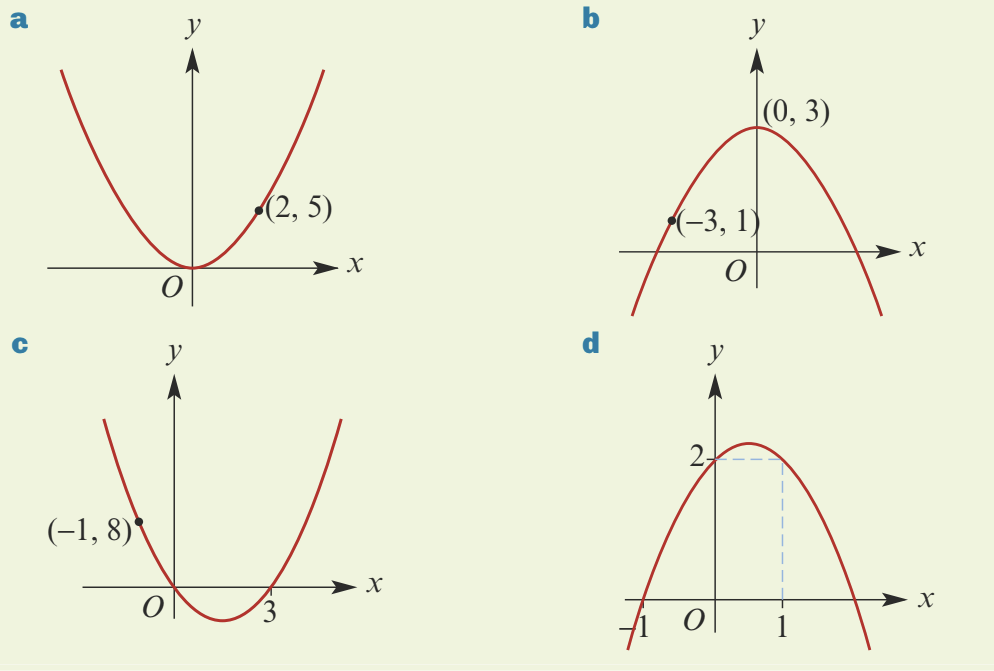
Solution:
Part a:
This parabola has its vertex at the origin, so it is of the form .
We can see that the point is on the parabola. Substituting:
The rule is .
Part b:
This parabola is symmetric about the y-axis, so it is of the form .
From the graph, the y-intercept is at , so .
The point is on the parabola:
The rule is .
Part c:
This parabola has x-intercepts at and , so it is of the form .
The point is on the parabola:
The rule is .
Part d:
This parabola is of the general form .
From the graph, the y-intercept is , so .
The parabola appears to have x-intercepts at and . We can verify using these points:
At :
At :
Wait, the maximum appears to be at approximately with . Let me use visible points instead.
From the graph, we can see the parabola goes through and the maximum is at approximately , with y-intercept at .
At :
At :
Adding equations (1) and (2):
Substituting into equation (1):
The rule is .
Important
Key strategies for finding rules from graphs:
- Look for x-intercepts first - if you can identify two of them, use the factored form
- Check if the vertex is at a special position (like the origin) - this can simplify your equation
- Look for symmetry about the y-axis - this means in the general form
- Identify the y-intercept - this gives you the value of in the general form
- The sign of determines whether the parabola opens upward (positive) or downward (negative)
Remember!
Summary
Key Points to Remember:
-
Choose the right form based on available information: Factored form for x-intercepts, vertex form for the turning point, and general form for three random points
-
The coefficient determines the parabola's shape: Positive means the parabola opens upward, negative means it opens downward, and the magnitude of affects how wide or narrow the parabola is
-
Systematic substitution is key: Always substitute known point coordinates carefully into your chosen form and solve for the unknown coefficient(s)
-
When using the general form with three points: Set up three equations and use substitution or elimination to solve the simultaneous equations systematically
-
Read graphs carefully: Identify all key features including intercepts, turning points, and any points with clear coordinates before choosing your approach