Determining the Rule for the Graph of a Polynomial (VCE SSCE Mathematical Methods): Revision Notes
📚Revision Notes
Determining the Rule for the Graph of a Polynomial
Introduction
When working with polynomial functions, we often need to determine the rule (equation) from information shown on a graph. The key principle to remember is this: a polynomial function of degree is completely determined by any points on the curve.
Note
This principle applies to all polynomial functions:
- A straight line (degree 1) needs 2 points
- A quadratic function (degree 2) needs 3 points
- A cubic function (degree 3) needs 4 points
- A quartic function (degree 4) needs 5 points
This means that if we know enough points on a polynomial graph, we can work out its exact equation.
Forms of cubic functions
Cubic functions can be written in several different forms, and recognizing which form to use depends on the information given in the graph.
Translated form
If you can identify the point of inflection , the cubic may have the form:
In this case, you need one additional point to find the value of .
Factored form with three distinct roots
If the graph crosses the -axis at three different points, say , , and , then:
You need one more point (often the -intercept) to find .
Factored form with a repeated root
If the graph touches the -axis at one point and crosses at another, there's a repeated factor. For example, if it touches at and crosses at :
Again, one additional point determines .
General form
When no special features are obvious, use the general cubic form:
You'll need four points to create simultaneous equations for , , , and .
Important
Choosing the Right Form:
Always examine the graph carefully before choosing which form to use:
- Can you identify a point of inflection? → Use translated form
- Does it cross the -axis three times? → Use factored form with distinct roots
- Does it touch the -axis once and cross once? → Use repeated factor form
- No clear pattern? → Use general form
Worked example: Finding the coefficient
Example
Worked Example: Using the Translated Form
Problem: A cubic function has rule of the form . The point is on the graph. Find the value of .
Working:
The point of inflection is at , so we use the form .
Substitute the point :
Therefore, .
Explanation: When the coordinates of the point of inflection are known, and we have one other point on the graph, we can substitute directly to find .
Example
Worked Example: Using Three x-axis Intercepts
Problem: A cubic function has rule of the form . The point is on the graph. Find the value of .
Working:
The -axis intercepts are at , , and .
Substitute the point :
Therefore, .
Explanation: When three -axis intercepts are known, these give us the three linear factors. We need one additional point to find the coefficient .
Example
Worked Example: Finding Two Unknowns
Problem: A cubic function has rule of the form . The points and are on the graph. Find the values of and .
Working:
We know and .
Substituting :
Substituting :
Multiply equation (1) by 2:
Subtract equation (3) from equation (2):
Substitute into equation (1):
Therefore, and .
Explanation: When we have two unknowns, we need two points to create simultaneous equations, which we then solve.
Worked example: Finding all four coefficients
Example
Worked Example: Finding All Four Coefficients Using Simultaneous Equations
Problem: For the cubic function with rule , the points , , and lie on the graph. Find the values of , , and .
Working:
Substitute each point into the general form:
Point :
Point :
Point :
Point :
From equation (2), we know .
Add equations (1) and (3):
Substitute and into equation (3):
Substitute and into equation (4):
Multiply equation (3') by 2:
Subtract equation (5) from equation (4'):
Substitute into equation (3'):
Therefore, , , and .
Important
Exam Tip: You can check your answer by verifying that all four points satisfy the equation .
Worked example: Using x-axis intercepts
Example
Worked Example: Using Three Distinct X-axis Intercepts
Problem: The graph shown is that of a cubic function. Find the rule for this cubic function.
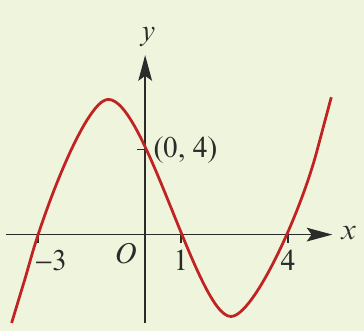
Working:
From the graph, the -axis intercepts are at , and .
Therefore, the function has the form:
The graph passes through the point . Substitute this point:
The rule is .
Explanation: When the graph crosses the -axis at three distinct points, each intercept gives a linear factor. The -intercept (where ) is then used to find the value of .
Worked example: Using a repeated factor
Example
Worked Example: Recognizing and Using a Repeated Factor
Problem: The graph shown is that of a cubic function. Find the rule for this cubic function.
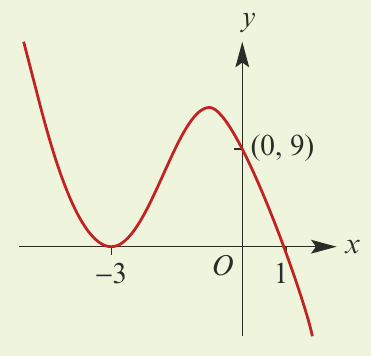
Working:
From the graph, we can see that:
- The graph touches the -axis at (it doesn't cross)
- The graph crosses the -axis at
Because the graph touches at , this is a repeated factor. Therefore, the function has the form:
The graph passes through the point . Substitute this point:
The rule is .
Explanation: When a graph touches the -axis at a point (rather than crossing it), that -value is a repeated root. For a cubic, this means the factor appears twice (squared). This is different from a simple crossing, which gives a single linear factor.
Important
Exam Tip: Always check whether the graph crosses or touches the -axis at each intercept. Touching indicates a repeated factor.
Remember: "Touch means twice" — if a graph touches the -axis, that factor appears squared.
Worked example: Using four general points
Example
Worked Example: Using Four General Points (No X-intercepts Given)
Problem: The graph of a cubic function passes through the points , , and . Find the rule for this cubic function.
Working:
The cubic function has the general form:
From the point :
Using the point :
Using the point :
Using the point :
Add equations (1) and (3):
Substitute into equations (1) and (2):
Multiply equation (4) by 2:
Subtract equation (6) from equation (5):
From equation (4):
The rule is .
Explanation: When no -intercepts or special features are given, use the general form. Four points give four equations, which can be solved systematically to find all four coefficients.
Using technology
Note
Modern calculators can solve systems of simultaneous equations quickly:
TI-Nspire: Use menu > Algebra > Solve System of Equations, or use the solve command with 'and' between equations.
Casio ClassPad: Define the function, then use the simultaneous equations icon to enter and solve the system.
While technology is helpful for checking, you should understand the manual method for exams.
Summary
Summary
Key Points to Remember:
- A polynomial of degree requires points to determine its equation completely
- For cubic functions, identify which form is most appropriate based on the given information
- When a graph crosses the -axis, that gives a simple linear factor
- When a graph touches the -axis, that indicates a repeated factor (appears squared)
- The -intercept (point where ) is often the easiest additional point to use
- Always check your answer by substituting points back into your final equation