Solving Cubic Inequalities (VCE SSCE Mathematical Methods): Revision Notes
📚Revision Notes
Solving Cubic Inequalities
What are cubic inequalities?
A cubic inequality involves a polynomial of degree three and an inequality sign (such as , , , or ). Just like with quadratic inequalities, we can solve cubic inequalities by examining the graph of the corresponding polynomial function.
Note
The Key Approach:
To solve a cubic inequality, we follow three essential steps:
- Sketch the graph of the cubic function
- Identify where the graph satisfies the inequality condition
- Express the solution using set notation
This is the same graphical approach used for quadratic inequalities, adapted for cubic functions.
Method for solving cubic inequalities
To solve a cubic inequality, follow these steps:
Step 1: Use the factor theorem
Find at least one linear factor by testing simple values (like , , , etc.) in the polynomial. If P(a) = 0, then (x - a) is a factor.
Step 2: Complete the factorisation
Use polynomial division to find the remaining factors. Express the cubic in fully factored form.
Step 3: Find the intercepts
- x-axis intercepts: Set each factor equal to zero and solve for the zeros or roots
- y-axis intercept: Substitute into the function
Step 4: Sketch the graph
Draw a smooth curve through the intercepts, remembering that:
- Cubics with positive leading coefficient start low (on the left) and end high (on the right)
- Repeated factors create turning points where the graph touches but doesn't cross the x-axis
Step 5: Solve the inequality from the graph
- For or : find where the graph is on or below the x-axis
- For or : find where the graph is on or above the x-axis
Step 6: Express the solution
Write your answer using set notation or interval notation.
Note
Reading Solutions from Graphs:
Remember the simple rule: "Less than means below, greater than means above"
- or : Look for where the curve is below (or touching) the x-axis
- or : Look for where the curve is above (or touching) the x-axis
Worked example
Example
Worked Example: Solving a Cubic Inequality with a Repeated Factor
Find
Solution:
Let
First, use the factor theorem to find an initial factor by testing simple values:
Since P(1) = 0, we know that (x - 1) is a factor.
Now perform polynomial division to find the complete factorisation:
Notice this cubic has a repeated factor (x - 1)². This is important for sketching the graph.
Next, find the axis intercepts:
x-axis intercepts: Set
- gives
- gives
There are only two x-intercepts: and
y-axis intercept: Set
The y-intercept is at
Now sketch the graph. The graph:
- Passes through , , and
- Has a turning point at (1, 0) because of the repeated factor — the graph touches the x-axis at but doesn't cross it
- Starts from the bottom left (as , )
- Ends at the top right (as , )
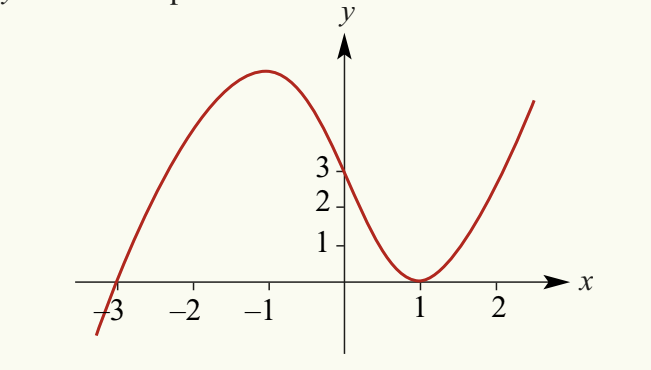
From the graph, we can see that in two regions:
- When (the graph is below the x-axis to the left of )
- When (the graph touches the x-axis at exactly this point)
Therefore, the solution is:
Note: The square bracket at indicates that is included in the solution (since we have not ). The single-element set shows that only the point satisfies the inequality in that region.
Understanding repeated factors
Important
Critical Concept: How Repeated Factors Affect the Graph
When a cubic has a repeated factor, such as , the graph behaves differently at that x-intercept:
- Single factor : the graph crosses the x-axis at
- Repeated factor : the graph touches the x-axis at but doesn't cross it — this creates a turning point
This is crucial when solving inequalities because a point where the graph just touches the x-axis may be an isolated solution point, as we saw in the example above where appeared as a separate part of the solution.
Key steps summary
Summary
Summary: The Factor-Sketch-Solve Method
- Factor the polynomial using the factor theorem and division
- Find all intercepts to help sketch the graph accurately
- Sketch the graph carefully, noting any repeated factors
- Read the solution from the graph based on the inequality sign
- Write the answer in proper set notation or interval notation
Remember!
Summary
Key Points to Remember:
- Cubic inequalities are solved by sketching the graph of the cubic function and identifying where it satisfies the inequality
- Use the factor theorem to find factors: if , then is a factor
- Repeated factors create turning points where the graph touches but doesn't cross the x-axis
- For or : find where the graph is below (or on) the x-axis
- For or : find where the graph is above (or on) the x-axis
- Always express your final answer using correct set notation, such as or