Families of Quadratic Polynomial Functions (VCE SSCE Mathematical Methods): Revision Notes
📚Revision Notes
Families of Quadratic Polynomial Functions
What is a family of quadratic functions?
A family of parabolas is a group of quadratic functions that share common characteristics. These families are defined using parameters - letters like , , , or that represent values which can vary. By changing the values of these parameters, we create different parabolas within the same family.
Note
Parameters act like variables that control the shape and position of parabolas. A single family can contain infinitely many different parabolas, each created by choosing different parameter values.
Examples of quadratic families
Here are some common families of quadratic polynomial functions:
| Family equation | Description |
|---|---|
| , where | All parabolas with their vertex at the origin |
| , where | All parabolas with turning point at |
| , where | All parabolas with -axis intercepts at and |
| , where | All parabolas with -axis intercept at |
| , where and | All parabolas with two -axis intercepts, one at the origin |
Each family contains infinitely many parabolas. For instance, the family includes , , , and countless others.
Visualising families
The diagram below shows several members of the family , where different values of and create different parabolas:
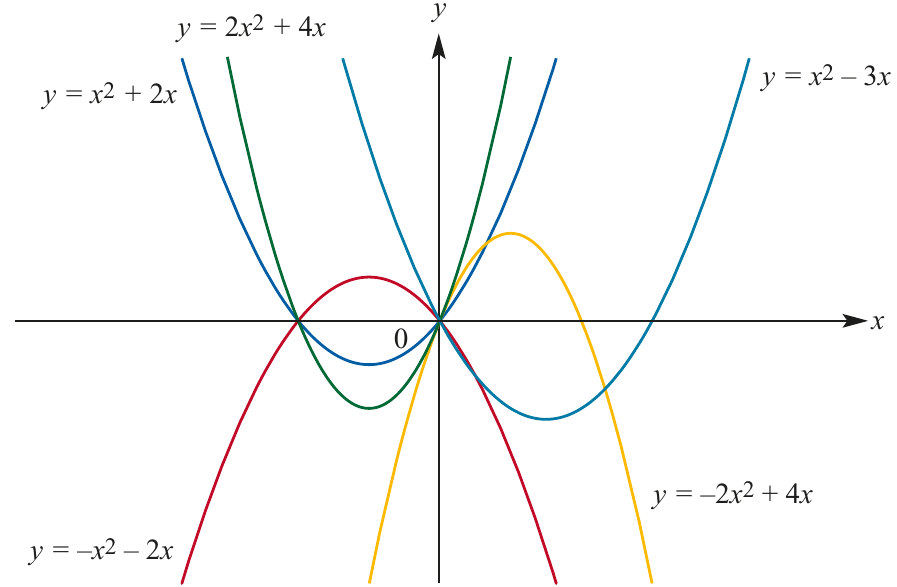
Notice how all these parabolas pass through or near the origin, but they have different widths, orientations (opening upward or downward), and positions. This variation is controlled by the parameters and .
Important
The role of parameter :
- When , the parabola opens upward
- When , the parabola opens downward
- Larger values of make the parabola narrower
- Smaller values of make the parabola wider
Determining quadratic rules
When we need to find the specific equation of a parabola, we choose the most appropriate form based on the information given. There are three main forms to use:
Form 1: Intercept form
Use this when: You know the two -axis intercepts and the coordinates of one other point.
In this form, and are the -intercepts, and you need to find the value of parameter .
Form 2: Turning point form
Use this when: You know the coordinates of the turning point (vertex) and one other point on the parabola.
In this form, represents the turning point coordinates, and you need to find the value of parameter .
Form 3: General form
Use this when: You know the coordinates of three points on the parabola.
In this form, you need to find the values of three parameters: , , and .
Note
Choosing the right form:
- "Two I's" - Intercept form needs two Intercepts
- "TP form" - Turning Point form needs the Turning Point
- "Three points for three unknowns" - General form needs three points to find , , and
- "h and k mark the spot" - is the turning point in vertex form
Worked examples
Example
Worked Example: Using general form with two unknowns
A family of parabolas have rules of the form . For the parabola in this family that passes through the points and , find the values of and .
Solution:
When , :
When , :
Subtract equation (1) from equation (2):
Substitute into equation (1):
Answer: The equation is
Explanation: We substitute each point's coordinates into the family equation to create two equations with two unknowns. Then we solve these simultaneously.
Example
Worked Example: Using the discriminant
A family of parabolas have rules of the form , where .
a) For a parabola in this family with its turning point on the -axis, find in terms of .
b) If the turning point is at , find the values of and .
Solution:
a) The discriminant is
For the quadratic , the discriminant is . In this case, .
Since the parabola touches the -axis at its turning point, :
Therefore:
b) The axis of symmetry has equation
Since the turning point is at , we know is the axis of symmetry:
This gives us:
From part a, we have
Substituting :
Since , we get:
Substituting into :
Answer: and
Explanation: When a parabola touches the -axis at exactly one point (its turning point), the discriminant equals zero. The axis of symmetry formula helps us relate the parameters to the turning point's -coordinate.
Example
Worked Example: Using intercept form
A parabola has -axis intercepts and , and it passes through the point . Find the rule for this parabola.
Solution:
Since two -axis intercepts are given, use the form :
Substitute the point :
Answer: The rule is
Explanation: The intercept form is ideal here because we know exactly where the parabola crosses the -axis. We substitute the third point to find the value of .
Example
Worked Example: Using turning point form
The coordinates of the turning point of a parabola are and the parabola passes through the point . Find the rule for this parabola.
Solution:
Since the turning point and one other point are given, use the form :
Substitute the point :
Answer: The rule is
Explanation: When we know the turning point (vertex) coordinates, the turning point form is most efficient. The values and go directly into the equation, and we just need to find using the additional point.
Example
Worked Example: Using general form with three points
A parabola passes through the points , and . Find the rule for this parabola.
Solution:
Since three points are given, use the form :
Substitute :
Substitute :
Substitute :
From equation (2), we know
Substitute into equations (1) and (3):
Add equations (1') and (3'):
Using equation (1'): , so
Answer: The rule is
Explanation: With three points and no other special information, we use the general form. This creates a system of three equations with three unknowns, which we solve using simultaneous equation techniques.
Example
Worked Example: Four different parabolas
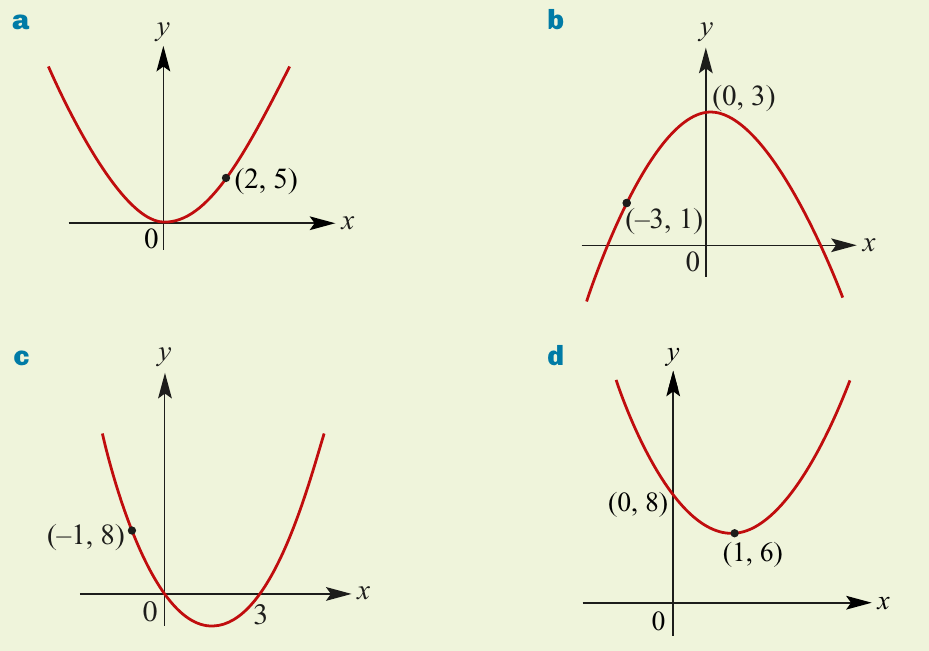
Determine the quadratic rule for each of the following parabolas:
Solution:
a) This parabola passes through with its vertex at the origin.
Use the form :
For point :
Therefore:
Rule:
b) This parabola has a vertex at and passes through .
Use the form :
From the -intercept:
For point :
Therefore:
Rule:
c) This parabola has -intercepts at and , and passes through .
Use the form :
For point :
Therefore:
Rule:
d) This parabola has a turning point at and passes through .
Use the form :
For point :
Therefore:
Rule:
Key insight: The choice of form depends on the features visible in each graph. Look for intercepts, vertices, or other special points to guide your selection.
Exam tips
Note
Strategic approaches for exam success:
- Always identify what information you have before choosing a form
- When using intercept form, remember that and are the -intercepts (the values where )
- When using turning point form, represents the coordinates of the turning point
- Check your final answer by substituting the given points back into your equation
- If a parabola touches the -axis at exactly one point, the discriminant
- The axis of symmetry formula is useful when working with the general form
Important
Common mistakes to avoid:
- Don't confuse the signs in intercept form: if the -intercept is , write , not
- In turning point form, pay careful attention to the signs of and
- Always verify your answer works for all given points, not just one
Remember!
Summary
Key Points to Remember:
- A family of parabolas is a collection of quadratic functions sharing a common characteristic, defined by parameters
- Parameters are variable letters (, , , , etc.) that determine specific members of a family
- Choose your form based on available information:
- Intercept form : when you know two -intercepts
- Turning point form : when you know the turning point
- General form : when you know three points
- The discriminant equals zero when the parabola touches the -axis at exactly one point
- Always verify your answer by substituting given points back into your final equation