Graphing Quadratics in Polynomial Form (VCE SSCE Mathematical Methods): Revision Notes
📚Revision Notes
Graphing Quadratics in Polynomial Form
Introduction
When working with quadratics, you don't always need to convert to turning point form to sketch the graph. Instead, you can work directly with polynomial form by finding key features: the intercepts, axis of symmetry, and turning point. This method is particularly useful when the quadratic can be easily factorised.
Note
This direct approach saves time when a quadratic is already in polynomial form and can be easily factorised. You can find all the information you need to sketch the graph without completing the square or rearranging the equation.
The general form of a quadratic function is:
where , , and are constants and .
The four-step method
Follow these four steps to sketch a quadratic from polynomial form:
Step 1: Find the y-axis intercept
To find where the graph crosses the y-axis, substitute into the equation.
For the general quadratic :
Important
Key point: The y-axis intercept is always equal to .
This makes finding the y-intercept very straightforward—just identify the constant term in your equation.
Step 2: Find the x-axis intercepts
To find where the graph crosses the x-axis, set and solve for .
To solve this equation, you need to:
- Factorise the right-hand side
- Apply the null factor theorem (if , then or )
The solutions give you the x-axis intercepts (also called roots or zeros).
Note
If the quadratic doesn't factorise easily, you may need to use the quadratic formula instead. However, the four-step method works best when factorisation is straightforward.
Step 3: Find the equation of the axis of symmetry
Once you know the x-axis intercepts, you can find the axis of symmetry using the symmetry properties of parabolas.
The axis of symmetry is the perpendicular bisector of the line segment joining the x-axis intercepts. In other words, it passes through the midpoint of the two x-intercepts.
If the x-intercepts are and , the axis of symmetry has equation:
This vertical line divides the parabola into two mirror-image halves.
Step 4: Find the coordinates of the turning point
The axis of symmetry gives you the x-coordinate of the turning point (vertex). To find the y-coordinate:
- Take the x-value from the axis of symmetry
- Substitute it back into the original quadratic equation
- Calculate the resulting y-value
The coordinates give you the turning point of the parabola.
Worked examples
Example
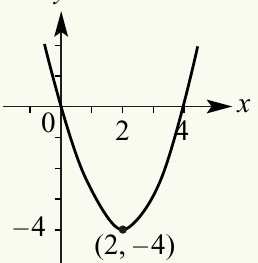
Worked Example: Sketching
Question: Find the x- and y-axis intercepts and the turning point, then sketch the graph of .
Solution:
Step 1: The constant term is , so the y-axis intercept is 0.
Step 2: To find the x-intercepts, set :
Using the null factor theorem:
The x-axis intercepts are 0 and 4.
Step 3: The axis of symmetry passes through the midpoint of the x-intercepts:
So the axis of symmetry is .
Step 4: To find the turning point, substitute into the original equation:
The turning point has coordinates .
Example
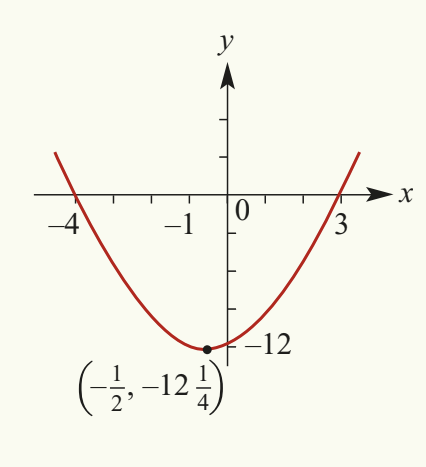
Worked Example: Sketching
Question: Find the x- and y-axis intercepts and the turning point, then sketch the graph of .
Solution:
Step 1: The constant term is , so the y-axis intercept is -12.
Step 2: To find the x-intercepts, set :
Factorising the right-hand side:
Using the null factor theorem:
The x-axis intercepts are -4 and 3.
Step 3: The axis of symmetry is:
Step 4: Substituting into the equation:
The turning point has coordinates .
Using technology
TI-Nspire
Note
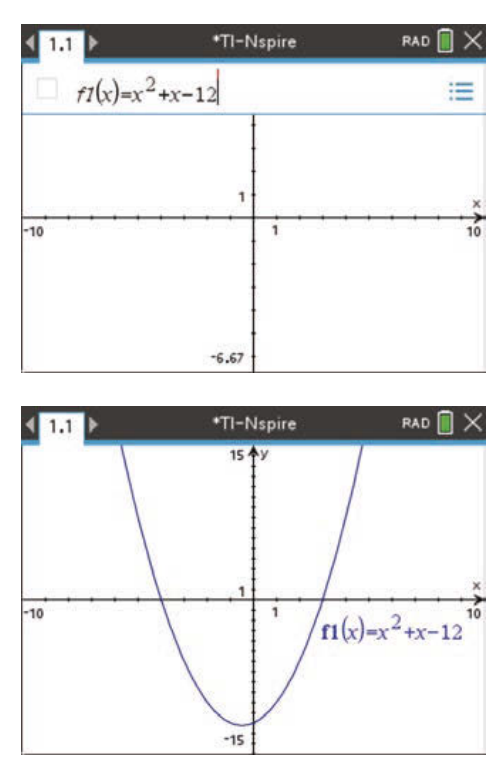
To graph the quadratic function on a TI-Nspire calculator:
- Enter the rule in the entry line of a Graphs application as shown, and press enter
- Using menu > Window/Zoom > Window Settings, select the window settings and to obtain the graph shown
Tip: You can also double-click on the end values to change the window settings.
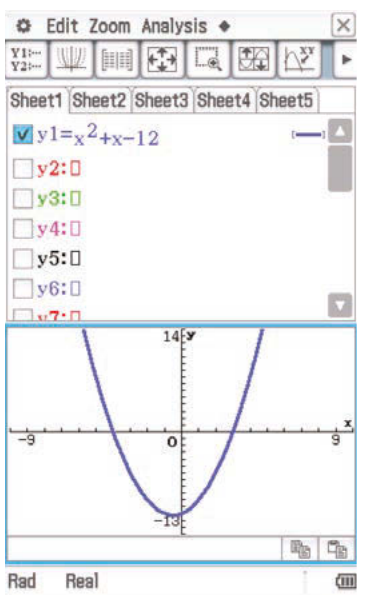
Casio ClassPad
Note
To graph a quadratic on a Casio ClassPad:
- Open the menu and select Graph & Table
- Type the expression in
- Tick the box and tap the graph icon
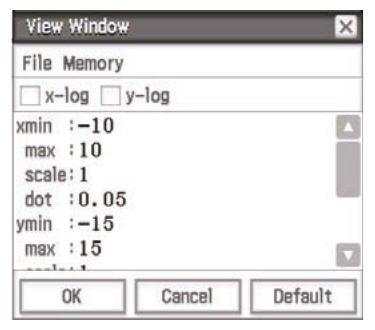
- It may be necessary to change the view window using the settings icon
Use these window settings for a clear view: from to , from to .
Remember!
Summary
Key Points to Remember:
- The y-intercept is always - just identify the constant term in
- Find x-intercepts by factorising - set and use the null factor theorem
- The axis of symmetry is the midpoint of the x-intercepts - calculate using
- The turning point lies on the axis of symmetry - substitute the x-value from the axis into the equation to find the y-coordinate
- Follow the four steps in order - Y-intercept, X-intercepts, Axis of symmetry, Turning point