Solving Simultaneous Linear and Quadratic Equations (VCE SSCE Mathematical Methods): Revision Notes
📚Revision Notes
Solving Simultaneous Linear and Quadratic Equations
Understanding the concept
When we solve simultaneous equations, we're finding where the graphs of these equations meet or intersect. Just as solving two simultaneous linear equations gives us the point where two straight lines cross, we can also find where a straight line meets a parabola by solving a linear and quadratic equation simultaneously.
Note
This concept extends what you already know about linear equations. Instead of finding where two straight lines cross, we're now finding where a straight line crosses a curved parabola. The mathematical process is similar, but the results can be different!
Possible intersection scenarios
A straight line can interact with a parabola in three different ways, giving us different numbers of intersection points:
- Two points of intersection: The line crosses through the parabola at two separate points
- One point of intersection: The line just touches the parabola at a single point
- No points of intersection: The line and parabola don't meet at all
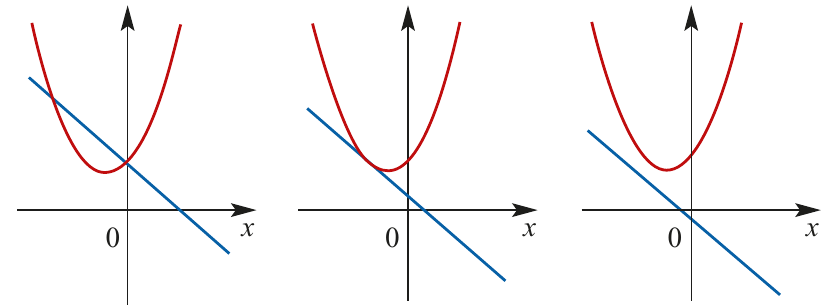
What is a tangent?
The term "tangent" has a specific meaning when we're talking about lines and parabolas:
Important
When there is exactly one point of intersection between the parabola and the straight line, we say the line is a tangent to the parabola. A tangent just touches the curve at one point without crossing through it.
The substitution method
To find the points of intersection between a linear equation and a quadratic equation, we use the substitution method. Here's how it works:
Step 1: Write both equations with as the subject.
For example:
- Linear equation:
- Quadratic equation:
Step 2: Since both expressions equal , set them equal to each other and solve for .
Step 3: Substitute your -values back into either equation to find the corresponding -values.
Step 4: Write your answer as coordinate points.
Worked example: Two points of intersection
Example
Worked Example: Finding Two Intersection Points
Find the points of intersection of the line with equation and the parabola with equation .
Solution:
At the point of intersection, both equations have the same and values, so:
Rearrange to get everything on one side:
Factorise:
Solve for :
Find the corresponding -values by substituting into the linear equation:
When :
When :
Therefore, the points of intersection are (2, 0) and (4, -4).
We can verify this graphically:
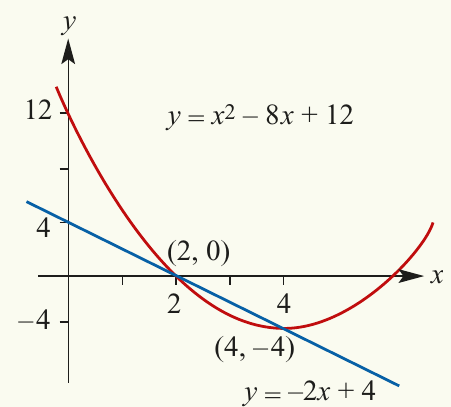
The graph confirms our two intersection points: one at on the -axis, and another at which is the vertex of the parabola.
Using technology
Note
Calculator Methods
These calculator methods can help you verify your solutions or solve more complex simultaneous equations quickly.
Using the TI-Nspire
To solve simultaneous equations on the TI-Nspire calculator:
- Select menu > Algebra > Solve System of Equations > Solve System of Equations
- Press enter to accept the default settings of two equations with variables and
- Complete the template by entering your equations
- The calculator will display the solution(s)
Using the Casio ClassPad
To solve simultaneous equations on the Casio ClassPad:
- In the Main screen, turn on the keyboard
- Select the simultaneous equations icon from Math1
- Enter your equations into the two lines
- Enter as the variables
- Tap EXE to solve
Worked example: Proving a line is tangent
Example
Worked Example: Proving a Line is a Tangent
Prove that the straight line with equation meets the parabola with equation once only.
Solution:
At the point of intersection:
Rearrange:
Factorise (this is a perfect square):
Solve for :
Find the -value:
Since we get only one solution for , the straight line just touches the parabola at the single point (1, 0). This proves the line is a tangent to the parabola.
We can see this graphically:
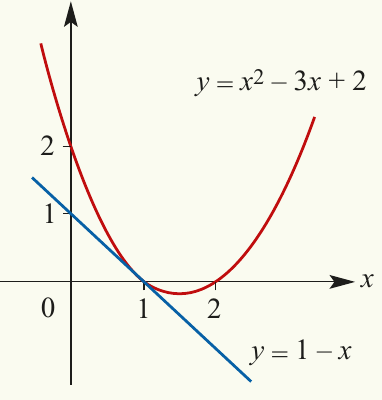
The graph shows that the blue line touches the red parabola at exactly one point, confirming it's a tangent.
Important
Key Indicator: When factorising gives you a perfect square like , this tells you there's only one solution, which means the line is a tangent to the parabola.
Summary
Key Points to Remember:
- Solving simultaneous linear and quadratic equations finds where a straight line and parabola intersect
- There can be 0, 1, or 2 points of intersection depending on how the line and parabola are positioned
- When there's exactly one point of intersection, the line is a tangent to the parabola
- Use the substitution method: set the two expressions for equal to each other and solve for
- A perfect square result like indicates a tangent (one solution)