The Discriminant (VCE SSCE Mathematical Methods): Revision Notes
📚Revision Notes
The Discriminant
Introduction
When we solve quadratic equations using the quadratic formula, we encounter a special expression that tells us important information about the solutions. This expression is called the discriminant.
The quadratic formula for solving is:
The expression under the square root sign, , is the discriminant. We use the Greek letter delta (∆) to represent it:
Note
The discriminant is a powerful analytical tool that tells us how many solutions a quadratic equation has and what type of solutions they are, without actually solving the equation. This makes it invaluable for quickly analyzing quadratic functions and their graphs.
The number of x-axis intercepts
A parabola can intersect the x-axis in three different ways:
- Zero intercepts – the graph sits entirely above or entirely below the x-axis
- One intercept – the graph touches the x-axis at exactly one point (the turning point)
- Two intercepts – the graph crosses the x-axis at two distinct points
The discriminant determines which of these situations occurs for any quadratic function .
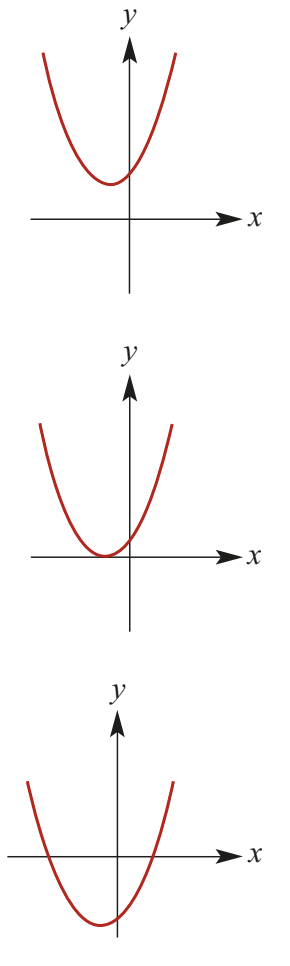
Case 1: No x-axis intercepts (∆ < 0)
When the discriminant is negative (), the equation has no real solutions. This means the parabola does not intersect the x-axis at all.
Note
Why does this happen? Because you cannot take the square root of a negative number in the real number system. The parabola either sits completely above the x-axis (if ) or completely below it (if ).
Case 2: One x-axis intercept (∆ = 0)
When the discriminant is zero (), the equation has exactly one solution. The parabola touches the x-axis at one point, which is the turning point (vertex) of the parabola.
We sometimes say the equation has two coincident solutions – two identical solutions that coincide at the same point.
Case 3: Two x-axis intercepts (∆ > 0)
When the discriminant is positive (), the equation has two distinct real solutions. The parabola crosses the x-axis at two different points.
Here are the three cases depicted graphically:
Important
Quick Reference for Number of Solutions:
- → No real solutions (no x-axis intercepts)
- → One solution (one x-axis intercept)
- → Two distinct solutions (two x-axis intercepts)
Worked example: Finding discriminants
Example
Worked Example: Finding Discriminants and Determining Intercepts
Question: Find the discriminant of each of the following quadratics and state whether the graph crosses the x-axis, touches the x-axis, or does not intersect the x-axis.
a)
b)
c)
Solution
a) For :
Here, , , and .
Since ∆ > 0, the graph intersects the x-axis at two distinct points.
This means there are two distinct solutions to the equation .
b) For :
Here, , , and .
Since ∆ = 0, the graph touches the x-axis at exactly one point.
This means there is one solution to the equation .
c) For :
Here, , , and .
Since ∆ < 0, the graph does not intersect the x-axis.
This means there are no real solutions to the equation .
Worked example: Finding parameter values
Sometimes we need to find values of a parameter (like ) that give us a specific number of solutions.
Example
Worked Example: Finding Parameter Values for Different Numbers of Solutions
Question: Find the values of for which the equation has:
a) one solution
b) no solution
c) two distinct solutions
Solution
For the quadratic , we have , , and .
The discriminant is:
a) For one solution, we need :
Therefore, the equation has one solution when m = 3 or m = -3.
b) For no solution, we need :
From the graph below, we can see this occurs when -3 < m < 3.
c) For two distinct solutions, we need :
From the graph, this occurs when m > 3 or m < -3.
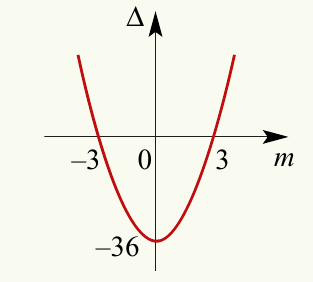
The graph shows plotted against . Notice that the parabola has its vertex at and crosses the m-axis at and .
The nature of solutions
The discriminant not only tells us how many solutions a quadratic equation has, but also what type of solutions they are.
For a quadratic equation where , , and are rational numbers:
Rational solutions
Two rational solutions: If is a perfect square and , then the equation has two rational solutions.
Note
A perfect square is a number like 4, 9, 16, 25, etc. – numbers whose square root is a whole number or fraction. When the discriminant is a perfect square, we can simplify to a rational number, which makes the entire quadratic formula result in rational solutions.
One rational solution: If , then the equation has one rational solution (or two coincident rational solutions).
Irrational solutions
Two irrational solutions: If is not a perfect square and , then the equation has two irrational solutions.
For example, if , then is irrational, so the solutions will be irrational.
Worked example: Proving rationality of solutions
Example
Worked Example: Proving Solutions are Rational
Question: Show that the solutions of the equation are rational for all rational values of .
Solution
For this equation, , , and .
Calculate the discriminant:
Expand :
Factor the expression:
Since , we know that:
for all values of
Furthermore, ∆ is a perfect square for all rational values of , because is always a perfect square when is rational.
Therefore, the solutions are rational for all rational values of m.
Important
Key Insight: When the discriminant can be expressed as a perfect square (like in this example), we can immediately conclude that the solutions will be rational, provided the coefficients , , and are rational.
Remember!
Summary
Key Points to Remember:
-
The discriminant of a quadratic is
-
If : no real solutions and the parabola does not intersect the x-axis
-
If : one solution (two coincident solutions) and the parabola touches the x-axis at one point
-
If : two distinct solutions and the parabola crosses the x-axis at two points
-
For rational coefficients: if is a perfect square (and ), solutions are rational; if is not a perfect square (and ), solutions are irrational