Monosaccharides (AQA A-Level Biology): Revision Notes
📚Revision Notes
Monosaccharides
What are carbohydrates?
Carbohydrates are organic molecules made from carbon atoms combined with water molecules. The name literally means "carbon-hydrate" - carbon plus water. These molecules vary greatly in size, from small simple sugars to large complex structures.
Note
The term "carbohydrate" provides a helpful clue about the composition of these molecules - they're essentially carbon combined with water in various arrangements.
Life based on carbon
Carbon atoms have a unique property that makes life possible. They bond very easily with other carbon atoms, forming long chains of varying lengths. This creates a backbone structure where other atoms can attach, allowing for an enormous variety of different molecules. All organic molecules in living organisms are built around this carbon framework.
Note
Carbon's ability to form four covalent bonds and chain together makes it the perfect foundation for the complex molecules that make life possible.
Building large molecules
Many biological molecules are constructed like chains, made up of individual building blocks called monomers. When these monomers link together, they form long chains called polymers.
In carbohydrates, the basic monomer unit is a sugar, also known as a saccharide. These can combine in different ways:
- A single monomer = monosaccharide
- Two monomers joined = disaccharide
- Many monomers joined = polysaccharide
Structure and properties of monosaccharides
Monosaccharides are sweet-tasting, water-soluble substances that represent the simplest form of carbohydrate. They have the general formula , where n can be any number from three to seven.
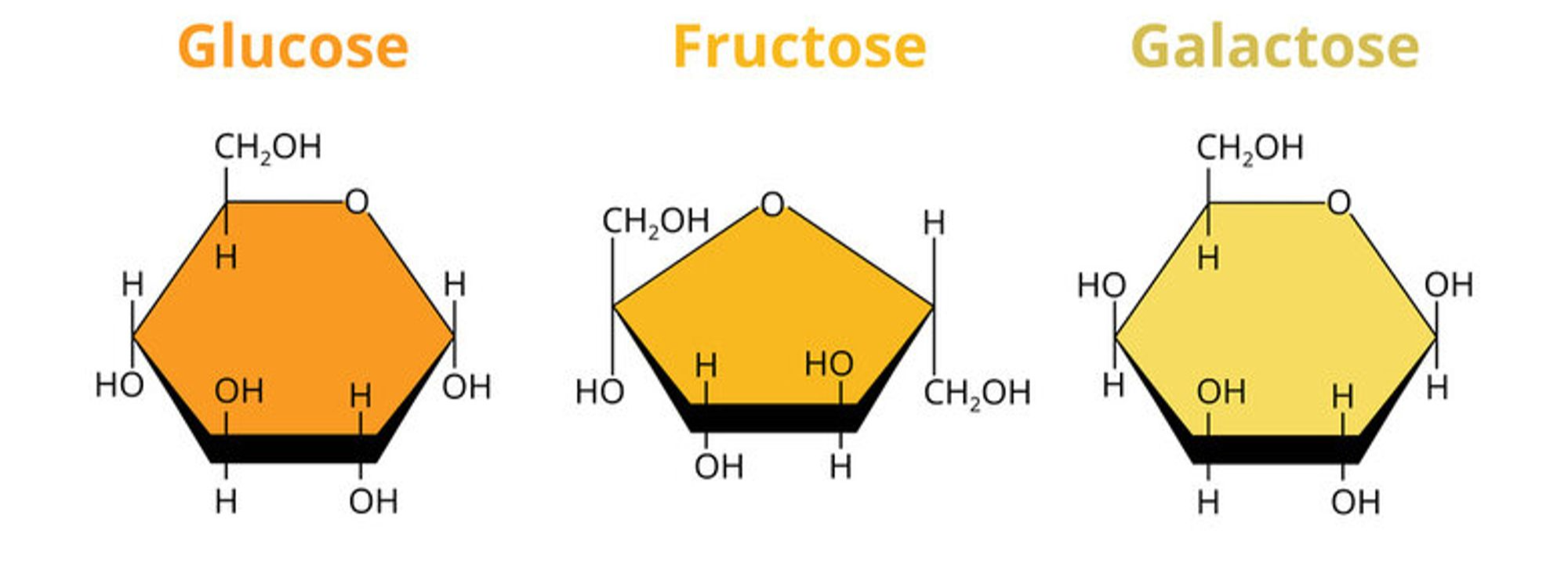
Common examples include glucose, galactose, and fructose. Glucose is particularly important as it's a hexose (6-carbon sugar) with the molecular formula .
Glucose isomers
Even though glucose has a fixed molecular formula, the atoms can be arranged in different ways to create isomers. The two main forms are:
- α-glucose (alpha-glucose)
- β-glucose (beta-glucose)
These differ in the position of the hydroxyl (-OH) group on one of the carbon atoms, which affects how they can link together to form larger molecules.
Important
The difference between α-glucose and β-glucose may seem small, but it's crucial for determining how glucose molecules can join together to form different polysaccharides like starch and cellulose.
Benedict's test for reducing sugars
What are reducing sugars?
Reducing sugars are sugars that can donate electrons to other chemicals during reactions. All monosaccharides and some disaccharides (like maltose) are reducing sugars.
Note
Reduction is a chemical reaction involving the gain of electrons or hydrogen. A reducing sugar is a sugar that can donate electrons to (or reduce) another chemical.
The Benedict's test procedure
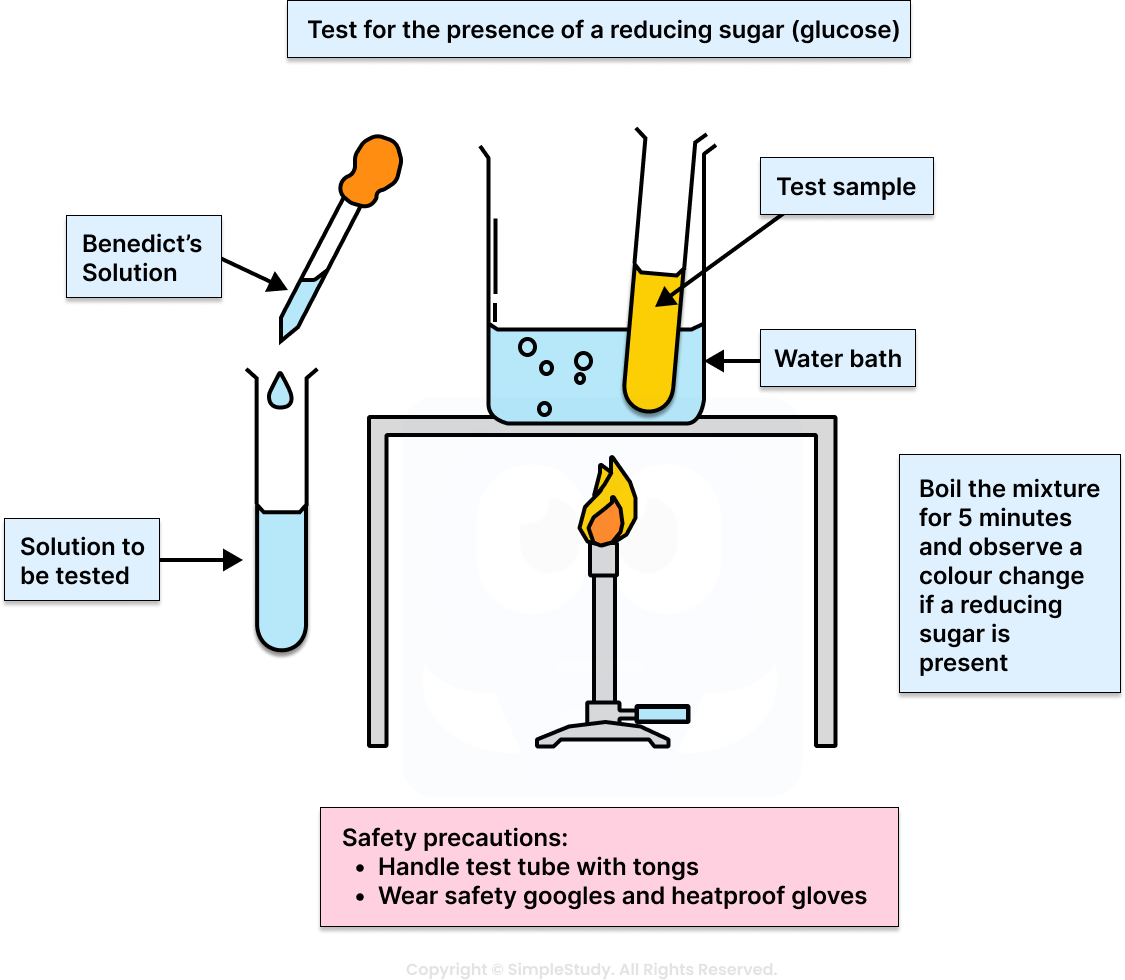
Benedict's reagent is an alkaline solution containing copper(II) sulphate, which appears blue. When heated with a reducing sugar, it undergoes a chemical reaction:
Example
Benedict's Test Procedure:
Step 1: Add 2 cm³ of the food sample to a test tube (grind solid samples in water first)
Step 2: Add an equal volume of Benedict's reagent
Step 3: Heat the mixture in a gently boiling water bath for five minutes
Results
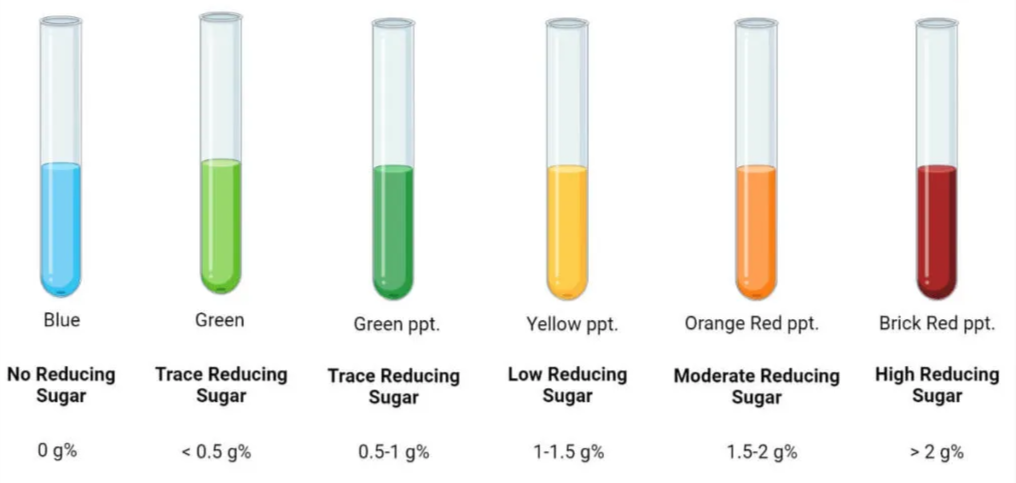
If reducing sugars are present, the blue Benedict's reagent changes colour and forms an insoluble red precipitate of copper(I) oxide. The solution turns from blue through green and yellow to orange-brown or red.
Note
The colour change occurs because the reducing sugar reduces the blue copper(II) ions to red copper(I) oxide, which is insoluble and forms a visible precipitate.
 Semi-quantitative analysis
The Benedict's test can estimate the approximate concentration of reducing sugar in a sample. Different concentrations produce different colours:
| Concentration | Colour |
|---|---|
| None | Blue |
| Very low | Green |
| Low | Yellow |
| Medium | Orange |
| High | Red |
Important
Remember that Benedict's test is semi-quantitative, not quantitative. It can tell you the relative amount of reducing sugar present but cannot give you precise measurements or identify specific types of sugars.
Key terminology
Understanding Greek and Latin prefixes helps with carbohydrate terminology:
Summary
Key Prefixes to Remember:
- mono = one
- di = two
- tri = three
- tetra = four
- penta = five
- hexa = six
- poly = many
Summary
Key Points to Remember:
- Monosaccharides are the simplest carbohydrates with the general formula
- They are sweet-tasting, water-soluble molecules that serve as building blocks for larger carbohydrates
- Glucose exists in two isomeric forms (α-glucose and β-glucose) that differ in their structural arrangement
- Benedict's test detects reducing sugars by changing from blue to red when heated, forming a precipitate
- The test is semi-quantitative - different concentrations of reducing sugar produce different colours from green through yellow to red